Photo Booth Pricing in 2027: How to Charge Without Guessing
A pricing formula built from your real costs, three packages, and a corporate quoting process, so you can charge with confidence instead of copying the operator down the street.

Nicholas Rhodes
Drafted with AI assistance; reviewed and approved by Nicholas Rhodes before publishing.
How much should you charge for a photo booth in 2027?
Photo booth pricing works best when you build it from your actual costs, not from what the operator down the street charges. Start with a formula that covers direct costs, labor, overhead, and profit, then check the result against real booking data. A standard event package commonly runs $500–$1,500, with corporate and premium AI packages going higher.
Beginner series · Stage 1 of 5 · Part 7 of 22
This guide covers your own pricing formula as an operator setting a rate card, not what a couple should expect to pay for a rental. If you’re researching what a photo booth costs to book, see how much a photo booth rental costs instead.
Start with the pricing formula
Use this as your internal starting point:
Selling price = direct event costs + labor + overhead allocation + profit
If you want to target a specific profit margin, use this version instead:
Selling price = total cost base ÷ (1 − target profit margin − payment processing rate)
Your total cost base should include:
- Direct event costs (supplies, print media, travel)
- Your own labor
- Assistants and contractors
- A share of monthly overhead
- Software and AI processing
- Equipment wear and replacement reserves
This gives you a price based on the business you’re running, not just the hours guests spend in front of the booth.
Example assumptions
Say you’re pricing a four-hour wedding booking with $50 in direct supplies, $36 in print media, $60 in travel, $405 for your own labor, and $100 in overhead allocation. Your cost base is $651. Targeting a 20% profit margin with 3% payment processing:
$651 ÷ (1 − 0.20 − 0.03) ≈ $846
You might round that into a package price of $849 or $895, depending on positioning and your local market. The exact number will change for every operator; what matters is knowing what the number represents.
Use market data as a reference, not a rule
Published booking data can help you sanity-check your number, but it shouldn’t replace your own cost calculation. An analysis of roughly 118,000 real bookings found a median photo booth booking of $681. Wedding bookings had a median of $886, and corporate bookings had a median of $899, with the top 10% of bookings running well above those medians. That data comes from Check Cherry’s booking dataset, covered in more depth in Pictor’s pricing benchmark guide.
That data comes from one booking platform and won’t capture every premium operator or custom quote. Treat it as directional context, not a universal price list.
For a deeper look at how one working operator thinks through a pricing floor and budget-bucket conversations with clients, see Pictor’s pricing conversation with Chris Meyer of BoothCamp Create.
Hourly pricing versus package pricing
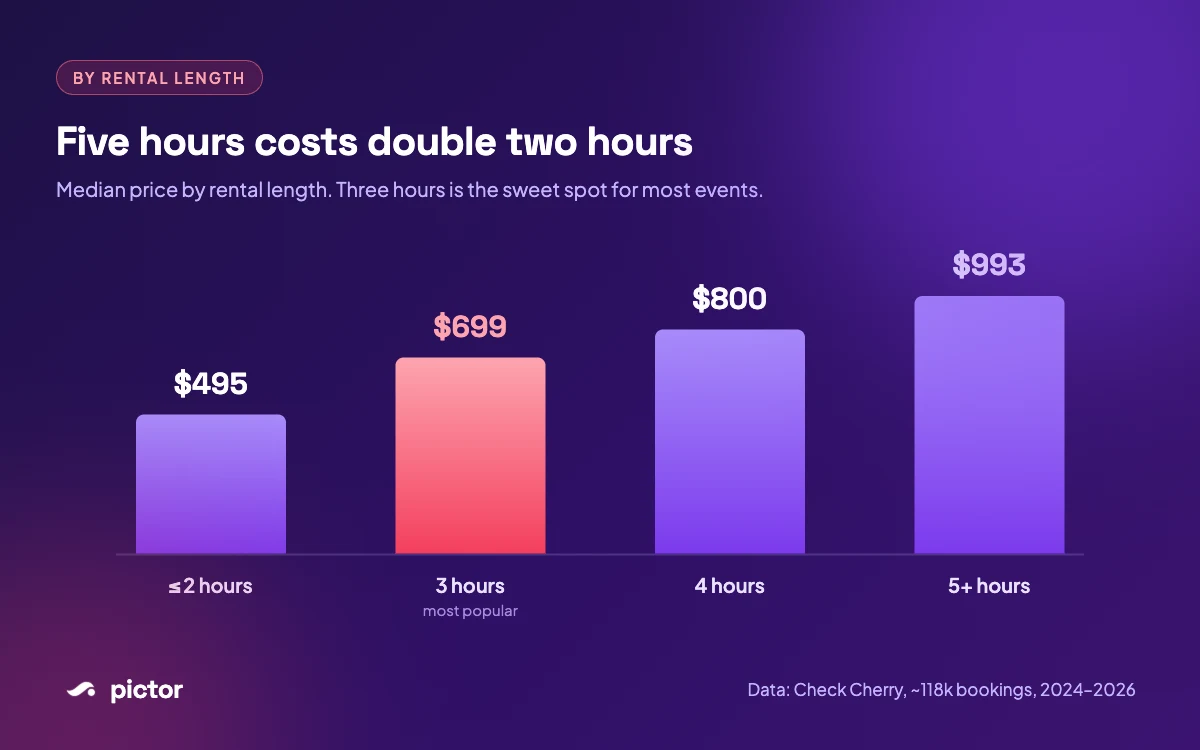
For most operators, the practical approach is:
Calculate internally by the hour. Sell externally as a package.
Hourly pricing protects your time. Package pricing makes the buying decision easier for clients. A package can include a defined number of active hours, setup and teardown, digital delivery, a print allowance, one backdrop or template, basic props, travel within a set area, and an online gallery.
Internally, still track your effective hourly rate after every hour is counted: inquiry calls, emails and contracts, design and revisions, packing, driving, setup, event operation, teardown, gallery delivery, and follow-up. A four-hour booking can consume eight or ten hours of your actual time. Pricing only the hours guests see is one of the fastest ways to underprice your work.
Build three simple packages
A three-tier structure is usually enough for a new operator.
| Tier | Inclusions |
|---|---|
| Starter (small parties) | 2 hrs, digital sharing |
| Signature (weddings) | 3–4 hrs, overlay, prints, attendant |
| Experience (premium/brand) | 5+ hrs, AI photo/video, lead capture |
The names and inclusions are yours to set. What matters is that each level has a clear operational scope, so you’re never guessing what a booking actually requires on the day.
Price travel deliberately
Travel isn’t free just because the event is outside your normal service area. Pick a method that’s easy to explain: include travel within a defined radius, use geographic zones, charge a per-mile rate beyond the included area, add parking or tolls separately, or quote long-distance events as custom projects. Avoid hiding a large travel cost inside every package if most bookings are local; it makes nearby clients subsidize distant ones and makes your pricing harder to understand.
Don’t offer “unlimited prints” without doing the math
Prints are a direct event cost, even when the client sees them as part of the experience. Estimate guest count, expected sessions, prints per session, paper and ribbon cost, and waste. Then decide: a set number of prints, one print per guest session, a print allowance with add-on bundles, digital-only service, or prints as a paid upgrade. If you do include unlimited prints, build a realistic usage assumption into the price, or one highly active event can erase the margin from the whole booking.
Charge properly for overtime and assistants
Define overtime before the event begins: billed in one-hour increments, payment due before the extra time starts, and a higher rate than your standard package since the request is last-minute. If another person works the event, their cost belongs in the quote too. An assistant working six hours at $25 an hour creates $150 in direct labor before travel or payroll costs. That expense shouldn’t come out of your profit after the event.
Treat AI as an experience, not a cheap filter
AI can be sold as an upgrade, a dedicated package, or part of a corporate activation. Your pricing should account for AI processing or token costs, software subscription costs, prompt and template development time, testing, and gallery delivery, alongside the value of the finished experience. Operators commonly report charging 30–60% more for AI-forward packages than traditional-only offers.
Pictor combines traditional photos, AI transformations, AI video, GIFs, boomerangs, and branded delivery in one platform. On Pictor, AI images cost 1–2 tokens (as low as $0.07 each at volume, tokens never expire), which makes it straightforward to test an AI package price without committing to a plan change first. Compare Pictor plans, and see Pictor’s guide to pricing AI photo experiences for a deeper look at AI-specific pricing.
Corporate pricing is usually project pricing
Corporate clients aren’t only buying booth hours. They may be buying campaign-specific branding, lead capture, multiple staff members, backup equipment, brand approvals, usage rights, multi-day coverage, and reporting. A corporate quote should usually include separate lines for pre-production, equipment and software, staffing, event operation, travel, branding, data capture, and additional usage or event days.
Corporate example
Say a three-hour activation requires 10 hours of pre-production, three hours on-site, two staff members, $250 in direct costs, and $200 in overhead. If the total labor and cost base is $1,200 and you target a 25% margin with 3% processing:
$1,200 ÷ (1 − 0.25 − 0.03) ≈ $1,667
That’s not a universal corporate rate. It’s an example of how a seemingly short event becomes a bigger project once the full scope is counted. Pictor’s platform supports the branded overlays, AI experiences, lead capture, and multi-event delivery that corporate quotes are built on; see how to win your first corporate client Coming Dec 15 later in this series, and Pictor’s pricing conversation with Chris Meyer for more on the AI-pricing conversation.
Set deposits, cancellation terms, and processing fees clearly
Many operators collect a deposit of 25% to 50% at signing, with the balance due seven to fourteen days before the event. State the amount due to reserve the date, whether it’s refundable, the final payment deadline, and what happens if the client reschedules or the venue changes. Don’t copy another company’s cancellation policy without checking whether it fits your location and business structure.
Card payments are convenient, but processing fees reduce what you keep. Build the average fee into your prices, or charge a card fee only where legally permitted and properly disclosed. A 3% fee on a $2,000 activation is $60 off the invoice before any other expense.
Which Pictor plan do you need for pricing tools?
Start on Basic ($49/mo) for core photo, GIF, and print packages. Move to Pro ($99/mo) when you want the Custom Prompt Editor for AI-forward packages and DSLR tethering. Premium ($149/mo) adds AI video, useful once you’re selling a dedicated AI experience tier. AI images cost 1–2 tokens and tokens never expire, so testing an AI price point doesn’t require a plan change first.
Want to test an AI-forward package before you price it? Build a sample event free on Pictor →
Review your pricing after every event
After each booking, record total revenue, total hours, direct costs, travel, print usage, AI usage, assistant cost, payment processing, actual profit, and whether you’d accept the same booking again. If your effective hourly rate is too low, you have three choices: raise the price, reduce the scope, or improve the workflow. Software that reduces setup and delivery friction is one practical way to improve the third option; you can build and test a Pictor event before deciding which plan fits.
The practical pricing checklist
Before publishing your rate card, confirm you have a minimum booking price, a target hourly rate, three clear packages, a travel policy, a print policy, an overtime rate, an assistant rate, an AI upgrade or package, a corporate quoting process, a deposit requirement, a cancellation policy, a payment processing plan, and a way to track actual profit.
You don’t need to guess what your business should charge. Start with the work, calculate the cost, decide what the experience is worth, and review the result after every event.
Not legal, tax, insurance, or financial advice. Consult your insurance provider about appropriate coverage, and a qualified lawyer about contracts, deposits, cancellations, liability, payment terms, and local requirements before publishing your policies.
From the operators: on Show & Tell, Catalina Bloch and Meir Israel of Illuminate explained how they price the whole job, not just the hours on site, and when Meir says it is time to raise prices 20%. Read the Illuminate recap.
FAQ
How do I price a photo booth business, not just a rental?
Build your price from a cost base (direct costs, labor, overhead) divided by your target margin, then check the result against market data like the $681 median booking value. Selling price should reflect your business costs, not just what a competitor charges.
What’s a typical photo booth package price?
A standard event package commonly runs $500–$1,500, with weddings and corporate events often priced at the higher end and premium AI-forward packages going beyond that range.
Should I charge by the hour or sell packages?
Calculate internally by the hour so you know your true effective rate, but sell externally as a package. Packages are easier for clients to compare and buy, while your internal hourly math protects your time.
How much extra can I charge for AI experiences?
There’s no universal number, but operators commonly report charging 30–60% more for AI-forward packages than traditional-only offers. Price AI as an experience with its own costs (tokens, testing, template development), not as a free add-on.
How do I price a corporate photo booth activation?
Corporate quotes are usually project pricing, not hourly pricing. Include pre-production, staffing, branding, lead capture, and reporting as separate line items, since a short on-site window often hides a much larger scope.
Do I need a written deposit and cancellation policy?
Yes. Most operators collect a 25–50% deposit at signing with the balance due before the event, and a clear written cancellation policy protects both you and the client. Confirm the specifics with a lawyer familiar with your location.
Next in the series: How to Get Your First Photo Booth Clients.
Beginner series · Stage 1 of 5 · Part 7 of 22
Start here: How to Start a Photo Booth Business
Previous: How to Build Your First Photo Booth Package
Next: How to Get Your First Photo Booth Clients