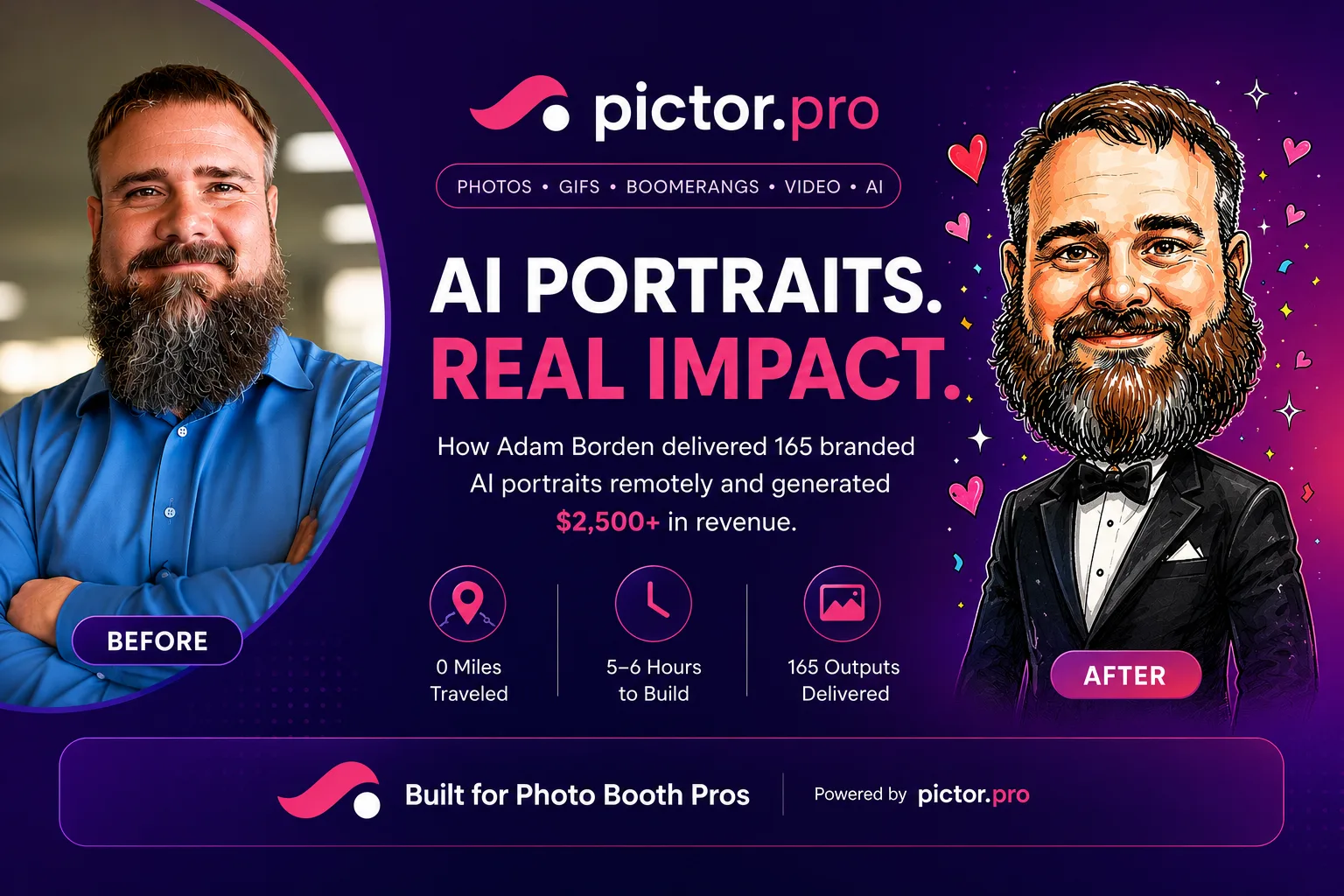
How to Deliver AI Portraits Remotely — $2,500, 165 Outputs, 0 Miles Traveled
How Adam Borden delivered 165 AI portraits and earned $2,500+ in revenue working remotely—no travel, no gear setup, 100% virtual.
Nicholas Rhodes
Drafted with AI assistance; reviewed and approved by Nicholas Rhodes before publishing.
Show & Tell with Adam Borden of Premier Pics Maryland — May 20, 2026
Recap from our May 20, 2026 Show & Tell with Adam Borden of Premier Pics Maryland
Every Wednesday, we host a live Show & Tell where Pictor operators bring their real projects, ask real questions, and build alongside us. This week’s guest was Adam Borden of Premier Pics Maryland — and what he shared flipped a lot of assumptions about what a photo booth job actually has to look like.
Adam recently delivered 165 branded AI caricature portraits for a corporate awards dinner. He never left his house. He never set up a booth. He never printed a single photo. And he walked away with $2,500+.
Here’s how he did it — and what you can take from it.
Meet Adam: From Condiment Cows to Corporate Events
Adam runs Premier Pics Maryland out of Frederick, MD. He stumbled into the photo booth industry at IAAPA — the largest amusement and entertainment trade convention in the US — four years ago. He wasn’t there looking for photo booths. He was there for agritourism. Specifically, a product called the Condiment Cow, a farm-themed condiment dispenser that’s now sold internationally.
When he wandered past a photo booth display, it clicked. He bought two booths off the show floor that day and drove them home. Today he runs five booths and is three years into operating as a real business. His mix is roughly 70% private events (weddings, parties) and 30% corporate — with the corporate side bringing in revenue that’s trending close to equal with the private side, despite the lower event count.
That ratio is shifting. And this project is exactly why.
The Inquiry: A Client Who Didn’t Want a Booth
The client found Adam on LinkedIn. She had seen his AI caricature work — he’d been doing them for weddings — and wanted to know: can you apply this to our brand?
The answer was yes, with one unusual requirement. They didn’t want a physical photo booth at their event. They wanted it done entirely remotely, in advance. Employees would arrive at their corporate awards dinner and find a printed portrait of themselves already waiting — a surprise reveal, tucked into their award packet. No participation required. No booth on site.
This changed the shape of the project entirely.
What the client provided:
- A spreadsheet with each employee’s name (including preferred nicknames)
- A folder of headshots, each named by employee
- Brand colors, logo files, and a preferred font for the overlay text
- A second, elevated “Hollywood Glam” treatment for the award winners specifically
What Adam delivered:
- 135 standard caricature portraits for all employees
- 30 Hollywood Glam award edition portraits for the winners
- 5×7 print-ready JPEGs, sent digitally to the client for local printing
The client handled printing. Adam handled everything else.
Building the AI Prompt: 5–6 Hours of Craft
Adam came into this project with a head start. He’d already done AI caricature work for weddings, building on a superhero-themed caricature prompt he’d developed for a local event. He had the proportions he wanted. He had a baseline marker-drawing aesthetic (borrowed and adapted from a PBM prompt library). What he needed was to get the business casual attire right and nail a consistent branded background.
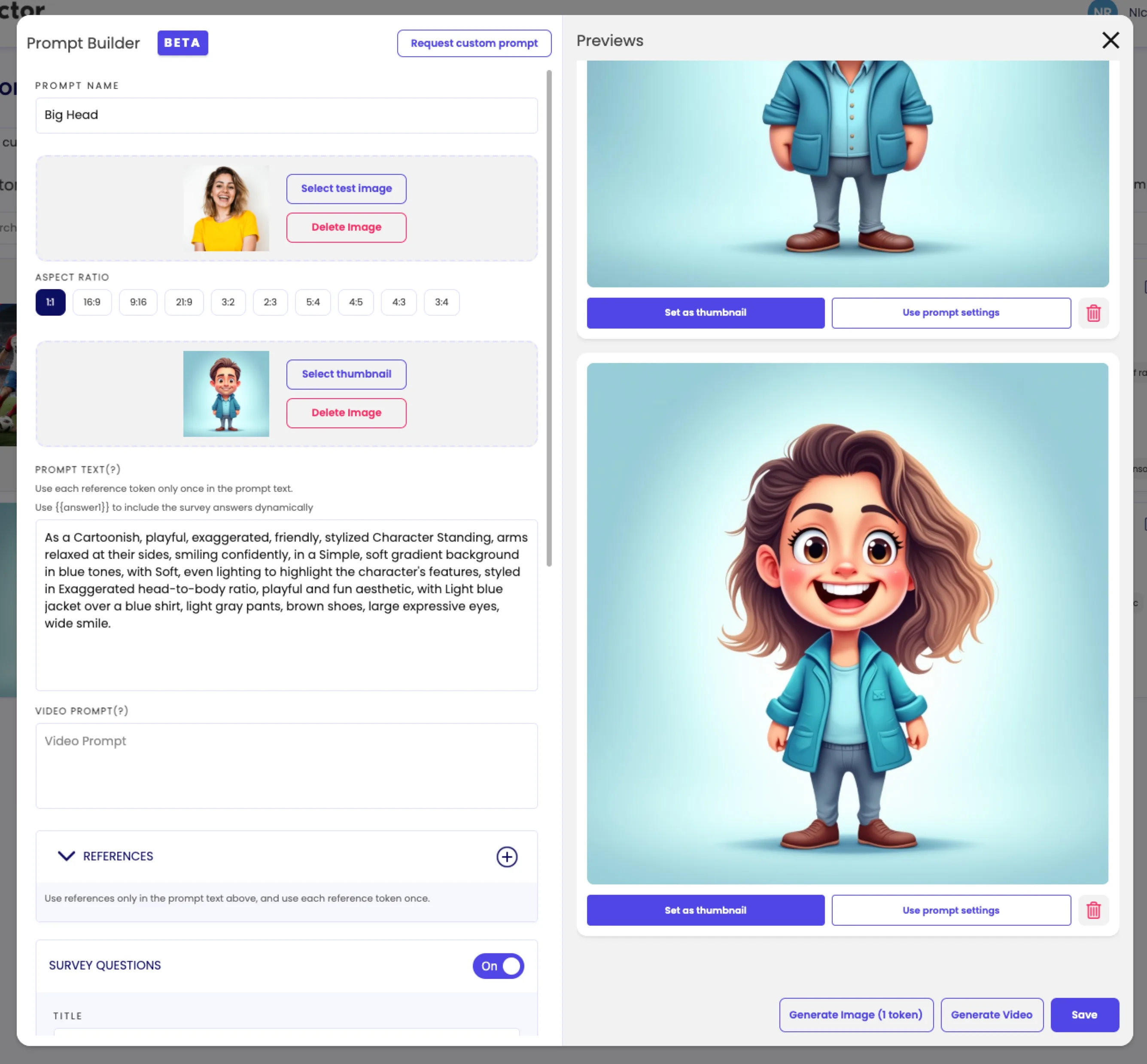
That background was the hard part. The client’s branding included a logo and a sweeping color scheme they wanted in every portrait. AI is notoriously inconsistent with logos — it interprets, it invents, it drifts. Rather than fight that in the prompt, Adam built around it.
His solution: multiple reference images.
Pictor lets you upload several reference images into a single prompt and instruct the AI to rotate between them. Adam designed two distinct branded backgrounds and saved them as reference images. The prompt told the AI to randomly select one per portrait. The result: every portrait was brand-consistent, but no two looked identical.
“You never knew which picture was going to get what background,” Adam said, “but at least it was always brand consistent. And it didn’t just leave it up to the roll of the dice.”
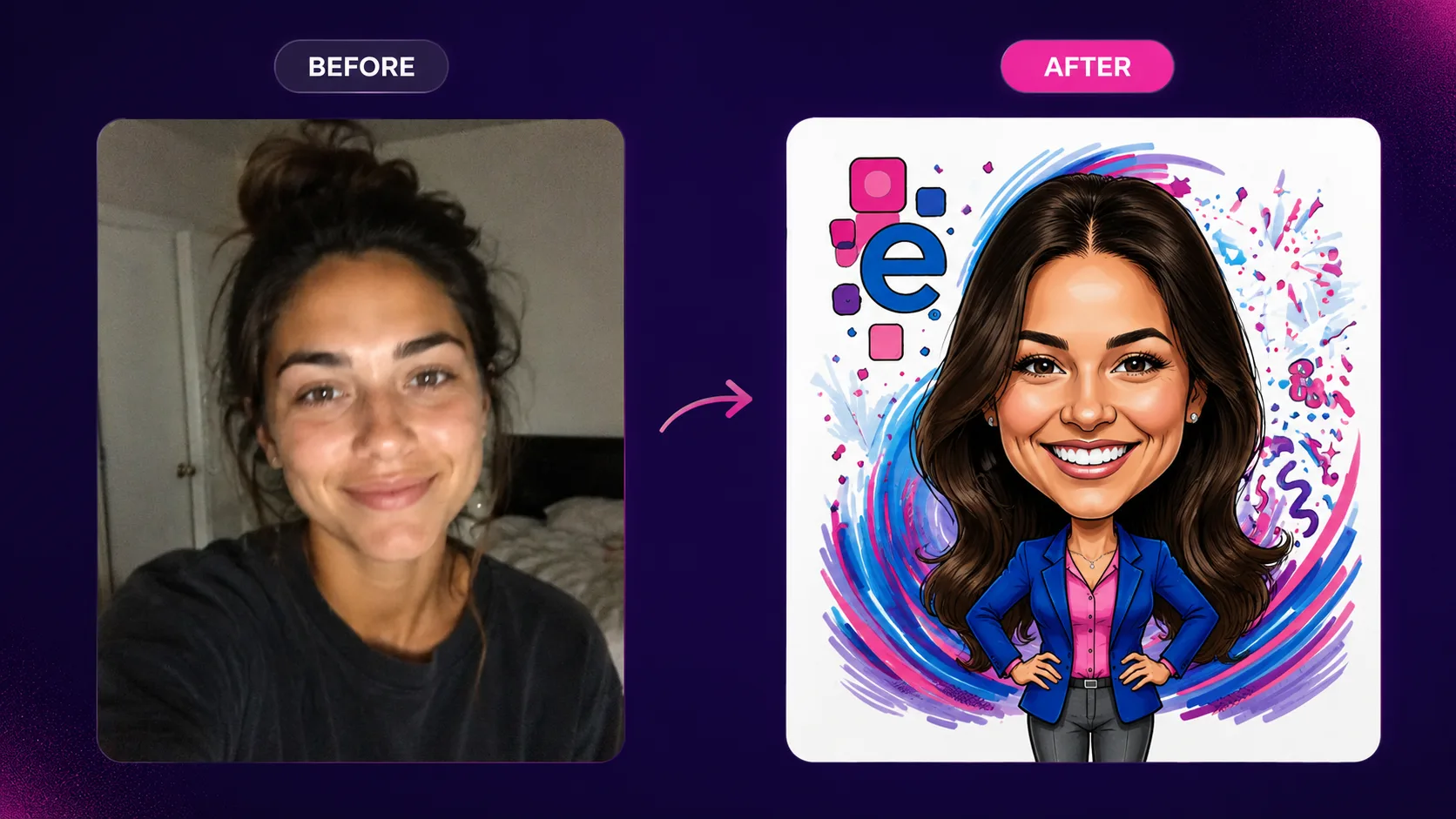
Pro tip: If you’re struggling to get a client’s logo to render correctly inside the AI image, consider building the background separately and placing the logo as a static layer in Pictor’s template editor instead. That way it’s always exact, always consistent, and the AI doesn’t touch it.
The Hollywood Glam variant came with its own challenge. “Hollywood Glam” as an AI prompt instruction tends to produce revealing attire — not appropriate for a corporate awards dinner. Adam had to break down the instruction into something more specific: formal gala-style gowns with full coverage. Finding the right language without triggering unwanted outputs took iteration.
Total time from concept to final reliable output: 5–6 hours.
“You’ve got to take the time into consideration when somebody wants something custom,” Adam said. “It’s not what you’re looking for, it’s what the client’s looking for.”
Running the Virtual Booth: Pictor as a Production Tool
Here’s where this project takes a different shape than a typical booth rental. Adam used Pictor’s virtual booth not as a guest-facing experience — but as a personal production tool.
He logged into the virtual booth interface, opened the client’s spreadsheet alongside it, and uploaded each headshot one by one. Pictor ran the AI processing, applied the branded overlay, and populated each portrait with the employee’s name from a survey field Adam filled in as he went. Output came out the other side print-ready.
It took about an hour to set up the event in Pictor. Then it was just working through the spreadsheet.
“I wanted something that I could run all the way through from start to finish and the output, I was done,” Adam said. “Your virtual booth allows you to do that.”
Two ways this same project could have run differently:
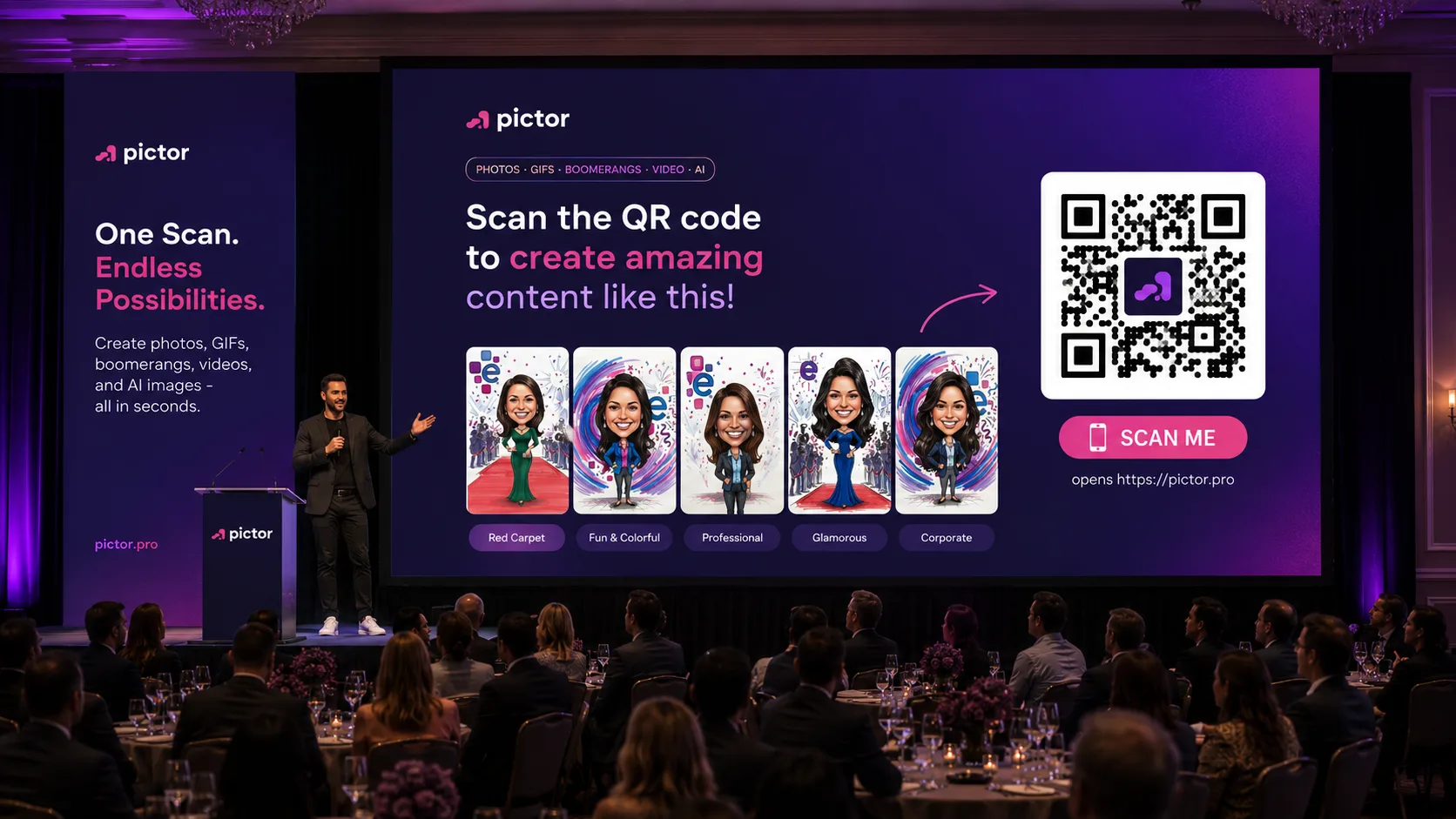
- Live QR code activation — Employees could have scanned a QR code at the event, uploaded a selfie, filled in their name, and received their AI portrait on the spot. This works well for events with flexible timing and a slideshow component.
- Pre-shared QR link — The client could have sent a link to employees ahead of time, letting them upload their own headshot and input their name before the event — like filling out a form before you arrive.
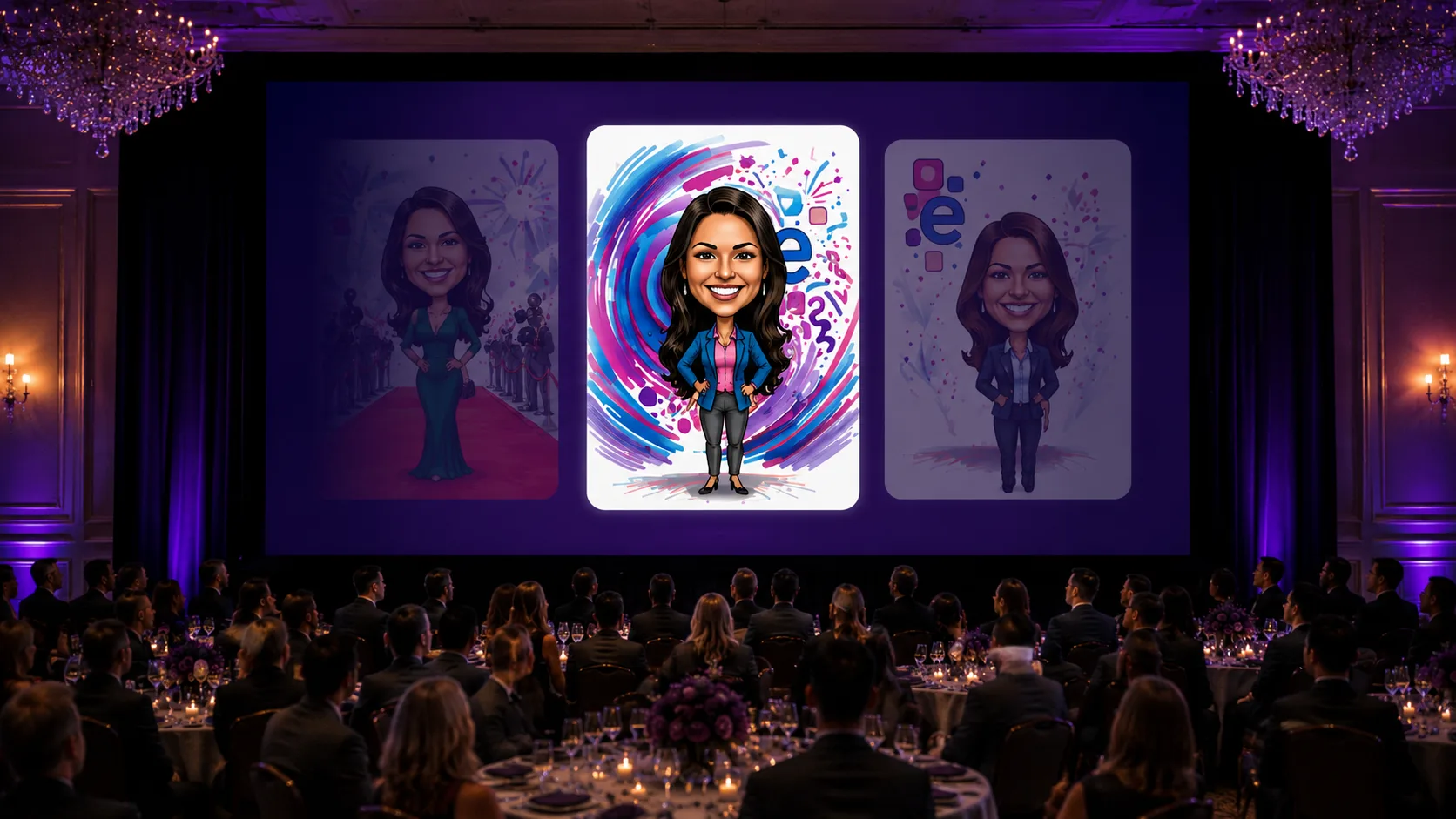
Adam chose neither of these, because the client specifically wanted the surprise element. The portraits showing up in the award packet, unannounced, was the whole point.
Pro tip: Even for remote delivery jobs like this, send the client a virtual preview link before the actual event. Walking them through the experience — seeing what the portrait looks like, what the text overlay looks like — catches typos and design issues days before you’d otherwise discover them on-site.
Pricing: $15 Per Portrait, Per Head
Adam’s pricing model for this project was simple and scalable. The client originally wanted around 100 portraits. He quoted $15 per portrait, which covered his time developing the prompt and made the project profitable on delivery. As the headcount grew — the client added employees, including a batch of award winners — the price per additional portrait stayed the same. No renegotiation needed.
“Being remote, I wanted to offer a per-price because she gave the feeling that she wanted to add more,” he said.
The math on this project:
- 165 portraits × $15 = $2,475 gross (plus a bit more for scope adds)
- Platform cost: ~$161–$215 (AI tokens + $149/month Pictor license)
- Net: ~$2,200–$2,300 before factoring in time
Adam values his time at $50/hour internally and closer to $150/hour when billing AI prompt development to a client. At 5–6 hours of prompt development, that’s $750–$900 in creative time. Still well in the black.
For context on the compute cost: AI tokens in Pictor run $0.07–$0.20 per portrait depending on the resolution tier and token bundle you’re on. At 165 portraits using the lower tier, that’s about $12 in AI processing. The rest of the platform cost is the monthly license.
The client didn’t flinch at the price. Adam’s take on that:
“When I price things like that, you have to get comfortable. It’s not about how much it was, it’s what the perceived value is for the client. Have you ever worked for a company — would you expect them to at least spend $15 per employee on you at a party?”
What This Project Is Really Worth
The $2,500 is one number. The other number is harder to quantify but arguably more valuable: Adam now has a proof of concept he can walk into any corporate conversation with.
“You got literally paid to make marketing materials for your own company,” we told him on the call. He agreed.
Since this project wrapped, he’s already landed a new inquiry from a local distillery — a recurring virtual booth activation that rotates themes every two months. He’s also running an AI-powered wine label activation at a Caribbean music festival, printing custom labels on site as guests buy bottles.
Neither of those would have been as easy to pitch without a concrete example to point to.
FAQ
What is AI virtual photo booth software?
AI virtual photo booth software lets photo booth operators deliver branded AI-generated photo experiences — portraits, caricatures, styled images — without a physical booth on site. Guests upload a photo via QR code or link, and the software processes it through an AI model and returns a branded output. Pictor is the only virtual photo booth software that supports AI photo and video outputs, multiple reference images, and real-time slideshow display.
Can you run a virtual photo booth event without being physically present?
Yes — and that’s one of Pictor’s core use cases. Operators can set up the virtual booth experience remotely, share a QR code or link with guests, and receive completed outputs without ever being on site. Adam ran this entire project from his home office.
How long does it take to build an AI prompt for a corporate event?
Expect 4–8 hours for a fully custom, brand-consistent AI prompt. Getting to a working output is fast — getting to a reliable, repeatable output that looks correct across hundreds of different people takes iteration. Plan for it. Charge for it.
What does virtual photo booth software cost?
Pictor’s premium license is $149/month. AI processing runs $0.07–$0.20 per image depending on resolution and token bundle. For a project like Adam’s (165 portraits), total platform cost was approximately $161–$215 including AI compute.
How do you price a remote AI portrait project?
A common approach: charge per output, with your creative/prompt development cost baked into the base number. Adam charged $15/portrait. This worked because the client could add headcount at any point without renegotiating — a clean, scalable structure for growing corporate lists.
What image quality do you need for AI caricatures?
Most of the time, surprisingly little. Adam had a handful of blurry or compressed headshots and most came out fine. The exception is very tightly cropped images — if there’s almost no body in the frame, the AI can struggle with proportions. When that happened, Adam simply asked the client for a new photo.
How is Pictor different from other photo booth software for AI outputs?
Pictor supports multiple reference images per prompt, AI video outputs in addition to photos, a full virtual booth with custom branding, and a real-time slideshow. It’s the only platform we know of that offers all of these in one place. Snapic, for comparison, supports one reference image.
Can I use the virtual booth as a production tool, not just a guest-facing experience?
Yes — and this is exactly what Adam did. You can upload photos yourself through the virtual booth interface and use Pictor as your production pipeline. This works well for pre-event portrait projects where the outputs are meant to be a surprise.
Join Us Next Week
Want to see how this works firsthand? Come to our next live Show & Tell.
Register for the next Show & Tell →
Haven’t tried Pictor yet? You can access almost everything — building events, testing your virtual booth, experimenting with AI prompts — for free before you run your first live event.
Start your free trial at app.pictor.pro/register →
Want the numbers, timeline, and process in a structured breakdown? Read the full case study: How Premier Pics Maryland Delivered 165 AI Portraits and $2,500+ in Revenue Without Leaving Home.
Nicholas Rhodes
Founder of Pictor & OutSnapped
Nicholas is the founder of Pictor and OutSnapped—a premium photo experience agency producing AI activations, red-carpet productions, and branded content for global events. He hosts Pictor Show & Tell almost every Wednesday.
Nicholas has produced thousands of branded photo experiences for global clients through OutSnapped and builds the tools operators use daily at Pictor.