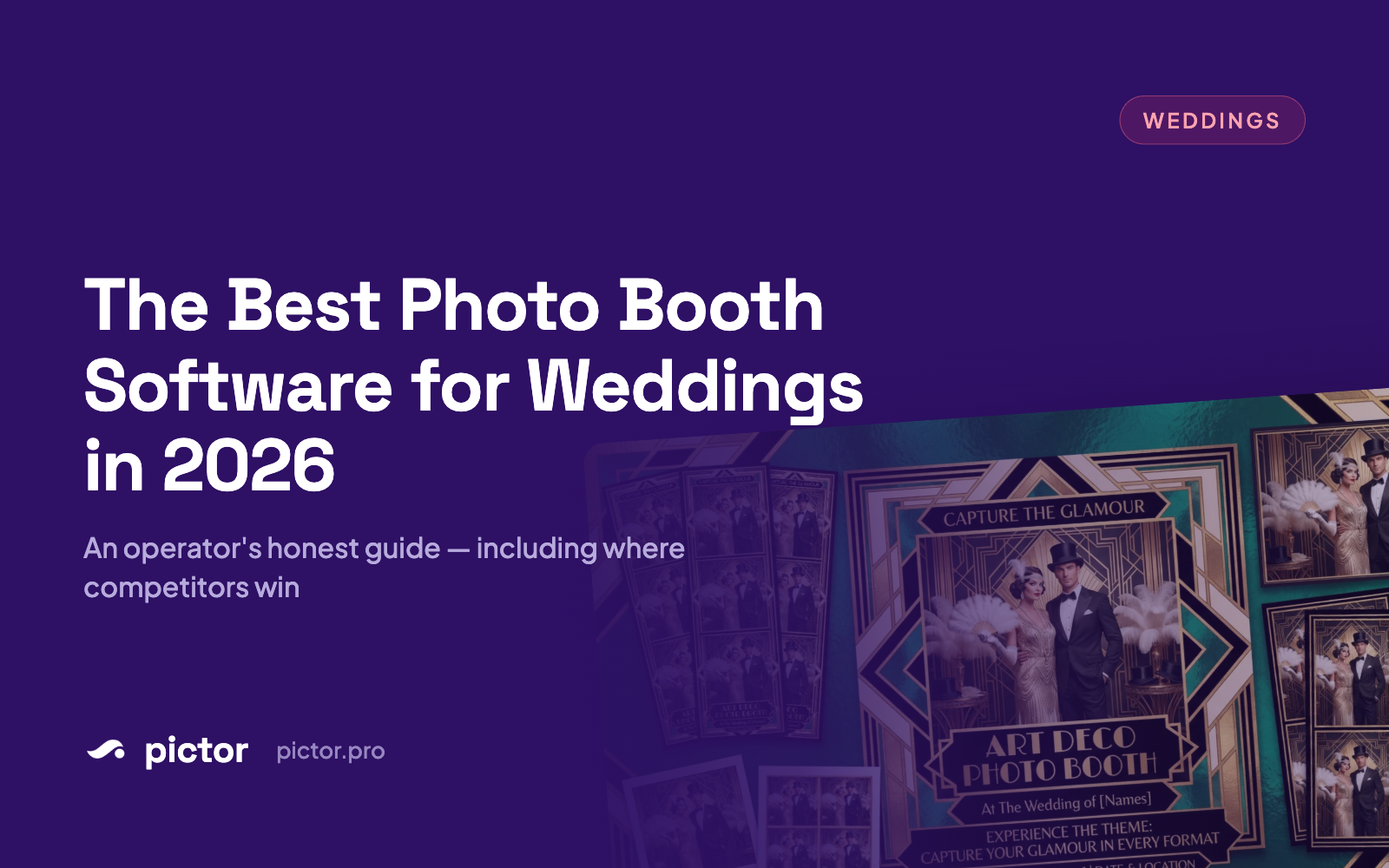
The Best Photo Booth Software for Weddings in 2026 (An Operator’s Guide)
The best photo booth software for wedding operators in 2026: features that matter for bridal events, real operator reviews, and pricing comparison.

Eve Martin
Weddings are one of the highest-revenue photo booth opportunities—couples spend $1,000–$5,000 for a booth rental and guests tip generously in the moment. But choosing software matters. You need reliable hardware pairing, fast processing to handle 200+ guests in 4 hours, and a guest experience that feels premium, not clunky. This guide walks through which software fits which operator setup and why some platforms dominate the wedding market while others fall short.
What Makes Wedding Photo Booth Different
Weddings aren’t typical corporate events. Guests are tipsy, dressed up, and want instant gratification. The booth needs to:
- Process captures in under 3 seconds so the line keeps moving.
- Handle 150–300 captures in a single 4–5 hour event without crashing.
- Deliver prints on-site (optional but expected at upscale venues).
- Create shareable gallery links for out-of-town guests to download later.
- Not require an operator’s constant attention—set it and leave it (mostly).
- Look polished on screen and in prints; no cheap gimmicks.
Pictor handles AI effects and modern aesthetics well. For DSLR-focused weddings, consider pairing Pictor with LumaBooth, Breeze Remote Pro, or Darkroom. For DSLR tethered directly into Pictor, use Pictor Pro or Premium on iPad with DSLR tethering.
The Two Types of Wedding Booth Operators
Wedding booth software falls into two categories:
1. Hardware-First Operators (Invested in a Physical Booth)
You own or lease a Mobibooth Aura (iPad), a LumaBooth kiosk (Windows PC), or a Breeze Remote Pro rig (Windows PC). Your software is locked to that hardware. Revenue model: rent the booth + setup to venues.
- Best for: Established operators; regional monopoly on “the wedding booth” at 3–5 venues.
- Software: LumaBooth, Breeze Remote Pro, Pictor (iPad with or without DSLR tethering), or Breeze Booth (iPad).
- Profit margin: High ($1,500–$3,000 per wedding after equipment amortization).
2. Software-First Operators (Flexible Hardware)
You bring your own iPad or laptop, use venue equipment, or set up a DIY booth frame. Your software adapts to whatever setup you have that day. Revenue model: undercut hardware-locked competitors by 20–30% and do 2–3x more events per year.
- Best for: Newer operators; high event volume in urban areas (15–25 weddings/year).
- Software: Pictor Pro/Premium on iPad (with or without DSLR tethering), Breeze Booth on iPad, Darkroom (if adding DSLR on Windows laptop).
- Profit margin: Lower per event ($600–$1,200) but higher total revenue due to volume.
Most successful wedding operators use a mix: a primary booth platform + a backup. For example, Pictor Premium on iPad as primary (with DSLR tethering for quality), LumaBooth on laptop as backup or add-on for traditional print couples.
Wedding Booth Software Comparison
| Platform | Best Hardware | DSLR Support | Print Server | AI Effects | Monthly Cost | Best For |
|---|---|---|---|---|---|---|
| Pictor (iPad, Pro/Premium) | iPad + DSLR tethering | ✓ (Pro & Premium via USB tethering: Canon/Nikon/Sony) | via Print Partner app (macOS 15+/Windows 10+) | ✓ (excellent) | $99/mo (Pro) or $149/mo (Premium) | Modern operators wanting DSLR + AI effects in one system |
| LumaBooth | Windows PC | ✓ (excellent) | ✓ (built-in) | Limited | $25/mo ($30/mo for Pro) | DSLR wedding specialists; print-heavy events |
| Breeze Remote Pro | Windows PC | ✓ (professional) | ✓ (built-in) | No | $349/license (12 mo updates) | Professional DSLR with hardware integration; custom booths |
| Darkroom | Windows (camera + DSLR) | ✓ (professional DSLR) | ✓ | No | $19/mo (legacy) | Professional DSLR photographers; print queues |
| Breeze Booth | iPad | — | AirPrint or external | ✓ (via FX add-on) | $49/mo per device | Modern, portable iPad-first operators; AI customization |
| BoothEverywhere | Any device + internet | — | — | No | $79/mo | Budget-conscious operators; online events |
Competitor pricing as of publish date — verify current pricing on vendor sites.
Pictor for Weddings: DSLR + AI in One System
Pictor shines when couples want premium, modern photo booth experiences with DSLR quality. Pictor Pro and Premium support DSLR tethering (Canon, Nikon, Sony) directly from the iPad app—no separate Windows kiosk needed. You get professional DSLR captures plus all of Pictor’s AI effects, custom branding, and modern gallery features in one system. Here’s where Pictor wins in a wedding context:
Strengths
- DSLR + AI in one app: Pro & Premium support DSLR tethering (Canon, Nikon, Sony). Capture professional DSLR photos, then apply Pictor’s AI effects, glam filters, or background removal—all without switching apps or rigs.
- Flexible capture: Use DSLR tethering for quality-conscious couples, or iPad camera for speed and ease. Switch between them during the same event.
- AI effects couples love: Beauty filters, Glam mode, video clips with AI video effects (Premium only). Guests share to Instagram Stories instantly.
- iPad flexibility: Set up on a Mobibooth Aura or any stand. Easy to move between venues if you handle multiple back-to-back events.
- Token-based AI pricing: Instead of fixed costs, you pay for AI usage. High-volume print events pay less than high-volume AI video events.
- Modern gallery: Instant QR code and gallery link for guests; easy SMS/email sharing.
Weaknesses for Weddings
- DSLR tethering requires Pro or Premium: Basic tier has no DSLR support. DSLR tethering is available on Pictor Pro ($99/mo) and Premium ($149/mo), not the lower tiers.
- iPad tethering is less stable than Windows apps: USB tethering on iPad works but isn’t as rock-solid as LumaBooth or Breeze Remote Pro on Windows. Have a backup plan for technical issues.
- On-site printing requires setup: Print to-site requires Pictor Print Partner companion app (macOS 15+/Windows 10+); not as seamless as LumaBooth/Breeze’s built-in print queues.
- Processing speed: Pictor processes in-app and to cloud (typically 2–3 seconds per photo). Not slower than competitors, but iPad refresh rate can feel less snappy than a dedicated Windows booth.
Real-world setup for a modern wedding operator: Pictor Premium on iPad with Canon EOS R5 tethered via USB. Use DSLR for main event photos (professional quality), iPad camera for quick candids and group shots. All captures + effects go into one gallery. Cost: Pictor Premium ($149/mo), iPad (~$800), Canon body + lenses (~$4,000). Revenue: $1,200–$1,800 per wedding. Pictor Pro/Premium operators often pair with LumaBooth or Darkroom as a backup for extra traditional booth weddings.
When to Use LumaBooth for a Wedding
Pick LumaBooth ($25/mo or $30/mo Pro) if:
- You own a DSLR and want professional-grade photos (sharp, large-format, studio lighting) as your primary booth.
- Couples expect traditional, timeless wedding photography (not social-media filters).
- You handle 2+ weddings per month and want the fastest per-photo processing.
- Guests expect on-site printing (LumaBooth’s print server is industry-standard).
- You’re in a market where competitors use LumaBooth and you need feature parity.
Honest take: LumaBooth is the market leader for DSLR wedding booths because it’s cheap, rock-solid, and trusted by thousands of operators. It’s the safe choice. Pictor is the cutting-edge choice if your couples want DSLR quality + AI effects in one system.
When to Use Breeze Remote Pro for a Wedding
Pick Breeze Remote Pro ($349/license, 12 months updates) if:
- You’re a professional operator building custom photo booth rigs with external hardware (touchscreens, lighting, advanced printers).
- You own or lease multiple DSLR setups and want enterprise-grade software.
- Couples demand professional DSLR quality and on-site printing as standard (not optional).
- You handle high-volume weddings (10+ per month) and want unlimited photo archiving.
- You’re willing to invest in a more powerful setup than LumaBooth to differentiate from competitors.
Honest take: Breeze Remote Pro is the professional choice for operators running full-service booth rental companies. It’s more expensive than LumaBooth ($349 vs. $25/mo) but offers advanced hardware integration and professional features. Best for established operators with significant wedding volume. Source: https://www.breezesoftware.com/remote-pro
When to Use Pictor Pro/Premium for a Wedding
Pick Pictor Pro ($99/mo) or Premium ($149/mo) if:
- Couples ask for “DSLR quality + Instagram effects” or want a modern, AI-powered experience.
- You’re younger than 30 and targeting millennial/Gen-Z weddings (they appreciate DSLR + AI combo).
- You want DSLR quality WITHOUT a separate Windows booth kiosk (Pictor Pro/Premium support DSLR tethering on iPad).
- You want AI video (Premium only: guests record 5-sec speech, AI makes it cinematic).
- You prefer iPad/phone mobility over a locked Windows setup.
- You want token-based AI pricing (pay only for the effects guests use).
Honest take: Pictor Pro/Premium is winning with couples who want DSLR quality + modern AI effects in one experience. It’s unique in offering native DSLR tethering on iPad—competitors require separate rigs. If you’re starting a booth business today and want a single unified system, Pictor’s DSLR tethering on Pro/Premium is worth exploring.
Operator Setup Recommendations by Style
Premium DSLR Operator (Traditional, Print-Heavy)
Setup: LumaBooth (main) + Darkroom (backup DSLR rig) + wireless print server.
Cost: $25/mo + $19/mo + print hardware (~$300 upfront).
Revenue per wedding: $1,500–$2,500 (high-end couples, print-heavy).
Professional Hardware-Integrated Operator
Setup: Breeze Remote Pro (main) on custom Windows rig with touchscreen, external lighting, professional printer.
Cost: $349 license + custom booth hardware (~$3,000+).
Revenue per wedding: $1,800–$2,500 (premium positioning, custom builds).
Modern DSLR + AI Operator (Unified System)
Setup: Pictor Pro or Premium on iPad with DSLR tethering (Canon/Nikon/Sony).
Cost: $99–$149/mo (Pictor) + iPad (~$800) + DSLR (~$2,000–$3,000).
Revenue per wedding: $1,000–$1,800 (couples want DSLR + modern effects).
Hybrid Operator (Pictor + LumaBooth)
Setup: Pictor Premium on iPad (DSLR tethered) + LumaBooth on laptop (backup or secondary traditional booth).
Cost: $149/mo (Pictor) + $25/mo (LumaBooth) + hardware.
Revenue per wedding: $1,200–$2,000 (couples get both modern + traditional options).
Rental Company (Volume, Multi-Location)
Setup: LumaBooth or Breeze Remote Pro across 3–5 booth rigs in multiple markets.
Cost: $25–$349/mo per rig + hardware per booth (~$2,000 per booth).
Revenue per wedding: $1,000–$1,500 (high margins through volume and equipment ownership).
Questions to Ask Before Choosing
- Do couples ask for specific features? (AI effects + DSLR → Pictor Pro/Premium with tethering; DSLR quality only → LumaBooth or Breeze Remote Pro; on-site prints → all of the above)
- What’s your budget for hardware? (iPad + DSLR = $3k+; Windows laptop + DSLR = $2k; professional booth rig = $5k+)
- How many weddings/year? (1–3 = any; 10+ = LumaBooth/Breeze Remote Pro scales better)
- Will you do other events? (Corporate, birthday, reunion → Pictor’s flexibility wins; weddings only → LumaBooth)
- Do you want DSLR + AI in one app or separate rigs? (One unified system → Pictor Pro/Premium; Separate traditional booth → LumaBooth or Breeze Remote Pro)
Real Wedding Operator Example: The Pictor Pro Operator (DSLR + AI)
Meet Maya, 26, who runs a photo booth business in Portland, Oregon. She shoots Pictor Pro on an iPad Pro tethered to a Canon EOS RP. Her pitch: “Professional DSLR photos with modern AI effects—the best of both worlds for young couples.” She does 12 weddings per year, charges $1,200 per event. Cost: Pictor Pro ($99/mo = $1,188/yr) + iPad Pro ($1,200 one-time) + Canon RP + lens (~$2,000 one-time) + insurance/gas = ~$2,500/yr all-in. Revenue: 12 weddings × $1,200 = $14,400/yr. Net profit: ~$11,900/yr before taxes.
Maya’s couples rave about having DSLR-quality photos in the app instantly, plus AI glam filters for selfies. She upsells tokens for premium AI video ($350 for 2,500 tokens = $80/wedding extra). Her backup plan: a Darkroom license ($19/mo) on her laptop if iPad tethering glitches. She loves the Pictor approach because she’s not locked into a dedicated Windows booth—she’s flexible and modern.
Real Wedding Operator Example: The LumaBooth Operator
Meet Marcus, 42, who’s been renting booths since 2010. He owns two LumaBooth Windows rigs with professional Canon DSLR cameras and a shared Epson print server. His pitch: “Professional photo booth with on-site prints—the classic experience.” He does 20 weddings per year, charges $1,800 per event, and works with two other operators (they share booth equipment and venues).
Cost: LumaBooth Pro ($30/mo = $360/yr) × 2 rigs + DSLR + print server + wear & tear = ~$3,000/yr. Revenue: 20 weddings × $1,800 = $36,000/yr. Net profit: ~$33,000/yr (much higher margin than Maya because equipment is paid off).
Marcus’s couples expect prints (“I want a physical booth photo for my memory book”). He doesn’t worry about AI—his clients are over 35 and value traditional prints. He’s stable, profitable, and not scrambling to adopt new features every quarter.
Pictor’s Honest Position in the Wedding Market
Pictor isn’t (yet) the default wedding booth. LumaBooth and Breeze Remote Pro dominate the traditional DSLR segment because they’ve been around longer and operators trust them. But Pictor Pro/Premium is winning with a specific type of couple and operator: younger, modern, tech-savvy, and wanting DSLR quality + AI effects in one unified system without a separate Windows kiosk.
If you’re starting a booth business today and want the best of both worlds (DSLR + AI), Pictor Pro/Premium on iPad with DSLR tethering is worth exploring. If you’re an established operator with a DSLR and a regional reputation, LumaBooth is lower risk. If you’re running a professional rental company with custom hardware, Breeze Remote Pro scales better.
Many successful operators don’t choose one. They run Pictor as the primary booth (DSLR + AI, social-first) and keep a second rig (LumaBooth, Darkroom, or Breeze Remote Pro) as a backup or for couples who specifically want a traditional print-only experience.
FAQ: Wedding Photo Booth Questions
Can Pictor handle DSLR on Pro and Premium plans?
Yes. Pictor Pro ($99/mo) and Premium ($149/mo) both support DSLR tethering via iPad (Canon, Nikon, Sony). Basic tier does not include DSLR support. Connect your DSLR to the iPad via USB and capture directly into Pictor.
Can I print photos from Pictor at a wedding?
Pictor doesn’t have a built-in print queue like LumaBooth or Breeze Remote Pro. You can use Pictor’s Print Partner companion app (macOS 15+/Windows 10+) for direct printing, or offer digital-only and send high-res files to a print partner later.
What’s the cheapest wedding booth software?
LumaBooth is $25/mo (or $30/mo Pro). Darkroom is $19/mo (legacy). Both require a Windows PC. For iPad, Pictor Pro is $99/mo and Breeze Booth is $49/mo. Cheapest overall: LumaBooth + a used Windows laptop.
How many photos does a typical wedding booth capture?
Usually 150–300 captures per 4–5 hour event, depending on guest count and booth placement. A 200-person wedding averages 200 photos. All major platforms handle this without crashing.
Do I need a Mobibooth Aura to use Pictor?
No. Pictor works on any iPad. Mobibooth Aura is a hardware booth stand (~$5,500) that makes the setup look professional. Many operators use Pictor on a regular iPad + tripod for events.
Can I run Pictor and LumaBooth at the same wedding?
Yes. Many operators run Pictor Pro/Premium on iPad (DSLR tethered or camera-only, with AI effects) as the main booth and LumaBooth (Windows, DSLR) as a secondary rig. Guests can choose their experience or both feeds merge into one gallery.
What’s Pictor’s AI video feature?
Premium ($149/mo) includes AI Video: guests record a 5–10 second clip and Pictor renders it with cinematic effects, transitions, and music. Very popular for toasts and messages at weddings. Costs 5–15 tokens per 5-second render.
Do wedding couples expect prints or digital?
It depends on couple age and venue. Over-35 couples often expect prints. Under-30 couples prefer instant digital (email, QR code, SMS). Consider offering both—digital always, prints optional (upsell with LumaBooth or partner print vendor).
How much should I charge per wedding?
Market rate: $600–$2,500 per event depending on location, reputation, and features. Budget operators (Pictor only, no prints): $800–$1,200. Premium operators (DSLR + prints): $1,500–$2,500. Regional variation is significant—check local wedding venues.
Which platform is easiest to learn for a beginner?
Pictor Pro/Premium on iPad is most beginner-friendly: one device, native DSLR tethering, instant sharing. LumaBooth and Breeze Remote Pro require more setup (Windows, print server, DSLR pairing) but are well-documented. All three have learning curves under a week.