photo booth pricing show tell chris meyer recap
Show & Tell

$681 Is Below the Floor: How to Price Your Photo Booth Services (Show & Tell Recap with Chris Meyer)

Chris Meyer of BoothCamp Create on how to price your photo booth services with confidence: why the $681 median is a floor, how to handle 'that's more than we budgeted', when to raise rates, and when to say no. Plus what 16 operators in the room actually charge.

Eve Martin

Eve Martin

· 16 min read

Show & Tell: How to Price Your Time and Photo Booth Services with Chris Meyer of BoothCamp Create — August 19, 2026

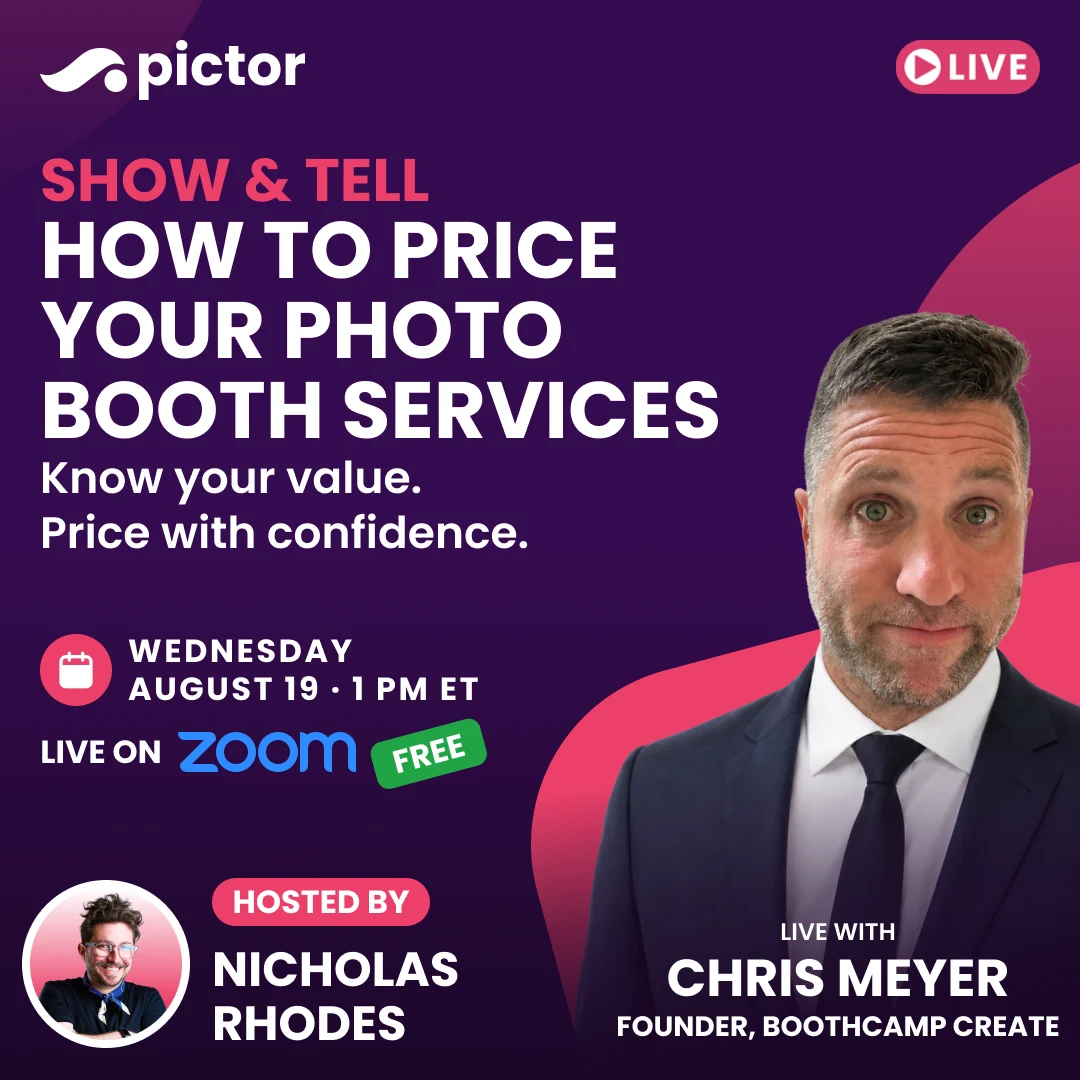
Recap from our August 19, 2026 Show & Tell with Chris Meyer, founder of BoothCamp Create

Last week Check Cherry published pricing from roughly 118,000 photo booth bookings: a $681 median, a top 10% clearing $1,642. We wrote up the numbers and said we thought they ran low. This week we asked Chris Meyer, 23 years in the industry and the person who started the Photo Booth Community group most of us read every day, to tell us what to do about it.

The short version: the median, $681 for a three-hour event, is not the market. It is the floor, and a lot of the room is already standing above it. Sixteen operators answered our unscientific live survey, and half of them charge $1,000 to $1,499 for a three-hour event. Two charge more than $2,500. The people who charge well are not lucky. They price the problem they solve, they ask for the budget before they quote, and they say no to the work that would make them resent the booth.

The full session is above. Here is what Chris and the room said, and what you can do with it this week.


Next up: we sat down with the co-founders of PBX Europe about the Amsterdam show, the venue, every keynote, and what to do before you fly. Read PBX Europe 2026 vs PBX Las Vegas: What the Co-Founders Told Us.

What 16 Operators in the Room Actually Charge

Before the conversation started we asked everyone what they typically charge for a three-hour event, before tax.

Three-hour event, before tax Operators
$500 – $999 6
$1,000 – $1,499 8
$2,500 – $4,999 1
$5,000+ 1
Bar chart: 16 photo booth operators surveyed live on what they charge for a 3-hour event: 6 at $500–999, 8 at $1,000–1,499, 1 at $2,500–4,999, 1 at $5,000+
What 16 operators in the room charge for a three-hour event. Ten of sixteen are at or above $1,000; the Check Cherry median is $681.

Ten of sixteen are at or above $1,000. Nobody in the room was under $500. So before anything else: if you are near the $681 median and feeling low about it, you are in a room where most people are already past it, and they got there on purpose.

The same survey asked which cost people are least likely to price in. Nine of sixteen said design, editing, communication and client management. Seven said add-ons and peak-date demand. Five said setup, breakdown, loading and travel. Those are not small things. Those are the hours that make a $681 booking a bad hourly rate, which is the whole argument of this post.

Bar chart of the costs photo booth operators say they are least likely to price in: design, editing and client management 9; add-ons and peak-date demand 7; setup and travel 5; premium equipment 3; staffing 1
The costs the room admits it does not price in. Design, editing, communication and client management lead by a wide margin.

Live Zoom survey during the session, August 19, 2026. 16 respondents. Not a scientific sample, but it is the same shape as the Check Cherry data, with a higher middle.


Median photo booth prices — $681 overall, $886 wedding, $899 corporate — shown as a floor beside the top 10% benchmarks of $1,642, $1,973 and $2,100
The median is what most clients think your service costs. The top 10% is what is possible. Figures from Check Cherry’s ~118,000-booking dataset.

The Median Is a Floor. Treat It Like One.

Chris was not thrilled with how Check Cherry’s report was published. “Even if it’s anonymized data, the data still doesn’t belong to them in that capacity.” But his bigger issue was the framing.

“I would have come at it and said, 90% of the photo booth industry is missing out on $1,000 an event. And here’s what the top 10% of performers are doing that is different from what the median is doing.” Same numbers, opposite effect. One version tells a client what a photo booth costs. The other tells an operator what is possible.

He also thinks the dataset skews low by construction: “It’s the lowest common denominator for people that are looking to completely automate their sales pipeline, that are not doing crazy custom bids.” Operators who quote custom work through their own process are not in it. Rick Schirm, joining from Arlington, Texas, made a similar point from the other side: most people who find the report will see the numbers and never read the article that qualifies them.

Nicholas put it plainly during the session: if OutSnapped did an event at any of those rates, the company would literally lose money. “These numbers to me, they’re like below the floor.”

Do this: stop benchmarking against the median. Benchmark against the top 10% ($1,642 overall, $1,973 for weddings, $2,100 for corporate in the Check Cherry tables) and ask what those operators do that you do not yet.


Price the Problem, Not Your Costs

Asked how he prices a standard three-hour booth, Chris said he mostly does not see one. His work almost always carries custom overlays, AI, a wrap, a backdrop. Then he said the line that reframes the whole conversation:

“My pricing is based more on the problem that I am solving than it is on my cost to actually execute something.”

A wedding booth solves entertainment and documentation. A corporate booth solves brand awareness and market penetration, which is a more complicated problem with a much bigger budget behind it. He gave a live example: a lead for a four-day, eleven-hour-a-day event in Iowa, starting tomorrow. “I’m pricing based on the fact that you need somebody right now.”

The other half of that is knowledge. Chris says he could not program an event in any software to save his life, but he knows what every platform can and cannot do, so he can solve a client’s problem in real time on the sales call. “Knowledge and confidence in my ability to problem solve makes my value proposition go up.”

Two-panel graphic: wedding booths solve entertainment and documentation; corporate booths solve brand awareness and market penetration, a harder problem with a bigger budget
Same booth, different problem, different budget. Price what the client is actually buying.

Do this: write down the problem each of your event types solves for the buyer, not the deliverables. Price that. Then learn what your tools can do well enough to answer “can you do X?” without a follow-up email.


Your Time Is the Thing They’re Paying For

We asked about the hidden cost new operators forget. Chris did not hesitate: “It’s your time. That is the thing that you are paying for.”

“I’m gonna book a $681 event and it took four hours of my time. That’s not a good return on attention.” Once you count the calls, the backdrop selection, the design, the hundred emails, the drive, insurance and software, he figures a $681 booking works out to about $20 to $23 an hour. “Why would you be self-employed and work for minimum wage?”

Graphic: a $681 photo booth booking works out to $20–23 per hour once inquiry calls, design, explaining your value, loading, driving, setup, breakdown and file delivery are counted alongside the three-hour event
The booth is three hours. The booking is not. Chris Meyer’s on-air estimate of what a $681 event pays per hour of your time.

Two more traps he named: pricing for today’s overhead instead of the business you want (“they don’t start pricing in a way that allows them to afford that additional help they need, so they get stuck”), and pricing low out of excitement over the first booking and then training every client on that number.

Chris has a phrase for the fix: Return on Attention. His biggest legacy client started as a $500 backdrop-and-red-carpet drop-off. He looked at who they were, saw the upside, and kept saying yes. This year they will do roughly $150,000 with him, including multi-city work, and “there is no sales process. It is, are you available? This is the location. This is what we want. This is the budget.” Four minutes of his time per booking.

Do this: for your last five bookings, add up every hour you spent on them and divide. If the number embarrasses you, that is your real rate, and it is the one to raise. We built a photo booth hourly rate calculator that does the math, and runs it backwards to the price that would pay you what you want per hour.


Ask for the Budget Before You Quote

This was the most practical stretch of the hour. Chris’s rule for “that’s more than we budgeted” is to never get there. He asks first.

“I will always ask, where are you trying to be at for budget? Because I want to preempt this conversation. If your budget is $800 for something that I think is worth $9,000, I don’t even want to continue the conversation.”

When they say they do not have a budget, he offers buckets: “We have options ranging from a thousand bucks to a hundred thousand dollars. Give me a bucket. Do you want to spend one to two? Three to seven? Seven to twenty?” Everyone has a budget; they just have not said it yet. Nicholas does the same with a range: depending on particulars you are looking at $19,000 to $28,000, what have you already set aside for this part of the event? As often as someone picks the low end, someone names a number higher than you expected.

Graphic: "Give me a bucket" with three budget ranges, $1k–$2k, $3k–$7k and $7k–$20k, from Chris Meyer's approach to asking for the budget before quoting
Ask for the budget before you quote. Offer buckets; everyone has a budget, they just have not said it yet.

If the gap is reasonable, he closes it: “If it’s like, oh, they were expecting it to be eight thousand when I’m at eighty-five hundred? Discount, done. You’re a first-time client, I’m happy to offer you a price concession to land the deal.” If the gap is a slap in the face, he refers it out and moves on.

Do this: put the budget question in your first reply to every inquiry. Offer three buckets. Do not send a quote until one is picked.


Say “Price Concession,” Not “Discount”

Chris never uses the word discount. He says price concession. And he has a structural trick to go with it: he has never called himself owner or CEO. His title is National Sales Director.

“I can use that as a stop gap. If I want to pause and just take a breath, I’ll just be like, hey, let me see if I can get a price concession. Hey, you know what, unfortunately I wasn’t able to do that. If this is your set budget, I can change these things, I can remove these things to hit that. Or if you need everything we’ve talked about, I have to be at this rate.”

Concessions trade scope for price. Discounts give price away for nothing. The word matters because it tells the client which one is happening.

He is not rigid about it. A recent ship-and-deploy event quoted at $4,800 came back at $4,000 and he took it, because that client has since booked five more events with him in Sydney, Japan and Toronto.

Do this: strike “discount” from your emails. When you move on price, move something else with it, and say so.


Have a Floor, and Put Your Energy Above It

Chris started as “the high volume, low price guy”: 255 events in his first nine months at about $550 each, a lot of it on Groupon, as a loss leader for a photography studio that was already doing half a million a year. He also points out that $550 in 2012 is about $900 today, which makes $681 in 2026 look even thinner.

He got out of that by setting a floor and aiming everything at clients who could clear it. At the companies he sold for, the floor was $2,500 to $3,500. For the last twelve months his own has been close to $6,000. “If I’m doing an event for under six grand, it wasn’t worth it. And that seems insane, but keep in mind that I worked very hard at funneling all of my energy into the people that could afford those rates”: corporates, brands, activations, trade shows, multi-day and multi-city work.

Rising steps showing Chris Meyer's pricing floor over 14 years: about $550 per event in 2012, a $2,500–$3,500 floor selling for others, and a roughly $6,000 floor in the last twelve months
The floor is a filter for where your hours go — Chris Meyer’s floor across 14 years.

The floor is not a number you announce. It is a filter for where you spend your hours. Today his business runs on five or six legacy clients, no website, and will do around $600,000 this year.

Do this: pick a floor you would not resent. Then look at where your marketing hours go and ask whether those people can pay it.


Raise Rates on Existing Clients With a Heads-Up, Not a Surprise

Chris’s approach to repeat clients is to preempt. “I usually like to give them a heads up and not just pull the rug out from underneath them.” The script: we have kept our prices as low as we can for as long as we can; in future events you will see a modest increase, 10 or 15 percent; if you need to hit a specific number we can reduce the level of service to get there.

Nicholas also shared something Chris Collins of BoothBook said on stage once: double your prices, and if you keep more than half your clients, you are ahead. Same revenue, half the events, half the stress, and room to take on new clients at the new rate.

If a client says no to the increase and there is no wiggle room? Chris will refer the job to someone in his white-label network if it is a five-minute favor. “It’s not about what the client thinks of me. It’s about what my white label person thinks of me.” The referral keeps the network warm for the next time he needs a favor.

Do this: pick a date. Tell your repeat clients now, with a reason and a scope option. Then hold it.


Know When to Take the Low One

Is there ever a good reason to take a below-floor job? Chris says yes, if it is about who the client is rather than what the event is. He has four events at IMEX in October where he is charging nothing and expects to lose $10,000 to $12,000 executing them. “These are one billion percent the people that I want to be in front of. I am happy to spend money on acquiring the right type of client.”

Nicholas framed it as an advertising cost. If you would spend 10% of a booking on a Google ad to win it, a strategic freebie or a deep concession for a whale is the same math, and the acquisition cost belongs in your pricing, not subtracted from it. He is otherwise against working for free: people do not treat an experience they did not pay for the way they treat one they did.

Losing a job to someone at a quarter of your rate has a script too. Chris replies: that sounds great, may the odds be ever in your favor, and by the way here is my emergency rate if they bail. The emergency rate is higher.

Decision graphic for below-floor offers: take the loss on purpose for the two or three logos you chose in advance; hold the rate for everyone else
A below-floor job is client acquisition or it is nothing. Decide the logos in advance; everyone else pays the rate.

Do this: decide in advance which two or three logos you would lose money to land. Everyone else pays the rate.


Questions From the Room

Tiffani Barner, three years in and running a two-person operation in Florida, asked the question half the room was thinking: “Charged $750 for a 2 hour school event with 4×6 prints. I never feel it is right because of the non negotiable 4×6 prints for their guests count. How do we confidently price our events and not feel like you have to apologize for them?” Same week, a bride wanted everything for $200.

Two answers. Nicholas: The school has someone whose job is booking this, so build the relationship around advance booking at a locked rate, and put rush fees on anything inside your window, because someone else’s late planning should cost them, not you. Chris: “Charge enough to make their headache worth your time. If they are a truly huge pain in the butt, guess what, your photo booth now costs $2,500. And if you say yes to that $2,500, then yeah, I’m excited.” Then his school hack: stop selling single events and lease the booth to the school for the year. “You could have a lease for nine, ten, twelve, fifteen thousand dollars that covers the entire year.” Dozens of events, one contract, and the headache goes to near zero. Gerald Hood in the chat: “It’s YOUR business and you set the prices and rules. I’ll let them go if they don’t respect you.” Kayla Braun: “Love the long term lease ideas for schools.”

Rick Schirm (Arlington, Texas, and his last booking was $13,000, “and yes it felt great”) asked how you reach companies with realistic budgets. Chris: go where they are. SITE, ILEA, NACE, the trade shows and conferences your buyers attend. “Everybody is always looking for the quickest win, and this is never the case with corporate. It is always a very long game. Sometimes that game is very expensive, but it is almost always worth it.”

Chris Bjorklund, who runs an ad agency in Vancouver that added photo booths eight or nine years ago, asked the hardest one: the receptionist who “just wants something fun,” does not know what she wants, and has a competitor quoting 40% less for identical gear. He then described losing a repeat corporate client to a side hustler $600 cheaper, and agencies he has served for years asking for “technician only” at rates that remove the backup van and the team. Chris Meyer’s answer was not soft: you are selling that person twice, because she is not the decision maker, and if closing takes nine hours of your time the job was never worth it. And: “Not every client is your client. I lost this client. That’s okay. It’s going to give me an opportunity to find somebody that’s better.” On small markets, he would not accept a 60-mile radius as a definition: “The market is whatever country you’re in, at a minimum.” Nicholas added that he knows Canadian vendors charging well above those rates who are busy all the time. Letting go of a client who no longer fits makes room for one who does.

Helena Tse asked how to get more school bookings. Chris: decide which schools first (private schools have money and sponsors), find a common denominator to get in the door, then do one at no cost to show what you can do and pitch the three or four events a year they will actually book. Nicholas: be in the room where school bookers are, and treat any free event as acquisition spend with a number attached.

Kayla Braun, on everything above: “YES. We are entertainment, not just a printing service.”


One More Thing

We ran this session because a report made a lot of good operators feel bad about numbers that were never theirs. The room’s own survey, Chris’s floor, Rick’s $13,000 booking and Tiffani’s three years in business all say the same thing: the price you can charge is higher than the median, and the way up is not a trick. Ask for the budget. Price the problem. Count your hours. Say no to the jobs that would make you resent the booth. Tell your clients the increase is coming, and mean it.

A few house notes. We use HubSpot at OutSnapped, which costs us roughly $20,000 a year, so we are not in the Check Cherry dataset either, and yes we are looking hard at BoothBook. The theme song at the top of the replay is a Pictor original, “Price It Like You Mean It,” because several of you asked. And Pictor V2 reached our staging servers this week; we will have something to show you in early September.


Photo Booth Pricing FAQ

How much should I charge for a 3-hour photo booth event?

There is no single right number, but the published median is a floor, not a target. Check Cherry’s data from roughly 118,000 bookings puts the median at $681 and the top 10% at $1,642 or more. Of the 16 operators in our live session, 8 charge $1,000 to $1,499 for a three-hour event, 6 charge $500 to $999, and 2 charge over $2,500. Price the problem you solve for the client and the hours the booking really takes, not just the time the booth is open. Our hourly rate calculator shows what a given price pays you per hour.

What do I say when a client says “that’s more than we budgeted”?

Ask for the budget before you quote so you rarely hear it. Chris Meyer’s approach: “Where are you trying to be at for budget?” If they say they do not have one, offer buckets, such as $1,000 to $2,000, $3,000 to $7,000 or $7,000 to $20,000. If the gap is small, offer a price concession tied to a first booking. If the gap is large, refer them out politely and keep the door open.

Should I offer a discount or a price concession?

Use the words “price concession” and trade scope for price: fewer hours, fewer features, a smaller deliverable. A discount gives price away for nothing and trains the client to ask again. A concession tells the client what changed in exchange for the lower number.

How do I raise my photo booth prices for existing clients?

Give them a heads-up, not a surprise. Tell repeat clients before their next booking that prices are going up by a modest amount, usually 10 to 15 percent, explain why, and offer a scope option if they need to hold a number. One rule of thumb shared in the session: if you double your prices and keep more than half your clients, you are ahead on revenue with half the events.

When should a photo booth operator turn down a booking?

When the price would make you resent the work, when the client is not the decision maker and closing will take more hours than the job pays, or when the rate is below the floor you have set for your business. The exceptions are strategic: a below-floor job for a client you want long-term is client acquisition, and the cost belongs in your marketing budget, not your rate card.

How many hours does a photo booth booking really take?

More than the event. Count inquiry and contract time, design and overlays, loading, driving, setup and breakdown, and post-event gallery delivery. In our survey, the costs operators said they were least likely to price in were design, editing, communication and client management (9 of 16), add-ons and peak-date demand (7) and setup, breakdown, loading and travel (5).


Watch the Replay

The full 89-minute session is at the top of this page. It is also on YouTube with chapters if you want to jump straight to a section.

Find Chris at BoothCamp Create, and in the Facebook groups: tag him with a question that helps the whole room and he says he will answer 99.99% of the time. BoothCamp Create runs again in February, right before PBX.

If you were in the room, claim your 50 free AI tokens here: forms.gle/pHSE1s4aH5YxF9jG8. Use the email on your Pictor account.


Join Us Next Week

(Almost) every Wednesday at 1 PM ET we host a live Show & Tell: real operators, real projects, chat open the whole time. RSVP free for the next Show & Tell →

If you have not read the benchmarks yet, start here: Photo Booth Pricing in 2026: What Operators Actually Charge. Then come back and find where your median booking sits. Most of this room is above it.

Share

More from Show & Tell

Ready to level up your photo booth business?

Start Free Trial

No credit card required