Fall 2026 Photo Booth Trends: What 3 Operators Told 29 of Their Peers
29 operators told us what's booking this fall: open-air 38%, AI 31%, 360 down to 7%. Lisa Oler, Meir Israel and Zach Schiffman on Fall 2026 photo booth trends.
Nicholas Rhodes
Drafted with AI assistance; reviewed and approved by Nicholas Rhodes before publishing.
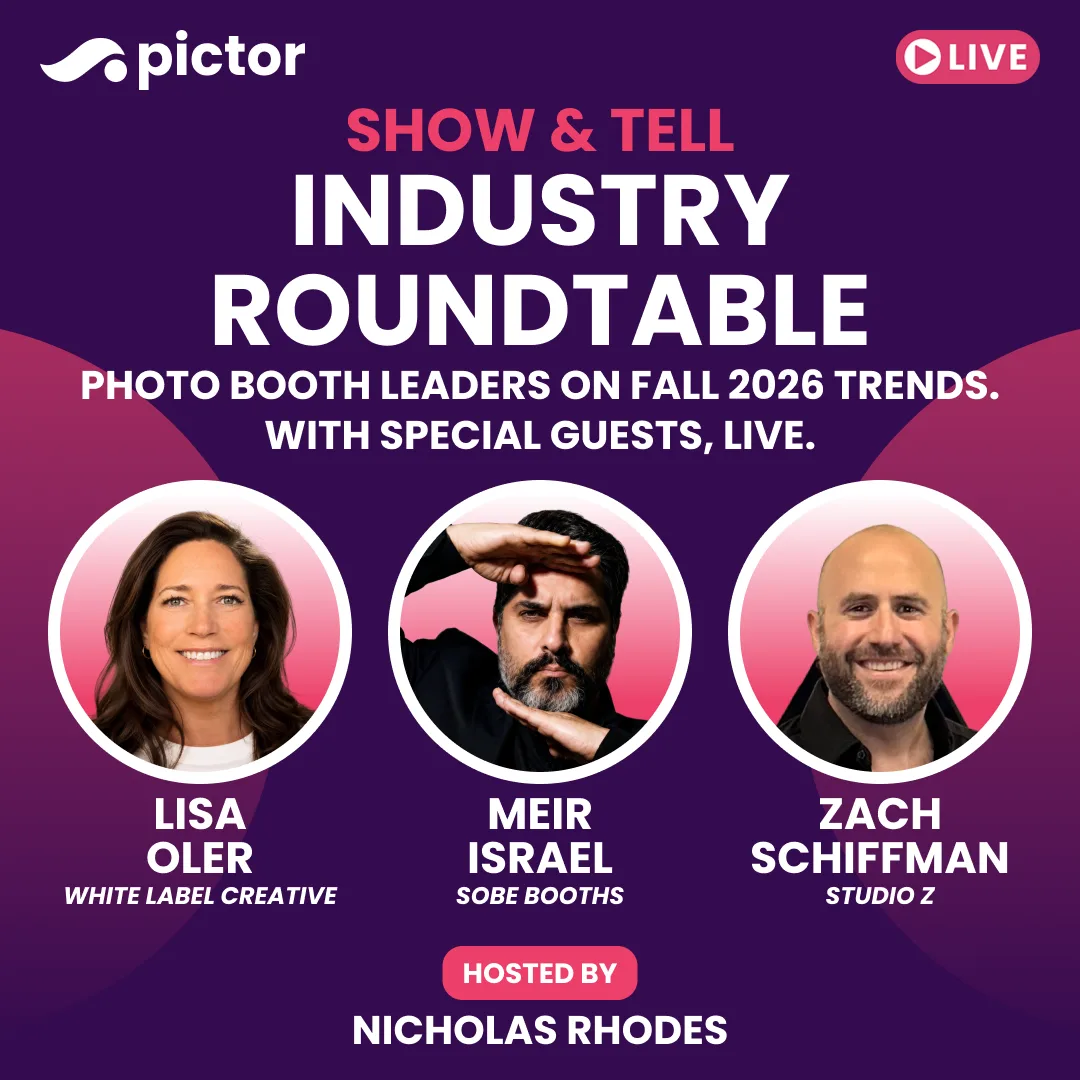
Industry Roundtable on Fall 2026 photo booth trends with Lisa Oler, Meir Israel and Zach Schiffman — August 5, 2026
Recap from our August 5, 2026 Show & Tell with Lisa Oler of White Label Creative, Meir Israel of The South Beach Photo Booth Company, and Zach Schiffman of Studio Z
(Almost) Every Wednesday we host a live Show & Tell where operators bring real projects and ask real questions. This one was different: instead of one guest, we put three of the most experienced people we know at one table and asked them what is actually booking this fall.
We also ran a live poll during the session, so we know what the room was booking, not just what the panel thinks. Twenty-nine operators answered.
The full session is above. Here is what we covered.

What 29 Operators Said They’re Actually Booking
We asked everyone in the room which of their booths is most popular right now. The answers:
| Booth type | Share of operators |
|---|---|
| Open-air photo booth | 38% |
| AI photo booth | 31% |
| Glam booth (studio lighting + DSLR) | 21% |
| 360° video booth | 7% |
| Mirror / selfie booth | 3% |
Their most common event types, from the same poll: corporate events (17 operators), brand activations (11), weddings (7), holiday parties (6), and trade shows or conferences (6).
Two things stand out. Open-air, the least fashionable booth in the industry, is still the most-booked — as it is in our honest roundup of photo booth software. And 360, which was everywhere at PBX in Las Vegas this spring, is down to 7%.
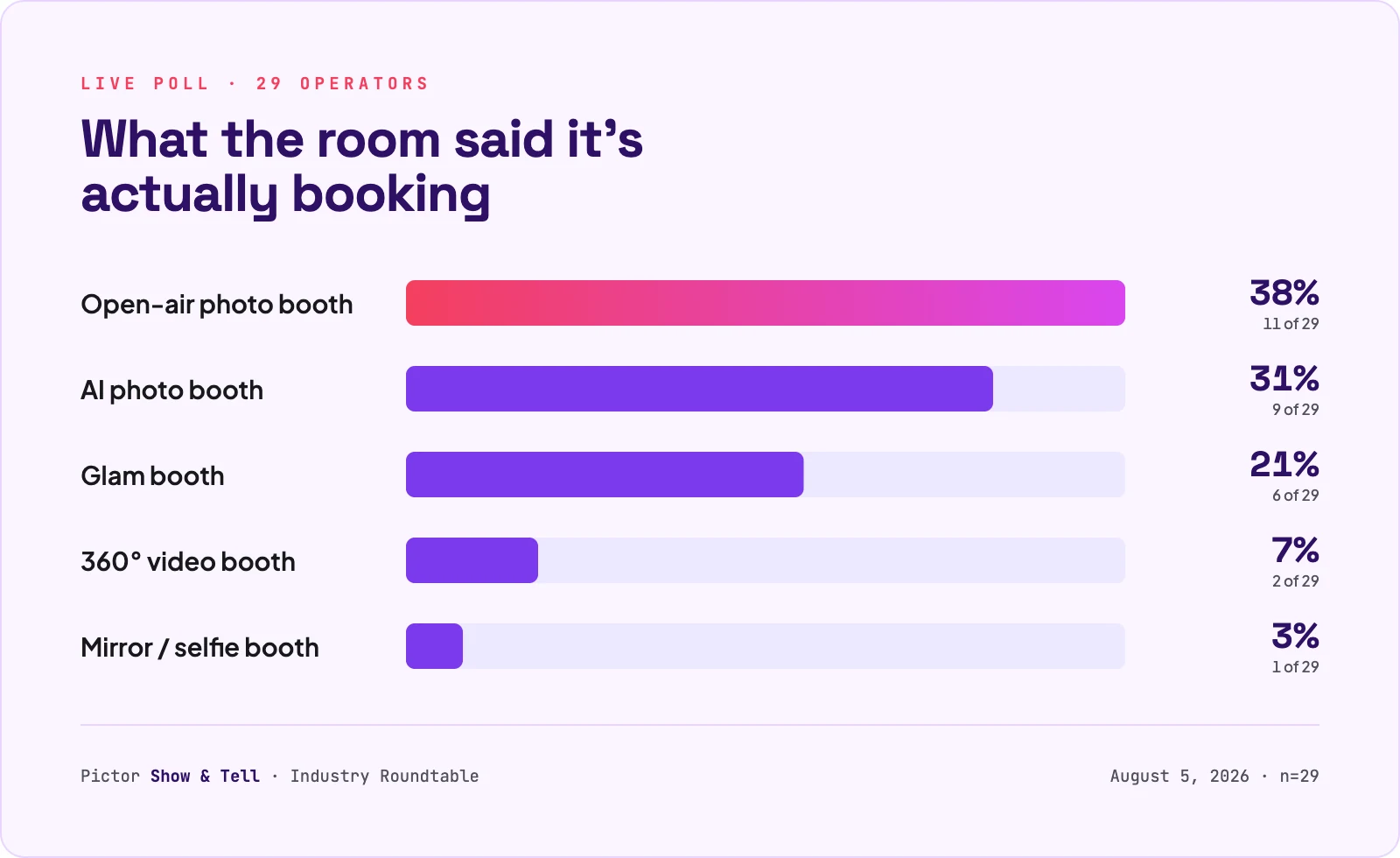
Live Zoom poll during the session, August 5, 2026. 29 respondents, including the three panelists. Excluding them, open-air rises to 42% and AI drops to 27%.
360 Is Now a Niche, Not a Category
When asked how much 360 work they are still doing, the panel did not hedge.
Lisa: “Zero.” Meir: “10%.” Zach: “It’s definitely gone down. I have a few yearly repeat clients that just kind of resign the contract and do it, but we don’t get a lot of active leads for 360 anymore. I think it’s kind of played out.”
That tracks with the poll. It does not mean the format is dead, though. On our side at OutSnapped, 360 bookings are now almost exclusively holiday parties and law firms. Zach pointed out the other place it still works: rooms that deserve it. He books 360 at venues like the atrium at BAM in Brooklyn, where the space itself makes the shot.
What to do about it: stop marketing 360 as a headline product and start attaching it to the two contexts where it still sells — corporate holiday parties, and venues with architecture worth spinning around in.
The Trend Window Now Closes Before PBX
This was the sharpest thing said all session, and it came in response to a run of chat questions about the Scribble Booth.
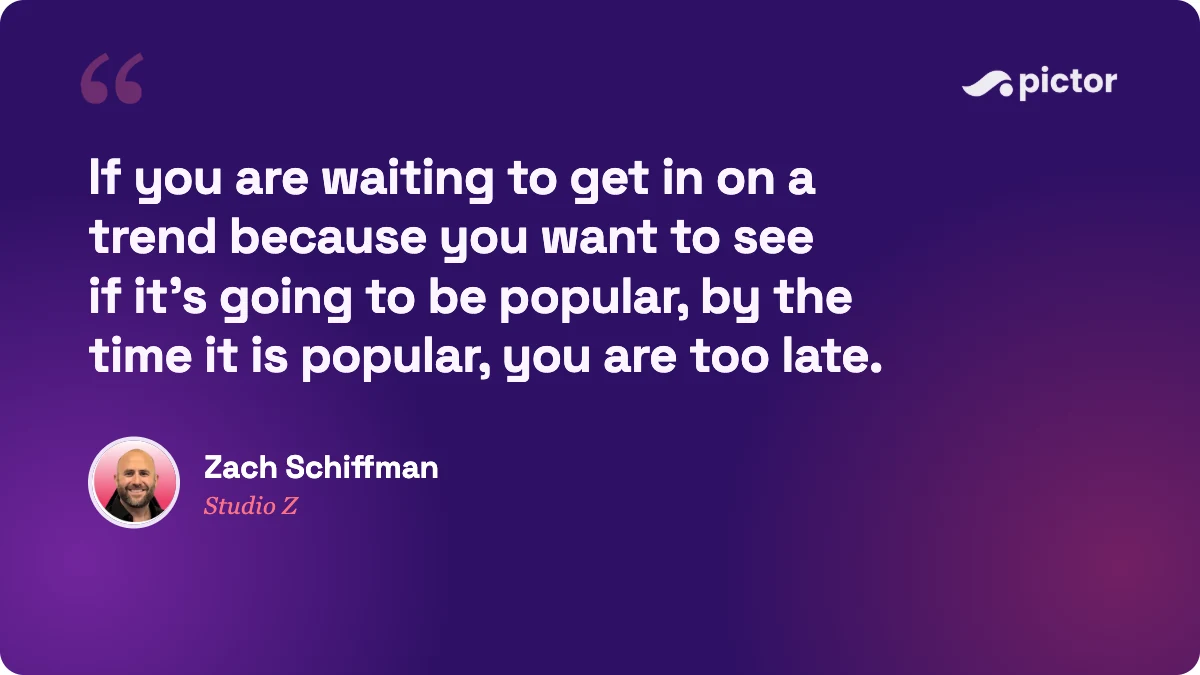
He has the receipts on both sides of it. He bought a Scribble Booth at PBX, rented it to the World Cup for $19,000 on a month-long drop-off, and made the purchase back on that single booking. He starts at $3,500. His read on next year: “There will be 15 of them at PBX next year. And by that time, everyone will be doing it for $500.”
The same curve already ran its course twice. He imported one of the first 360 booths from the UK for over $10,000 and made hundreds of thousands on it — and now tells people not to bother, because you can buy them for a few hundred dollars from China. Audio guest books were a $100,000 sub-business for him five years ago. He sells six a year now.
What to do about it: the money is in the gap between a product existing and a product being available at PBX. If you first hear about something on the show floor, the margin is already gone.
SEO Is How You Own a Trend Before Anyone Else
The other half of Zach’s trend strategy is not about hardware at all.
“There’s a reason Stephanie and I get leads for Scribble Booth. We both SEO optimized it when nobody had a page in February, and now we are Google authorities on that.”
He builds pages for services he does not offer yet, specifically to see whether anyone searches for them. He does not pay for marketing and says he does not network much anymore. The pages do it.
This showed up in the poll independently. Three operators named Scribble Booth as the biggest jump in requests without being prompted — including Katie Cox, who added it after PBX, and Catalina of MDRN Photo Booth Company, who simply wrote “Scribble booth — bought it.”
What to do about it: publish the page before you own the gear. It costs nothing and it tells you whether the demand is real in your market.
Print Is Back, and It Isn’t Strips Anymore
Lisa framed this as the pendulum swinging back toward analog, and the print vendors following it: “It’s not just a 4×6 or a 2×6 photo strip. You’ve got so many more options now.”
At OutSnapped we have seen roughly a 50% increase in print requests this year, especially for fall.
Meir’s addition is the one worth internalizing: when a corporate client skips prints, it is not always budget. “Sometimes it’s a big traveling event and they just don’t want to burden people with something else to carry.”
He also pointed out that none of the current print formats are new. Keychains and trading cards have been around for years. What changed is presentation: charm stations instead of a six-foot table with eyeloops. His die cutters are fifteen years old and still in rotation.
What to do about it: if you own analog finishing gear, do not sell it. If you do not, the format is cheap to add and clients are asking.
Corporate Clients Are Starting to Write AI Out of Contracts
Zach brought this one in the morning it happened:
“I got a service agreement from a corporate client brand today in lieu of our contract, and they had a clause that we weren’t allowed to use AI in any form in their event. I’ve never seen that before and I thought it was fascinating.”
The problem is that nobody can define the term. Having consulted with the HBOs, Netflixes and Warner Brothers of the world on exactly this, my honest read is that most clients do not know what they are afraid of. We use Gmail to send them an email, and Gmail has spell check in it. Your team gets to the venue in an Uber, which uses AI to route the car. These get slippery fast once a privacy officer is in the room.
Zach’s handling of it was practical. That particular lead was for a Scribble Booth, so there was no AI involved and he could simply sign. He drew the line clearly on the other side, though: if a client had asked to turn guests into superheroes while their contract banned AI, that is a liability problem, not a paperwork problem.
What to do about it: read the AI clause before you sign, and ask what specifically they mean by it. If the activation you sold requires AI and the contract bans it, that is a conflict to resolve before the deposit, not on site. For what the AI side actually costs to run, see the AI photo booth cost myth.
Fewer, Better Events Beats Racing to the Bottom
Lisa’s description of the inbound problem:
“They come with no creative brief, no concept, no budget. You have a thousand people at a corporate event and you’ve got four to six hours to get through. You tell me what your budget is and I can tell you what we can do.”
For the numbers behind that conversation, see what operators actually charge in 2026. The budget conversation is not an obstacle to get past before the real work starts. It is the fastest way to find out whether you and the client want the same thing. Someone with a clear number and a clear goal is easy to design for. Someone who will not say either usually has not decided yet, and the design work you do in that gap tends to get thrown away.
Zach has built an entire business model on choosing rather than chasing:
“We do more low volume, high profit events. I don’t want to burn out. And I have found that if I spend my time chasing $1,500, $2,500 events, I miss out on the $50,000 to $60,000 events.”
Meir is doing a version of the same thing from the other direction, deliberately cutting the number of products he offers so clients are not choosing from a muddled menu, and matching a scaled option to whatever the budget turns out to be.
There is a related tell worth watching for. AI has made it easy for anyone to send an email that sounds informed. You genuinely cannot tell from the writing whether this person has run 5,000 photo booth events or woke up this morning and this is their first one.
What to do about it: ask for the range early, and treat the answer as fit information rather than a filter. Chris Meyer took the same conversation apart in our Show & Tell on pricing. The goal is not to turn people away. It is to spend your best thinking on the clients you are actually right for.
You’re Selling Your Time, Not Your Gear
Meir’s framing, and the line most worth writing down:
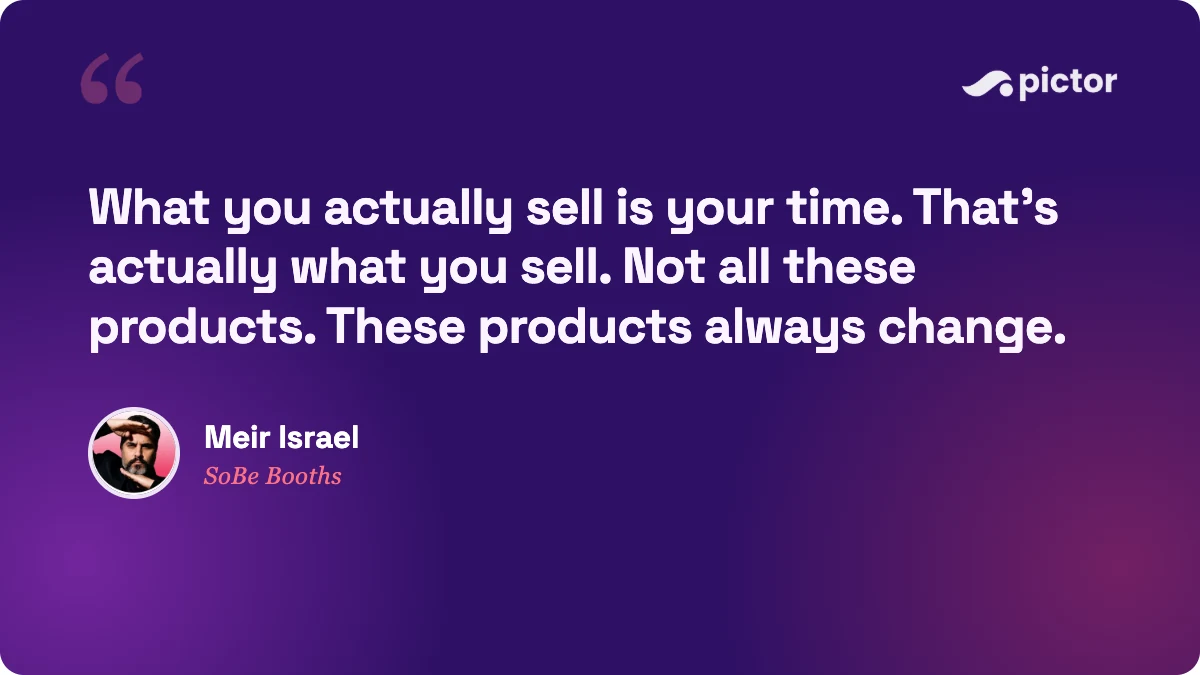
He is restructuring his sales funnel around it, deliberately cutting product options so clients are not choosing from a muddled menu, and going after bigger clients with clearer budgets.
The math side of this came up in the Q&A. Most operators price the on-site hours, which are the cheapest part of the job. Personally, I used to think of my rate as $250 an hour and have recently pushed that to $350, because everyone we pay has raised their prices. If you spent ten hours on a job before the event and four on site, the $500 in your hand is divided by all fourteen.
Zach’s version of the same point, about AI specifically: “You will lose so much money so fast if you underprice it.”
What to do about it: work out your real hourly rate including everything before and after the event, then check your last invoice against it.
Nobody Owns the Privacy Question Yet
This was the longest stretch of the session and the least resolved.
Lisa’s read is that corporate clients are pulling back from on-site data capture entirely because of privacy restrictions. Sharing now happens by QR code to a microsite, with no capture at all. She also named the absurdity in it: the client already has every attendee’s email address, because they used it to send the invitation.
Meir described a workaround one of his large corporate clients wrote into an installation contract — his company collected, stored and secured everything, and the client simply bought the final contact list. It moves the onus off them, though as he acknowledged, it does not really survive scrutiny.
Zach deals with it at the copyright end. Clients regularly try to redline his copyright clause to strip his rights to the images. His reply: if I have no rights to the photos, I cannot send them to guests or host them on our servers, because you could sue me for it. That usually gets the clause rewritten. On the strict end of the spectrum, he white-labels for Apple, where every event gallery is purged 24 hours after the event — guests get a final warning to download, and then the photos are gone.
Our own worst version of this: a large credit card company changed their requirements on the photo activation three hours before an event, in a way that put their demands in direct breach of the contract we had signed. Our lawyer and the credit card company’s agency’s lawyer wrote a separate indemnifying agreement in that window. It cost several thousand dollars which nearly put us in the red on the event, but indemnified us against the issue.
What to do about it: have a lawyer look at your standard contract before the season, not during an event. Lisa and Meir have a lawyer keynoting Illuminate Creative specifically on contracts, liability and exposure.
Questions From the Room
What is the average fee for an AI booth for a 4-hour activation? — asked by Richard E
There is no single answer, because the variables are the whole job: how many people are using it, how many themes, physical or virtual, custom development or not. For our own work at OutSnapped, a straightforward four-hour AI activation starts around $5,000. From there it scales with complexity, customization and the length of the engagement, and our AI work has run up to roughly $250,000 at the top end. Zach’s caution applies at every point on that range: sessions burn compute, and an unmetered virtual link can eat the margin after the event ends.
What about governance concerning the AI tool being used? Who’s liable? — asked by Misty
Lisa’s answer, from the chat: “We use an on-screen disclaimer that has been legal-checked for every AI event.”
Why do you think the consumer side for Glambot never took off? — asked by Ade Imaging
Two reasons from the panel. Lisa: it was cost-prohibitive for most social events to begin with. Zach: “The rise of quick buck companies doing it for less than I charge for a normal photo booth. The same happened with 360.” Zach has owned three consumer-level glambots, used one, and lost money on it. He argues a gimbal and a skilled operator produce a better result — and for high-end work he rents the rig and hires a dedicated operator rather than running it himself.
Meir’s addition is about the guests, not the gear: the Vogue-style glambot content everyone is copying features coached celebrities in couture. A conference of 300 insurance agents in t-shirts, asked to improvise for two seconds unprompted, produces a very different video.
How are you finding the reaction to the Scribble Booth? — asked by Rosie of Infinity Media Dallas
Lisa’s read: another case of what’s old is new again, and she expects the trend to be “big but brief.” Meir agreed it is landing well. Zach does not think the current hardware is the best possible version, and expects the market to flood next year.
If you were starting a new photo booth company, what would you focus on? — asked by Misty
Lisa, in the chat: it depends on your strengths and your equipment. Her own preference is the festival and conference niches.
Are you doing themes around GTA 6 for birthday parties? — asked by Misty
We do not build themes around anyone else’s intellectual property, and we would not ship one.
What Pictor gives you is an open prompt editor. Write the prompt yourself, or work it out in ChatGPT or Gemini first and paste it in — if you can describe a look, you can build it, and there is no waiting on us to add it to a menu. That is genuinely the fun of the tool.
The tradeoff is that an open editor means you are the one deciding what goes into it. We are not a rights clearance service, and we cannot tell you whether a particular look is safe to sell.
So: when in doubt, get it cleared first. If a client asks for something that looks like it belongs to somebody — a game, a film, a character, a logo, an athlete’s face — the question to ask is simply whether they have the rights or have cleared them. Often they do. Brands ask for their own IP all the time, and agencies usually have the paperwork sorted before they ever call you. It is a five-minute conversation before the event instead of a problem after it. If the answer is fuzzy, treat that as your answer.
We ran into this ourselves at OutSnapped recently. We did a large activation at Comic-Con where AI could have produced a much better version of what the client wanted. But once you count up every rights holder who would have to sign off on AI-generated material from film and TV, it becomes a no-fly zone. So we built it as a physical choose-your-own-adventure set instead: printed panels with holes in them, guests popping their heads through in different spots. It worked beautifully.
Which is the wider point, and it came up all session. AI is not always the right tool for the job — the same way 360 is not right for every room, a printer is not right for every traveling conference, and a glambot is not right for a hall full of engineers in cargo shorts. The operators doing well right now are the ones choosing the tool to fit the event, rather than fitting the event around whatever they just bought.
What event are you most proud of? — asked by Graham McDonald of Pixelated Gigs
All three answered at length, and this is the part worth watching rather than reading. Lisa’s was a pre-AI WWE activation in New Orleans built entirely from PNG overlays and face-in-the-hole framing. Meir’s was a capital company holiday party that changed how he writes proposals — itemizing every line rather than presenting one bottom-line number, which he believes is why he won it.
One Last Thing: Write the Thank You Note
We closed on something that was not a trend at all.
A client recently sent a long thank you note acknowledging our contribution to their event, and it landed harder than expected. Most of us only revisit a finished event when something went wrong and needs cleaning up. We have since restarted our post-event follow-ups, and it does not matter much that clients rarely reply, because they still receive them.
Lisa took it further:
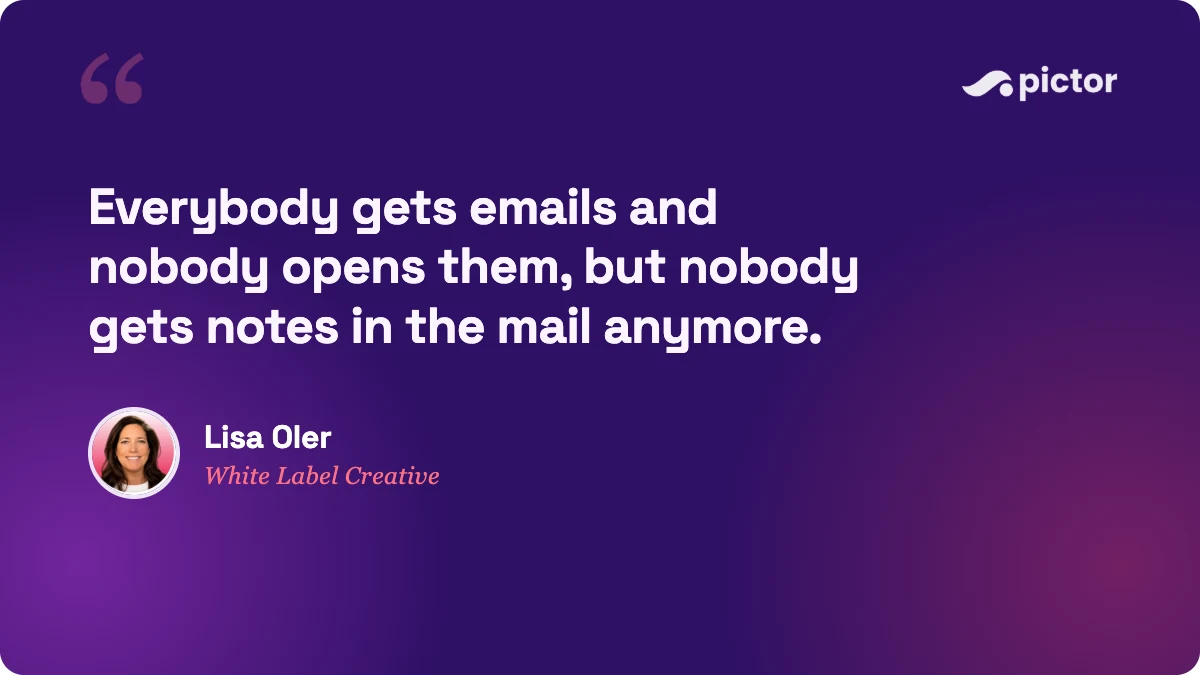
Ask for the mailing address. People give it.
Watch the Replay
The full 87-minute session is at the top of this page, including the Q&A and the parts we could not fit here. It is also on YouTube with chapters, if you would rather jump straight to a section: watch the Fall 2026 Industry Roundtable →
Thanks to Lisa, Meir and Zach for the time, and to everyone who showed up with questions.
Join Us Next Week
Show & Tell runs live every Wednesday at 1 PM EST. Bring your project.
Register for the next Show & Tell →
Haven’t tried Pictor yet? You can build events, test your virtual booth and experiment with AI prompts for free before you run your first live event.
Start your free trial at app.pictor.pro/register →
Frequently Asked Questions
What photo booth type is booking most in late 2026?
Open-air. In a live poll of 29 operators during our August 5, 2026 Roundtable, open-air led at 38%, ahead of AI photo booths at 31%, glam booths at 21%, 360° video booths at 7% and mirror booths at 3%. Excluding the three panelists, open-air rises to 42% and AI drops to 27%.
Is the 360 photo booth dead?
No, but it is a niche rather than a category. It was 7% of the poll, and the panel put their own 360 volume between zero and 10%. Where it still sells is corporate holiday parties, a handful of yearly repeat contracts, and venues whose architecture makes the shot.
When is the right time to buy into a photo booth trend?
Before the product reaches the PBX show floor. Zach Schiffman bought a Scribble Booth at PBX, rented it to the World Cup for $19,000 on a month-long drop-off and made the purchase back on that one booking — and expects fifteen of them at PBX next year with the rate down around $500. The money sits in the gap between a product existing and a product being widely available.
Are clients still asking for prints?
Yes, and not only photo strips. At OutSnapped print requests are up roughly 50% this year, especially for fall. The formats themselves are not new — keychains, trading cards, die-cut shapes — what changed is presentation, with charm stations replacing a six-foot table. If you own analog finishing gear, keep it.
What should I do if a corporate contract bans AI?
Read the clause before you sign and ask what specifically they mean by it. Most clients cannot define the term, and the line moves fast once a privacy officer is in the room. If the activation you sold requires AI and the contract bans it, that is a liability problem to resolve before the deposit, not on site.
How should operators handle guest data and privacy at events?
Nobody in the room had it fully solved. The patterns that are working: sharing by QR code to a microsite with no on-site capture at all; a contracted arrangement where the operator collects and secures the data and the client buys the final list; and holding copyright so you retain the right to deliver and host guest photos. At the strict end, some white-label clients purge the entire event gallery 24 hours after the event. The one thing everyone agreed on: have a lawyer read your standard contract before the season, not during an event.
Nicholas Rhodes
Founder of Pictor & OutSnapped
Nicholas is the founder of Pictor and OutSnapped—a premium photo experience agency producing AI activations, red-carpet productions, and branded content for global events. He hosts Pictor Show & Tell almost every Wednesday.
Nicholas has produced thousands of branded photo experiences for global clients through OutSnapped and builds the tools operators use daily at Pictor.