How to Win Q4 Corporate Holiday Bookings (Before Your Competitors Even Pitch)
Corporate holiday parties are booked in September and October, not December. A month-by-month outbound plan for photo booth operators, plus the procurement pack, pricing, and reporting that win the account.

Nicholas Rhodes
Drafted with AI assistance; reviewed and approved by Nicholas Rhodes before publishing.
If you are waiting until November to pitch corporate holiday events, you are usually too late.
By then most companies have approved the budget, booked the venue, picked the agency, and shortlisted the vendors they already trust. What is left tends to be smaller, more rushed, and more price-sensitive.
The operators who win the better bookings start earlier. They get in front of HR teams, marketing departments, agencies, venues, and caterers in September and October, while the event is still being shaped and the vendor list is still open.
The timing is worth the effort. Pictor was built inside a working photo booth company, and in our experience running brand activations, corporate work produces three to five times the margin of a typical wedding booking. The public booking data points the same way: the top 10% of corporate bookings clear $2,100, the highest of any event type in our photo booth pricing benchmarks. Chris Meyer made the same case on Show & Tell, where he explained why a corporate booth solves a bigger problem with a bigger budget behind it. Corporate work also brings repeat business, multi-date programs, referrals, and annual contracts.
What follows is how to approach the season as an event partner rather than a photo booth vendor.
Get the Q4 Corporate Pitch Kit
A 10-page worksheet, not a reprint: the 90-day to-do list, prospect tracker, buyer cheat sheet, concept builder, procurement pack, pricing worksheet, report template, three outreach emails, and an AI prompt for each. Enter your email and we will send it to you.
We email the link so we know it reaches a real inbox. One email, no list, no drip.
What clients already pay, by event type
Corporate is the least price-sensitive segment in the data
Median and top-10% booking values across roughly 118,000 real photo booth bookings since January 2024.
Median bookingTop 10% of bookings
- Corporate
- Wedding
- School / prom
- Party / personal
Source: Check Cherry booking data, via the Pictor photo booth pricing benchmarks.
Why corporate holiday bookings get decided early
A corporate holiday event involves more people than a private party. The person planning it may need sign-off from HR, finance, marketing, legal, procurement, and leadership, and every one of those is a reason the decision happens sooner than you would expect.
Large companies start months out, especially when the event spans multiple offices, a major venue, travel, or a branded activation. By late summer, planning teams are already working through headcount, budget approval, venue selection, the agency or production partner, catering and entertainment, and vendor contracts.
Cvent’s holiday party planning checklist, updated August 2026, tells planners to start 10 to 12 weeks out and to “lock the caterer and any headline entertainment in this same window, since they book out just as fast.” For a mid-December party, 12 weeks out is the last week of September. Nunify’s holiday event timeline lands in the same place.
September is when you want to become known. October is when you want to be shortlisted. November is when you should be confirming logistics, not introducing yourself for the first time.
Q4 corporate outbound sequence
Known in September. Shortlisted in October. Confirmed in November.
- SeptemberGet known50 to 100 prospects across HR, marketing, agencies, venues, and caterers. Short intro, two or three activation concepts, gallery link.
- Early OctoberGet shortlistedOne specific idea per prospect. A one-page concept they can forward internally.
- Late OctoberRemove frictionPricing, availability, COI, W-9, setup needs, data and consent summary, sample contract, sample report.
- NovemberConfirm and expandLock guest count, run of show, creative approvals, staffing. Ask about the other office events.
- DecemberExecute and reportRun it calmly. Send the participation and sharing report within a week. Book next year.
Most venues and headline vendors are locked 10 to 12 weeks out. For a mid-December party that is the first week of October. A first pitch in November is a pitch for the leftovers.
Timing source: Cvent holiday party planning checklist, August 2026.
Start with the right buyers
“Corporate events” is not one audience. Four different teams buy photo booth experiences for four different reasons, and the pitch has to change with the buyer.
Four corporate buyers, four different pitches
“Corporate events” is not one audience
-
HR and people teams
Employee holiday parties, recognition, culture events
They care about
- Participation and a smooth guest flow
- Inclusive, easy activations
- A vendor who creates zero extra work
Lead with: engagement and ease. A branded memory every employee leaves with.
-
Marketing and brand teams
Client appreciation, product launches, conference parties
They care about
- Brand fidelity and shareable content
- Consent-based lead capture
- A post-event report they can show a VP
Lead with: a branded content activation with numbers attached, not a rental.
-
Event agencies and producers
Many clients, many events, tight run of show
They care about
- Fast replies and paperwork already done
- Following the run of show
- Looking organized in front of their client
Lead with: a capabilities deck, packages, tech specs, and COI they can drop into their own proposal.
-
Venues and caterers
Hotels, conference centers, country clubs, corporate caterers
They care about
- You arrive prepared and stay out of the way
- Guests have a better night
- A referral they will not regret
Lead with: professionalism, not technology. They are in the room before the client starts searching.
HR and people teams
HR usually owns the employee holiday party, along with recognition programs and culture events. They want high participation, a smooth guest flow, an activation anyone can use, and a vendor who creates no extra work for them.
Lead with engagement and ease. Position the activation as a simple way for employees to connect, have fun, and leave with a branded memory of the night.
Marketing and brand teams
Marketing may be planning a client appreciation event, a product activation, a conference party, or a holiday campaign. They care about brand fidelity, shareable content, consent-based lead capture, and results they can put in front of a VP.
For this buyer a “photo booth rental” pitch is too weak. Present a branded content activation: custom overlays, a clear visual concept, a consent step, and a post-event report.
Event agencies and production companies
Agencies manage many clients and many events, which makes them some of the best partners an operator can have. They need someone who replies fast, follows the run of show, works cleanly with venue and production teams, has the insurance paperwork already done, and makes the agency look organized.
Your proposal should make their job easier. Send a concise capabilities deck, sample packages, technical requirements, insurance details, and two or three activation concepts they can drop straight into a client presentation.
Venues and caterers
Hotel event directors, conference venues, country clubs, corporate caterers, rental companies, and AV teams are already in the room with companies planning holiday events, usually before the client starts searching for entertainment.
A venue partner does not need a walkthrough of your technology. They need confidence that you will arrive prepared, work professionally, and make the guest experience better without disrupting their event.
What corporate buyers actually care about
Corporate buyers are not comparing you on the number of filters in your software. They are asking a more practical question:
Can this vendor deliver a polished, on-brand experience without creating risk or extra work?
Your sales materials should answer that directly, on five fronts.
Reliability
Explain how you handle setup, testing, connectivity, backups, staffing, and event-day support. If you run professional photo booth software, show how it lets you build a repeatable experience once and run it consistently across every date.
Brand fidelity
Corporate clients expect their visual identity to be respected. Show that you can work with logo placement, approved colors, typography, campaign creative, legal disclaimers, and custom calls to action. The overlay should look like part of the client’s campaign, not a logo pasted onto a template the night before.
Measurable results
For an employee party, success may mean participation. For a client-facing activation, it may mean leads, opt-ins, shares, or follow-up meetings. Agree on the definition before the event, then report against it: total participants, photos and videos created, shares and gallery views, email or SMS opt-ins, and the most-used style.
Pictor’s Operator-Smart Analytics tracks sessions, output, shares, and gallery views per event and exports the sharing data as a CSV, which turns the activation into a reportable business outcome rather than a one-night expense. Analytics is included on Pro and Premium plans.
Data handling and consent
If you collect names, email addresses, phone numbers, or marketing opt-ins, be ready to explain what you collect, why, how consent is recorded, where the data is stored, how long you keep it, and how the client can export or delete it. Do not wait for legal or procurement to ask. Include a short data-handling summary with the proposal.
Paperwork
Corporate work needs more than a signed booking form. Have the W-9, certificate of insurance, service agreement, invoice terms, data-processing summary, vendor registration details, and cancellation terms ready before the first call. The easier you make procurement, the easier it is for your internal champion to keep you in the conversation.
The corporate procurement pack
Have these ready before anyone asks
Every document a champion has to chase is a day the competitor with a tidier folder gains on you.
-
01
W-9
Requested by nearly every accounts-payable team before the first invoice.
-
02
Certificate of insurance
Venues want it before load-in. Have the standard limits ready to send same day.
-
03
Service agreement
Scope, hours, overtime, cancellation and reschedule terms, weather and force majeure.
-
04
Invoice and payment terms
Deposit, balance date, net terms, accepted methods. Corporate AP runs on its own clock.
-
05
Data-handling summary
What you collect, why, how consent is recorded, where it lives, how long, how to delete.
-
06
Vendor registration
Portal details, tax ID, remit-to address. Some procurement teams require it before a PO.
-
07
Sample post-event report
Participation, content created, shares, opt-ins. Shows the buyer what they get back.
-
AI
AI usage allowance
If AI transformations carry a per-use cost, state the included allowance and the overage rate up front.
Build the pitch around the activation, not the software
Start with the event outcome.
Instead of:
“We offer AI photo booth software with custom prompts and instant sharing.”
Try:
“We’ll create a branded holiday content experience that gives every guest a shareable takeaway and gives your team measurable participation and lead data.”
Then show how you will deliver it. A strong corporate proposal covers five things:
- Activation concept. A branded winter editorial portrait, or a cinematic “year in review” video moment.
- Guest journey. What guests see, how they take part, when they consent, and how they receive their content.
- Brand treatment. Sample overlays, colors, typography, calls to action, and delivery screens.
- Operational plan. Setup time, staffing, space, internet needs, event hours, and backup procedures.
- Reporting plan. The metrics you will deliver after the event and when the client will have them.
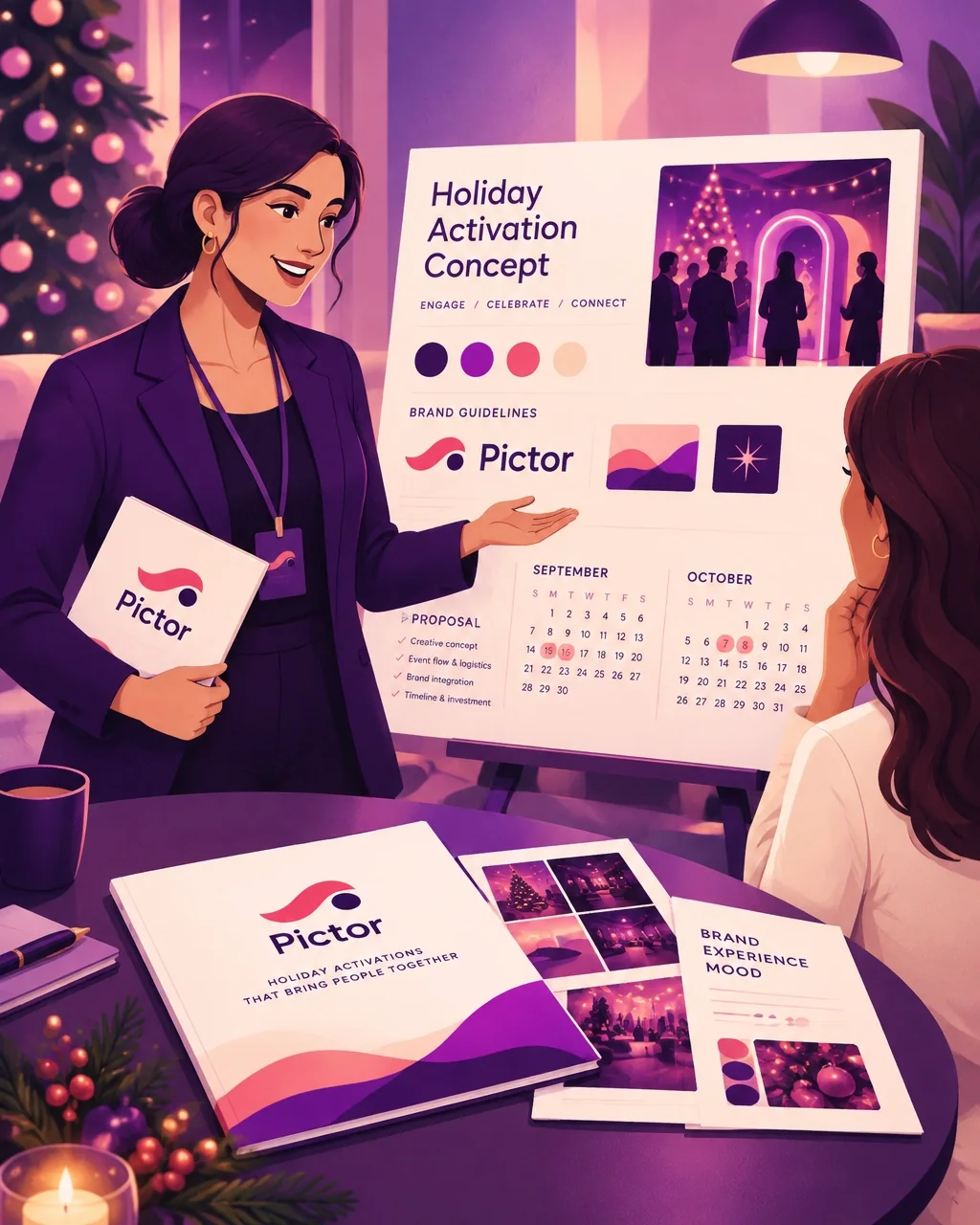
This is where AI photo booth software earns its place. AI photo and AI video make the experience feel new, but they should support the concept rather than replace it. Use AI to give guests a clear reason to step in: a branded editorial portrait, a company-themed environment, a cinematic five-second video, a seasonal visual style, or a group shot that still looks like the people in it.
That last one matters at corporate events, where most sessions are teams rather than individuals. Pictor’s GroupSense™ is designed to preserve each person’s likeness in multi-person AI shots, so a department photo comes back as a department photo.

Package multi-night programs with the One-Click Event Builder
Corporate clients rarely have one event. They have three office parties, a two-night client activation, a regional employee tour, or one campaign that has to look identical at several venues.
Build the offer around that. With Pictor’s One-Click Event Builder you set up the branded experience once, duplicate it for each date, and adjust only what changes: the venue, the audience, the campaign line. The client gets consistency and you skip rebuilding from scratch.
Sell it as a program, not a stack of separate rentals: shared creative direction, consistent overlays, multiple dates, centralized reporting, one point of contact, and optional AI photo or AI video upgrades. That is worth more to a corporate buyer and takes less of your time than quoting every night on its own.
Your September-to-December outbound sequence
September: get known
Build a list of 50 to 100 prospects across HR, marketing, agencies, venues, caterers, and production companies. Send a short introduction with your corporate capabilities, two or three activation concepts, a gallery link, a sample package or rate card, and an invitation to talk about upcoming events.
The goal is not to close. It is to be a known option before the proposal process starts.
Early October: send the tailored pitch
Follow up with one specific idea per prospect:
“I noticed your team is planning a client holiday event. We’ve put together a branded AI portrait activation that gives guests a polished takeaway while collecting consent-based opt-ins. I’ve attached a one-page concept with sample deliverables.”
Make it easy to forward internally. One page, one concept, one price.
Late October: remove friction
Send the things that slow corporate decisions down before anyone asks for them: pricing, availability, COI, W-9, setup requirements, the data and consent summary, a sample contract, and a sample report. If they need to move fast, do not make them chase you for basic documentation.
November: confirm and expand
For booked clients, finalize guest count, run of show, creative approvals, staffing, venue access, internet requirements, consent language, and reporting expectations.
This is also the moment to ask whether the client has other office events, partner events, or client activations that need the same experience.
December: execute and document
Run the event calmly, collect the agreed metrics, and capture approved behind-the-scenes content. Within a week, send a report with participation numbers, content created, delivery statistics, opt-ins or leads, a few selected examples, and notes for next time.
Price and package for corporate buyers
Corporate pricing should reflect planning, customization, staffing, risk, and reporting, not just hours on site. Most operators land on some mix of:
- Single-event packages for one holiday party
- Multi-date packages for office tours or regional events
- Retainers for agencies or companies with recurring activations
- AI upgrades for advanced photo and video experiences
- Lead-capture packages with consent screens and exports
- White-label packages for agencies that want the experience under their own brand. In Pictor, full white-labeling of gallery, SMS, and email domains is part of the Enterprise add-on, which sits on top of a Basic, Pro, or Premium plan. Guest-facing branding on the booth itself is available on every paid plan.
A multi-date booking can justify a better per-event rate, but do not discount away the work. You are already saving sales and setup time, so build the package around shared creative, repeatable workflows, and centralized reporting rather than a lower number.
If AI generation carries a usage cost, price it clearly. Give the client a defined number of transformations or a reasonable allowance, then charge a premium for the creative direction and production rather than for the tokens.
Common mistakes that cost operators corporate bookings
- Pitching in December instead of September or October
- Sending a wedding package to a corporate buyer
- Listing features without the business outcome
- Ignoring COI, W-9, invoicing, and procurement requirements
- Promising lead capture without explaining consent and data handling
- Offering AI without a relevant branded concept
- Quoting one night when the client has four
- Finishing the event without sending a useful report
Corporate buyers want creativity, but they want predictability more. The strongest pitch has both.
The opportunity is earlier than you think
Q4 corporate bookings are not won by the loudest operator in December. They are won by whoever was prepared while the event was still taking shape.
Get in front of the right teams in September. Send brand-specific proposals in October. Make procurement easy. Package the work around outcomes. Then use reliable photo booth software to deliver an activation that looks polished, runs smoothly, and leaves the client with something useful after the last guest leaves.
That is how a holiday party becomes a repeat corporate account.
Start building your next branded event with Pictor.
FAQ
When should photo booth operators start pitching corporate holiday events?
September. Corporate planners and HR teams lock December venues and vendors in September and October, and many companies rebook the same vendor the following year. An operator who reaches out in November is competing for whatever is left.
Who books a corporate holiday photo booth?
Usually one of four buyers: an HR or people team, an internal events or office manager, a marketing team for a customer-facing party, or an agency producing the event for a client. Each cares about something different, so the pitch changes by buyer.
How do corporate holiday bookings compare with weddings?
Published booking data puts corporate and wedding medians close together, with the top corporate bookings reaching higher because of add-ons such as AI experiences, branding, and multi-night programs. Package for the outcome, not the hours.
What paperwork do corporate buyers need before they can pay a photo booth vendor?
A W-9, a certificate of insurance naming the venue or company, a signed agreement, and often a vendor registration form. Having the procurement pack ready removes the most common reason a corporate booking stalls.
Does adding AI to a corporate holiday package raise the price?
Operators report charging 30 to 60 percent more for AI experiences than for traditional-only packages. Branded AI portraits also give the marketing or HR buyer content they can use after the event, which is a stronger pitch than photos alone.
How do you turn one holiday party into a repeat client?
Send a short post-event report with participation, shares, and gallery views, then ask for the next event while the results are fresh. Pictor’s per-event analytics and the One-Click Event Builder make the report and the multi-night rebooking easy to produce.
Start the kit this week
A 10-page worksheet, not a reprint: the 90-day to-do list, prospect tracker, buyer cheat sheet, concept builder, procurement pack, pricing worksheet, report template, three outreach emails, and an AI prompt for each. Enter your email and we will send it to you.
We email the link so we know it reaches a real inbox. One email, no list, no drip.