Spend One Hour Calling Your Live Quotes: How to Turn Photo Booth Inquiries Into Bookings (Show & Tell Recap with Anthony Stears)
Anthony Stears, The Telephone Assassin, on turning photo booth inquiries into bookings: have a conversation, not a pitch, why dropping your price rarely wins, what to say to too expensive and I need to ask my boss, and the one hour to spend on your live quotes this week. Free quote tracker.
Nicholas Rhodes
Drafted with AI assistance; reviewed and approved by Nicholas Rhodes before publishing.
Full replay: Anthony Stears, The Telephone Assassin, on Pictor Show & Tell, November 4, 2026.
Anthony Stears, The Telephone Assassin, joined our November 4 Show & Tell to talk about the part of the business most of us would rather skip: the sales conversation. Anthony is an international speaker, the author of Telephone Assassin and the founder of the Telephone Assassin Online Academy. He doesn’t teach people how to sell. He shows them how to help customers buy.
We covered what to do before you send a quote, why dropping your price rarely saves a booking, how to follow through when a client goes quiet, what to say to “too expensive” and “I need to run this past my boss”, and the one hour Anthony wants you to spend on your pipeline this week. Operators brought real calls from that same week, including one that ended with a hang-up.
Key takeaways
- Make it a conversation, not a pitch. Be curious about the event before you talk about your packages.
- If you drop your price and they still don’t book, price was never the problem.
- Every voicemail and follow-up ends with when you’ll be in touch next.
- When a client says “too expensive”, ask what they’re comparing it to.
- Never give a discount for nothing. Swap it for something that’s worth money to you.
- This week: spend one hour calling every live quote and every past client.
Here’s everything we covered. Grab the free quote tracker at the end of the post: it’s built for that one hour.

Most bookings go quiet. They don’t get lost on price.
We asked the room where they lose most bookings. Of the seven operators who answered in the chat, five picked “they go quiet after the quote.” Two picked “it’s too expensive.” Nobody picked “we found someone cheaper” or “we need to think about it.”
That matches what Anthony sees. Price gets the blame, but most quotes die in silence because nobody picks the conversation back up.
Do this: count your open quotes right now. How many haven’t heard from you in a week?
Have a conversation, not a pitch
When an inquiry comes in, it’s tempting to tell the client everything you can do. Anthony calls that premature elaboration: answering questions nobody has asked yet.
“The essence of a good sales conversation is make sure it’s a conversation, not a pitch.” Anthony Stears, The Telephone Assassin
His advice is to be curious. Ask about the event, the guests and what they want people to remember. “The more you understand them, the easier it is to offer a solution or show value.” Being curious also makes the harder questions about budget and timing feel natural.
Do this: on your next inquiry call, ask three questions about the event before you say a single word about packages.
If you drop your price and they still don’t book, it was never about price
Anthony has a name for discounting to win a booking. He calls it pants-down pricing (please excuse his phrasing), and it often doesn’t even work:
“Sometimes, quite often, you’ll drop the price and they still won’t buy. That is telling you it is not down to price.” Anthony Stears, The Telephone Assassin
When that happens, it’s either not the right client or not the right timing. And if you do win the booking at a price you resent, every small request from that client feels bigger.
Do this: decide your floor before the call, not during it. Chris Meyer’s pricing recap shows how to set it.
Ask permission to speak, and end every call with when you’ll follow up
Anthony opens every follow-up call with what he calls PTS, permission to speak. He assumes he’s caught you at a bad time and asks when it’s better to call back. It’s good manners, and it disarms people who are braced for a pitch.
He ends every message with a TFR: telling them when he’s going to phone back. A voicemail after a new inquiry sounds like this:
“I’ll drop you a quick email straight after this. But I tell you what, I’ll make a note to give you a call on Friday if I haven’t heard back from you.” Anthony Stears, The Telephone Assassin
Every message after that raises the level of concern about whether they got the last one. Anthony calls it “following through, not following up.” The client always knows what happens next, and you always have a reason to call.
Do this: end every voicemail, email and text with the day you’ll be in touch next. Then put it in your calendar.
They’re the one having the bad day, not you
Some calls go badly. Anthony’s rule: if someone is rude the first time, they’re probably having a bad day. Get out of the call politely and try again another time.
“Just remember they are the one having the bad day, not you.” Anthony Stears, The Telephone Assassin
Do this: after a rough call, write down the next date to try, then move on to the next quote.
Sniper selling, not scattergun
Anthony doesn’t work through a huge database asking everyone if they need him. He keeps a wish list.
“As a salesperson, I do what I would refer to as sniper selling, not scattergun.” Anthony Stears, The Telephone Assassin
Pick around 20 clients who would change your quarter. Build the relationship slowly: follow them on LinkedIn and Instagram, offer a test drive, let them see your work before you ask for anything. His CRM is simple too: Capsule for contacts and a notebook he carries everywhere.
Do this: write down 20 companies you’d love to work with. If you’ve worked with one marketing manager in an industry, start with the others in that industry.
“Too expensive?” Ask what they’re comparing it to
This was the one-liner I asked Anthony for, and it’s simple:
“Do you mind sharing what you’re comparing that to?” Anthony Stears, The Telephone Assassin
Often the answer is another company at half the price. That’s your chance to ask what’s included: the kit, the staff, the props, or just an iPad on a stand. If they really want the cheapest option, Anthony says so out loud, and uses the word “cheap” twice, because nobody likes to be called cheap.
Do this: next time you hear “too expensive”, don’t defend your price. Ask the comparison question and listen.
“I need to run this past my boss”: book the next step
Anthony calls this the objection that feels perfect to whoever gives it. Instead of asking whether you can get the boss on a call (they’re always busy), he assumes the meeting is happening:
“How far ahead in the diary would we have to book just to get 10 minutes with your boss?” Anthony Stears, The Telephone Assassin
He frames it as making sure the boss has everything they need to decide. You’ve skipped the next excuse, and you have a date.
Do this: when a decision goes to someone else, ask when you can join that conversation, not whether you can.
The 1-to-10 question
This one is mine. At the end of a call that isn’t going well, I ask: on a scale of 1 to 10, where 0 means you wouldn’t work with us even if it was free and 10 means you’d sign right now, where are you? Almost nobody answers below five, and most say seven or eight, which changes how they remember the call. Anthony’s verdict: “It’s a very, very clever thing to do.”
His version for quotes that stall in the medium term is more direct: “I’m just phoning up, have you given up on that event yet?”
Do this: try the 1-to-10 question on your next quote that feels like it’s slipping.
Never discount for nothing: the value swap
If a client asks for money off, Anthony first tries to add value instead, like an extra set of props they can keep. If the price has to come down, take something out of the package. And if you do discount, trade it for something worth money to you: social posts before the event, your hashtag on their photos, a written testimonial, or a page and a QR code in the event guide.
He suggests keeping your own private list of those swaps so you’re never improvising. And he warns against simply dropping from $10,000 to $5,000: it tells the client your first price was never real.
“If you begrudge the fee, you’ll begrudge the work.” Anthony Stears, The Telephone Assassin
Do this: write a value-swap list today: five things a client could give you that are worth money to your business.

The one thing to do in one hour this week
I ask every guest this. Anthony’s answer: spend one hour calling all of your live quotes and inquiries, plus anyone you worked with in the last one to five years.
“You’ll probably stir up more than one opportunity in that particular time.” Anthony Stears, The Telephone Assassin
Don’t overthink what to say. Be polite, get permission to speak, catch up, and finish with a TFR.
To make that hour easy, we built a free Live Quotes kit: a quote tracker (one row per open quote, with when you sent it, when you last spoke, the objection you heard and the next step) and a printable one-hour call sheet.
AI power-up included. Step 1 in the kit is a copy-and-paste prompt for your AI assistant. Connect your email and your meeting recorder, run the prompt, and it digs up every open quote and past client from the last year and fills in the tracker for you. It only reads, so nothing goes out. You spend your hour on the phone instead of in your inbox.
Get the free Live Quotes kit
Step 1: an AI prompt that builds your open-quote list from your email and call notes. Step 2: a one-hour call sheet. Plus a spreadsheet tracker (Google Sheets or Excel) whose columns match the prompt, so you paste and go. Built for Anthony's one-hour challenge. Enter your email and we will send it to you.
We email the link so we know it reaches a real inbox. One email, no list, no drip.
Questions from the room
“Too crazy expensive,” then a hang-up. Kayla Braun of FotoFunSpot in Omaha told us about a call from the day before: a man wanted an enclosed booth for a birthday party, heard the price and hung up. Anthony laughed with her, then pointed out that’s probably not a client you want. When he gets the same reaction to his speaking fee, he sometimes asks what they’re spending on the tea and coffee for the event. The bigger number anchors the conversation and makes his fee look smaller.
“We’ll take it for $5,000.” I shared one of my own from this year. In a single day, we got three replies to proposals that accepted on their own terms. One quote was for $8,000, and the reply was essentially “looks amazing, we’ll take it for $5,000, please send the paperwork.” Anthony’s answer: “So which three grand bit are we taking out?” He holds his own terms too: a deposit within seven days, or he doesn’t hold the date.
How do you create urgency? An operator asked how to get clients to sign sooner. Anthony’s options: a genuine offer for this month, added value for booking now, or holding the date for a set time and calling when it runs out.
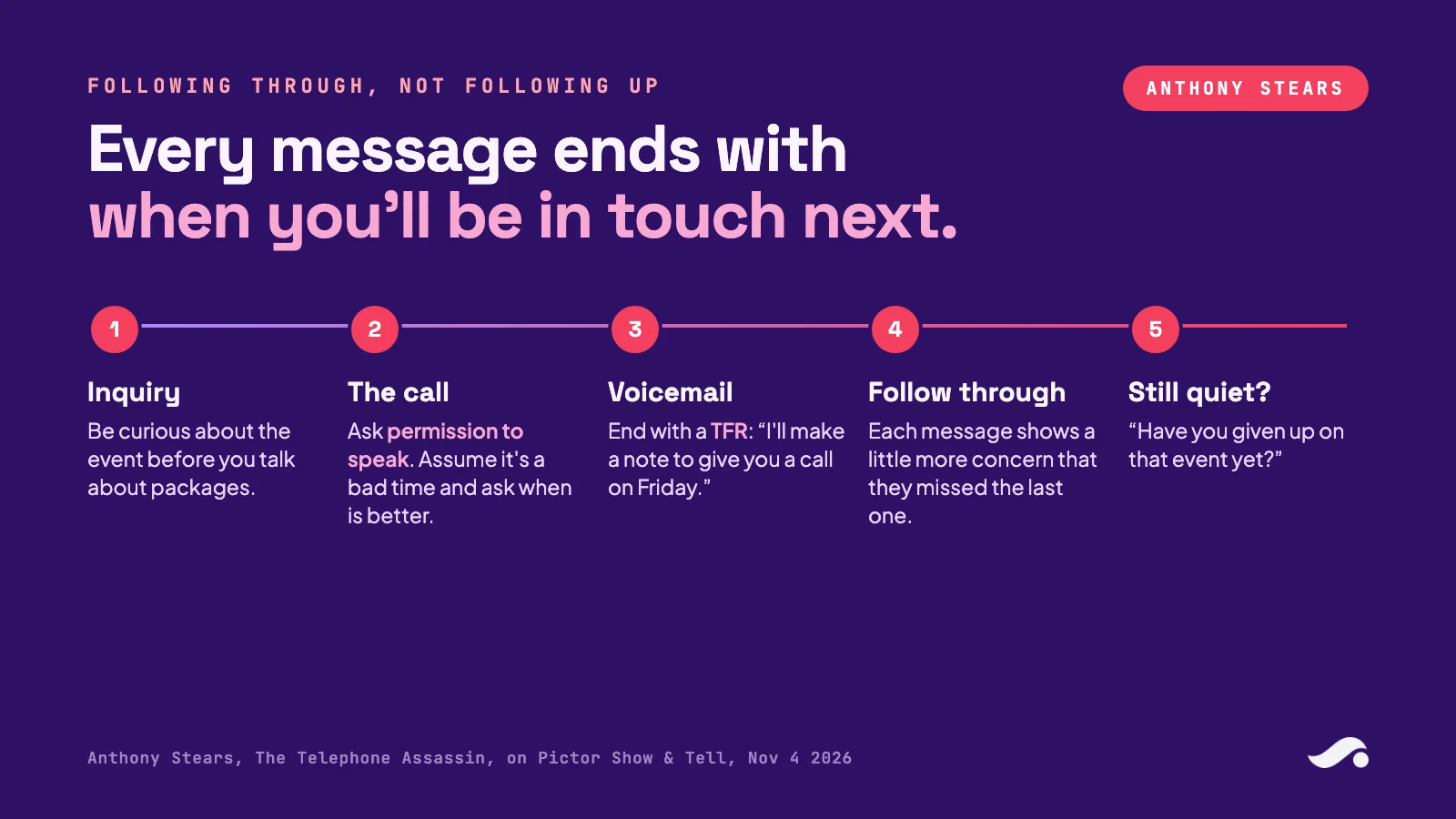
More from Show & Tell: the Illuminate co-founders on scaling a photo booth business past six figures: fewer events, better clients and a real team.
Photo booth sales FAQ
How do I turn a photo booth inquiry into a booking?
Have a conversation before you send a quote. Ask about the event, the guests and what matters to the client, then connect your package to what they told you. After the quote, follow up on a set day and always tell them when you’ll be in touch next.
What should I say when a client says my photo booth is too expensive?
Ask what they’re comparing it to. Anthony Stears suggests “Do you mind sharing what you’re comparing that to?” The answer usually tells you whether they’re comparing like for like, and gives you the chance to explain what’s included in your service.
How do I follow up on a photo booth quote without being annoying?
End every message with the day you’ll follow up, then do it. Anthony calls this a TFR. Each follow-up can show a little more concern about whether they got your last message, which keeps it polite and helpful rather than pushy.
Should I give a discount to win a photo booth booking?
Not for nothing. Try adding value first, then take something out of the package if the price has to come down. If you do discount, swap it for something worth money to you, like social posts, a testimonial or a page in the event guide.
What do I do when a client goes quiet after the quote?
Call them. In our poll, five of seven operators said this is where they lose most bookings. Anthony’s direct version for a stalled quote: “Have you given up on that event yet?”
How do I create urgency without being pushy?
Give a real reason to decide: a hold on the date that expires, an offer for this month, or this year’s pricing before an increase. Tell the client exactly when the hold ends and call them before it does.
Watch the Replay
Watch the full replay above, or on YouTube with chapters so you can jump to any section. Catch the next one live at pictor.pro/show-and-tell.
About Anthony Stears
Want Anthony’s full system?
Everything in this session comes from Anthony’s book, Telephone Assassin, and his training with sales teams, business owners and customer service teams. Read the book, or go deeper with the Telephone Assassin Online Academy.
Affiliate link: we may earn a small commission if you buy the book through it.
Photo booth software built by operators
Free until showtime.
Build your event in Pictor, let your client customize it in the Lookbook, and only pay when you use it at an event.
No credit card required · Pay when you use it at an event
Quotes are from Pictor Show & Tell on November 4, 2026. After the event, Ursula McKinley’s client follow-up checklist picks up where this one ends.