How to Scale a Photo Booth Business Past Six Figures: Fewer Events, Better Clients, a Real Team (Show & Tell Recap with the Illuminate Team)
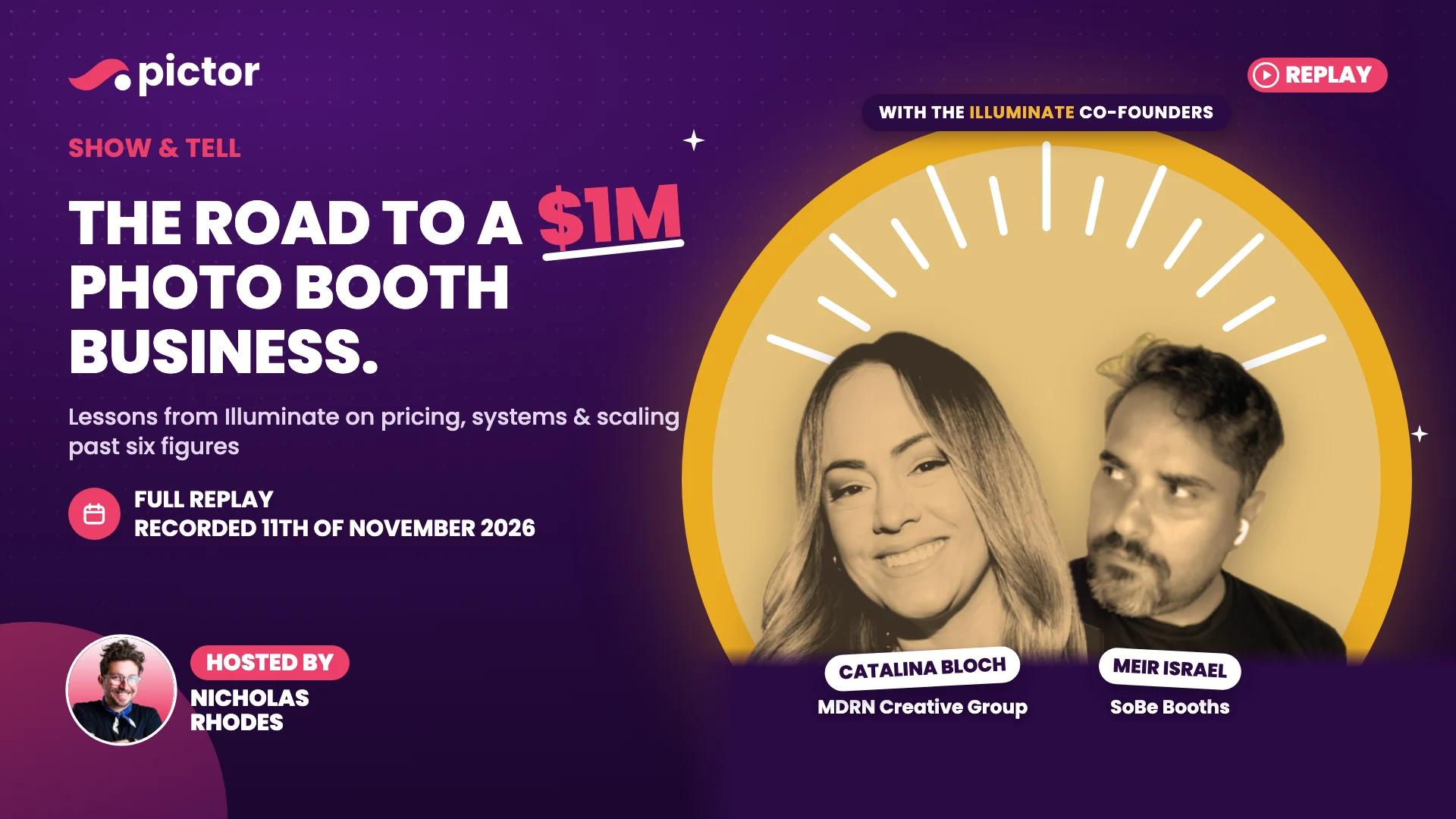
Catalina Bloch and Meir Israel of Illuminate on scaling a photo booth business: why more events is not the answer, pricing the whole job, hiring booth attendants first, using AI to grow your team, and finding corporate clients by sponsoring their events.

Nicholas Rhodes
Drafted with AI assistance; reviewed and approved by Nicholas Rhodes before publishing.
Full replay: Catalina Bloch and Meir Israel of Illuminate on Pictor Show & Tell, November 11, 2026.
Catalina Bloch of MDRN Creative Group and Meir Israel of South Beach Photo Booth Co. joined our November 11 Show & Tell, a month after they hosted Illuminate, the application-only retreat for six and seven figure photo booth founders, in Miami. Lisa Oler, who built Illuminate with them, couldn’t join us live, so Cat and Meir brought the lessons from the room to everyone who wasn’t there.
Cat hit six figures in her first year and a half in the business. Today her company has 10 full-time employees, and she coaches other photo booth founders on building the business they actually want. Meir started as an event photographer and built his photo booth company in 2008. Back in 2016 and 2017 he helped launch PBPI, Photo Booth Professionals International.
We talked about what separates a $100K business from a $1M one, how to earn more without booking more, who to hire first, how AI fits into a team, and where to find corporate clients.
Key takeaways
- More events is not the answer. Cat makes more profit on about 150 events a year than she did on 500.
- Budget like you already have a team, even if you are the whole team.
- Price the whole job. Five or six people touch an event before the day itself.
- Your first hire is a booth attendant. Stop working the cookie-cutter events yourself.
- Use AI to make your team more capable, not smaller.
- Find corporate clients by sponsoring the events they already go to.

Think like the business you want to become
We asked the room where their business is today. Of the ten operators who answered in the chat, four are under $50K a year and five are between $250K and $1M. So we asked Cat and Meir what actually separates a $100K business from a $1M one. Cat’s answer was mindset:
“If you want to be a hundred thousand dollar business, you need to think like a hundred thousand dollar business. You want to be a million dollar business, you have to think like a million dollar business.” Catalina Bloch, MDRN Creative Group
She admits it sounds woo-woo. In practice it means deciding what your business looks like at a million dollars and making every decision from there. For Cat, that means not working weekends, which is why she has a full staff. Other people build a million-dollar business on their own and run around 24/7. Both are fine, as long as it’s the one you chose.
Meir made it practical:
“Treat it like you have employees. Like, start doing your budgets. Like, I’ve got to pay three people to do this. You’re the three people.” Meir Israel, South Beach Photo Booth Co.
Do this: write down the three jobs you do every week (sales, production and on-site, for example) and put a wage next to each one. That’s what your prices need to cover.
More events is not the answer
This was the theme of the hour. Cat’s company did about 500 events in 2023. It was their highest revenue year, and she never wants to do it again.

“We’re making more profit now and doing, like, maybe 150 events a year, you know, and making more revenue.” Catalina Bloch, MDRN Creative Group
What changed was getting hyper specific about who they serve. When you know a client’s pain points, triggers and objections before they do, it’s hard for them to go anywhere else. Cat says many of her students are making double what they were within a year of doing the same thing: more money, fewer events.
Meir agreed. You can do less, more often than you think, by shutting off the work that isn’t for your ideal clients. (For where the profit in a booth business actually comes from, see Is a Photo Booth Business Profitable?)
Do this: write one sentence that describes the wedding client you want, and one for the corporate client you want. If you can’t, that’s the first thing to fix.
Price the whole job, not the three hours on site
Clients think they’re paying for the three hours your booth is at their event. They aren’t. At OutSnapped, five or six people touch an event before the day itself: sales, production, QA and more. All of that has to be in the price.
Cat builds her wedding and corporate packages from the same baseline, but they’re priced very differently. Her weddings run about $2,500. A corporate print booth can be about $4,000, because corporate gets custom-branded everything, while a wedding is personalization on a template. If you’re setting your own rates, our photo booth pricing guide walks through how to charge without guessing.
On raising prices, I shared something Chris Collins of BoothBook said on stage once: double your prices, and if you keep more than half your clients, you’re making more money. Meir puts the floor even higher. He says that when you raise prices, you’ll keep at least about 60% of your clients. But if you keep raising prices without improving what you deliver, those clients start to notice.
His rule for when to raise them: when too many of your clients are difficult to work with.
“Just up your prices 20%. It’s time, like, whatever you’re doing, up your prices 20%, make sure you’re doing it right. Like, make sure it’s not you.” Meir Israel, South Beach Photo Booth Co.
And if a client really isn’t a fit, let them go. You’ve just made room for one who appreciates you.
Do this: run your package through the photo booth hourly rate calculator with every hour you spend on an event, not just the hours on site.
Then check what is left after costs. Our margin calculator worksheet walks you through every cost on a job, so you can see what each event actually earns you before you decide to raise prices.
Get the free margin calculator worksheet
A fillable worksheet, not a reprint: four category checklists (direct costs, overhead, owner labor, tax reserve), a break-even snapshot for lean/standard/premium events, and space to run the math on your own last five bookings. Enter your email and we will send it to you.
We email the link so we know it reaches a real inbox. One email, no list, no drip.
Your first hire is a booth attendant

We asked the room what’s holding them back most. “I’m still doing everything myself” came out on top, with four of seven operators. Nobody picked pricing or cash flow. So who do you hire first?
“I’d say booth attendants are the number one thing someone needs to hire for right away.” Catalina Bloch, MDRN Creative Group
Start with the cookie-cutter events, and weddings above all. Train your attendants to run them. Cat can’t remember the last wedding she worked herself, and her clients still leave rave reviews. Meir went further:
“There is no high end wedding that you need to be at as an owner.” Meir Israel, South Beach Photo Booth Co.
It used to be that your first hire took admin off your plate. Cat thinks AI can now handle most of that, so a growing business doesn’t need to hire as many people as hers did.

Do this: pick the next wedding on your calendar and staff it with an attendant you’ve trained. Don’t go.
Make one person the ops manager
Meir’s one-hour challenge was to empower your team. Get a CRM you like, and never be afraid to change it if it stops serving you. Then get a shift-planning app and put one team member in charge of it: make them the operations manager and give them a small raise. Every new event goes up on the board, and the team signs up for shifts. No more texting everyone to find out who’s free.
“You will not grow without a root system and your team members are your root system.” Meir Israel, South Beach Photo Booth Co.
He has a tip for the team member who always says “I wish we did this.” Now that anyone can build with AI, hand them the job and let them build it.
Do this: choose who on your team owns scheduling, and tell them this week.
Use AI to make your team bigger, not smaller
A lot of the AI news is about cutting jobs. We’ve done the opposite at Pictor and OutSnapped: everyone on our team uses AI, and it’s made them far more capable. Cat runs her team the same way:
“We’re having them learn how to use AI to make them more effective and more efficient in their role so that they can actually do the things that they want to be doing.” Catalina Bloch, MDRN Creative Group
It’s a photo booth business. It’s supposed to have a fun, creative side, and your team shouldn’t spend half their day in CRMs and task lists.
My advice for the AI tools themselves: try everything, don’t get stuck anywhere, and if something isn’t working, leave it. Right now, knowing when to give up on a tool is as important as trying them all.
Do this: ask each person on your team for the task they hate most, then try one AI tool on it together.
Changing CRMs? Put all your data in one place first
My one-hour challenge was to build a source of truth. If you’re not using AI yet, take one baby step: make sure all of your documentation lives in one place, whether that’s Google Drive, Dropbox or your email. When you’re ready for the next step, your AI tools can read all of it. Because we have years of booking history in one place, our AI tools already know how we normally run an event.
It also changes how you think about your CRM. After years on the same system, we moved OutSnapped to BoothBook this year, and we’ve been very happy. It was built with the mindset of a photo booth company, and it connects to Pictor, so a booking becomes a Pictor event without anyone retyping it. Cat is in the middle of her own CRM move and is recording the whole thing for her students.

See how BoothBook and Pictor work together: Chris Collins walks through how a booking goes from inquiry to a live booth, and where the hours on every booking go.
Do this: pick one folder or drive as your source of truth and move this year’s contracts, quotes and event notes into it.
Find corporate clients in the rooms they’re already in
This is the question everyone asks Cat. Her answer: go to them.
“If you do it properly, it’s not working for free. It’s investing your marketing dollars in yourself versus throwing it away in Google Ads or something like that.” Catalina Bloch, MDRN Creative Group
Because they know exactly who they serve, they know where those people hang out and which associations they belong to. They find those associations’ events and sponsor them, so the clients experience the booth for themselves. It doesn’t pay off overnight. The payback usually shows up four to six months later.
She shared the math. From digital ads, a lead costs her about $167, and that’s just getting it in the door, not a booking. Sponsoring one event a month costs about $1,000 to $2,000 in staff and costs, and brings in around 100 qualified leads.

“So 167 times 100 leads, that’s $16,700 of value right there. And I didn’t spend that much money to be there. I spent $1,000 or $2,000. So $14,000 return on investment is pretty solid.” Catalina Bloch, MDRN Creative Group
The same works for luxury weddings. At a venue open house, Cat typically books three or four clients in the room, which she puts at $10,000 to $15,000 in revenue, and she leaves with a pile of marketing content.
Meir uses those rooms to show off. Rather than his standard packages, he brings the experimental ideas on his wish list, so planners and decision makers remember what his team can do. It’s still a far better use of the budget than ad spend, and it quietly steers away the inquiries that only want the basics.
For us, about 10% of the revenue from every event goes to marketing in some form, whether that’s ads or a referral fee. So when someone asks for a referral fee under 10%, I’m happy.
Do this: list three associations your ideal corporate client belongs to, and find the next event each one is hosting.
Two more for the corporate side: our guide to winning Q4 corporate holiday bookings, and Anthony Stears on turning photo booth inquiries into bookings from an earlier Show & Tell.
The biggest scaling mistake: taking the event you don’t want
Cat’s answer to the biggest mistake an operator can make when trying to scale was short: not knowing your target audience. Mine is related: taking an event just to have an event. There are months when you need one to keep the lights on. But if you take money from a client who’s wrong for you, it’ll drive you nuts the whole time.
Try not to make decisions from a place of fear. Show up excited, and your clients will see it in your work.
Do this: before you say yes to the next inquiry, ask whether it’s the kind of client you want more of.
Let your AI assistant do the repeat work
We played our What Is an MCP explainer on the show. MCP is the plug between AI assistants like ChatGPT and Claude and the apps you already use, including Pictor (what an MCP is, in plain English). At OutSnapped, it means our admin person can answer a client email, swap a logo on the event and move it on to QA without filing a ticket for someone else.
When we asked who’d like to try it, four of the six operators who answered said yes. Pictor MCP is in beta. See what Pictor MCP can do and grab a beta spot.
Books Cat and Meir recommend
- Cat: The Goal by Eliyahu M. Goldratt and Jeff Cox, a business book told as a story. It’s the book from the 1980s I’ve been rereading about structuring teams.
- Meir: Atomic Habits by James Clear.
From the chat
Systems got one operator past $100K. Rick Schirm of Big Time Selfies shared that they used to run every booking and email out of Outlook and folders, and struggled to reach $100K. Moving to a booking CRM took them from about 100 events a year to 240. In his words: “So having these tools cost but are well worth it.”
Build the team first. Rick again: “you need a solid team and you have to have a team that trust you and you trust them.” Greg of Smile Lounge said the same about his own bottleneck: “Multiple booths to perform multiple events on the same day. Good team members.”
The biggest mistake, from the room. When we asked about scaling mistakes, Rick added: “Spending too much on equipment right away. Buy when you sell it if there is demand.”
What’s next for Illuminate
Cat and Meir are still sifting through the content from Miami. Attendees are getting the recordings and the recipes for everything they learned in their portals. The next Illuminate is planned for 2027 or 2028. Follow along at illuminatecreative.live.
Scaling a photo booth business FAQ
What separates a $100K photo booth business from a $1M one?
Mindset and focus, according to Catalina Bloch and Meir Israel. Decide what your business looks like at a million dollars and make decisions from there. Get hyper specific about who you serve, budget as if you already have a team, and stop working events that someone you’ve trained could run.
Should I raise my prices or book more photo booth events?
For most operators, fix pricing first. Catalina Bloch doesn’t think more events is the answer: she makes more profit on about 150 events a year than she did on 500. Raise prices when you’re overbooked or attracting difficult clients, and keep improving what you deliver so the higher price holds.
Who should I hire first for my photo booth business?
Booth attendants. Train them to run your weddings and repeatable events so you’re not on site every weekend. Much of the admin that used to justify a first office hire can now be handled with AI tools.
How do photo booth companies find corporate clients?
Go where they already are. Find the associations and industry events your ideal corporate clients attend and sponsor them, so decision makers experience your booth in person. Catalina Bloch puts a digital lead at about $167, while one sponsored event a month brings her around 100 qualified leads.
Should I replace my photo booth staff with AI?
No. Both of our guests are training their teams to use AI so each person can do more, rather than cutting roles. Use AI for repetitive admin and keep people on the client and creative work.
How do I switch photo booth CRMs?
Get all of your data into one place first, then move it. Pick a CRM built for photo booth companies that connects to the rest of your tools. At OutSnapped we moved to BoothBook this year, which connects to Pictor so bookings become events without retyping.
Watch the Replay
Watch the full replay above, or on YouTube with chapters so you can jump to any section. Our Black Friday reveal is next Wednesday, November 18 at 1 PM ET: watch the countdown. Catch every episode live at pictor.pro/show-and-tell.
About Cat and Meir
Learn more from the Illuminate team
Cat coaches photo booth founders on building the business they want. Meir runs South Beach Photo Booth Co. in Miami. Together with Lisa Oler, they host Illuminate, the application-only retreat for six and seven figure photo booth founders.
Photo booth software built by operators
Free until showtime.
Build your event in Pictor, let your client customize it in the Lookbook, and only pay when you use it at an event.
No credit card required · Pay when you use it at an event
Quotes are from Pictor Show & Tell on November 11, 2026. For setting your floor price, see Chris Meyer’s pricing recap.