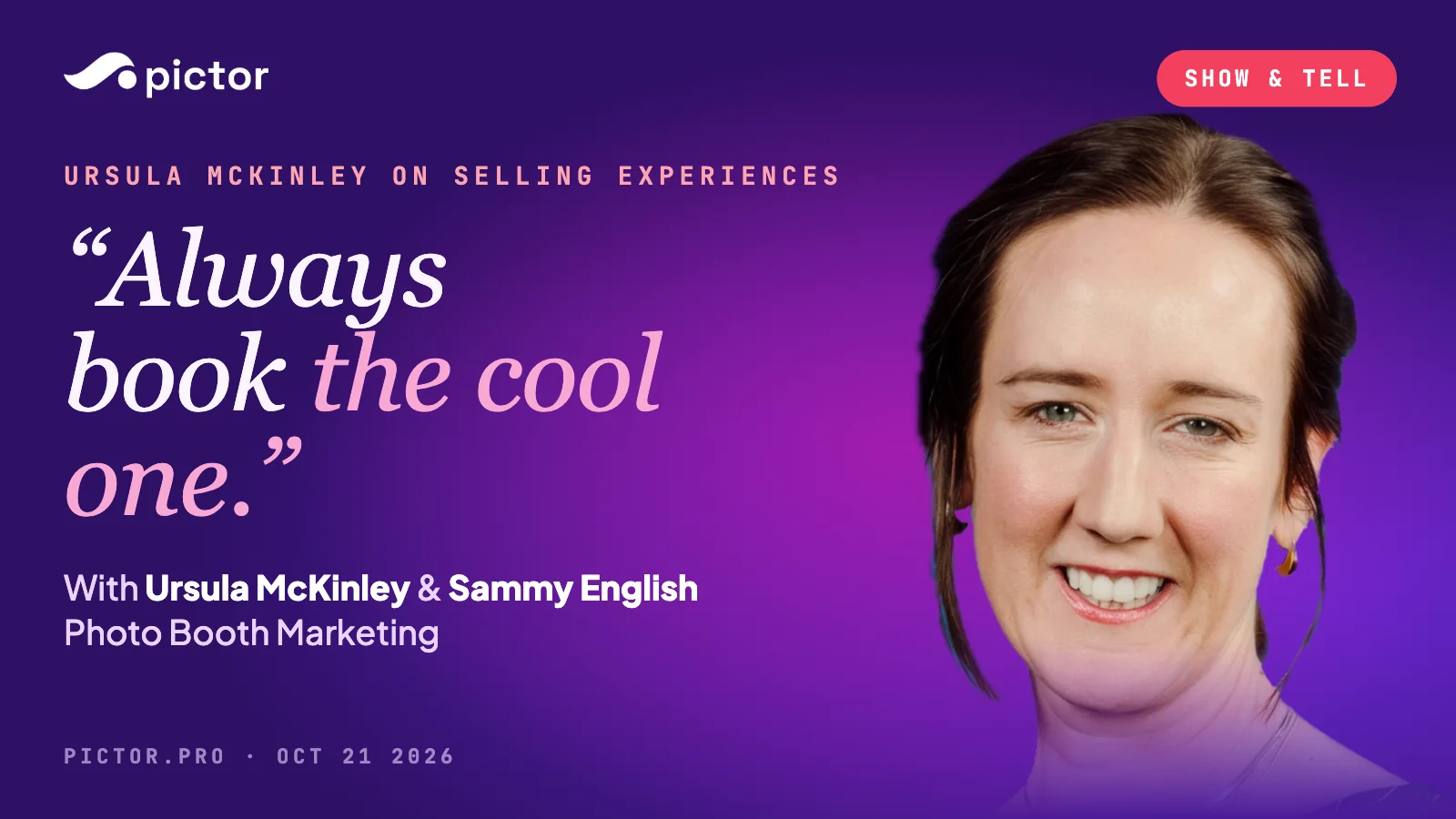
How to Sell Photo Booth Experiences Clients Actually Book: Ursula McKinley of Photo Booth Marketing
Ursula McKinley and Sammy English of Photo Booth Marketing on selling photo booth experiences: the three-tier proposal, the question to ask before you quote, a five-step follow-up sequence, and the Haunted House launched live in Pictor.
Nicholas Rhodes
Drafted with AI assistance; reviewed and approved by Nicholas Rhodes before publishing.
Full replay: Ursula McKinley and Sammy English of Photo Booth Marketing on Pictor Show & Tell, October 21, 2026.
Ursula McKinley and Sammy English, co-founders of Photo Booth Marketing (PBM), joined our October 21 Show & Tell to talk about the part of the business most operators skip: selling the experience after you’ve built it. Ursula spent close to 15 years in PR and brand agencies, on the other end of the phone when operators called to sell activations. Sammy ran a DJ business for about 10 years before moving to photo booths. Together they run photo booth businesses in Ireland, including the corporate marketing agency Media Lab, and PBM, which has been helping operators market their businesses since 2018. (Ursula has been on the blog before, with the branding secret to doubling your rates.)
We covered how to pitch something new, what to ask before you quote, Ursula’s full follow-up sequence, and why so many operators never use the marketing they already paid for. Then we launched PBM’s Haunted House experience live in Pictor with one click.
Here’s everything we covered.
How do you sell a new photo booth experience?
Lead with the basic booth and finish with the coolest thing you offer. Ursula’s view is that marketing exists to start the conversation, and the conversation is what sells. In her proposals the price comes in three tiers.
“When I send a proposal, I start with a basic photo booth and a picture, and here’s the price for this. Then a slightly cooler experience and then a really cool AI experience. What do they always book?” Ursula McKinley, Photo Booth Marketing
I guessed the middle one. Her answer:
“Always book the cool one… Everybody, no matter what they say, they want something different and they want something exclusive to their event.”
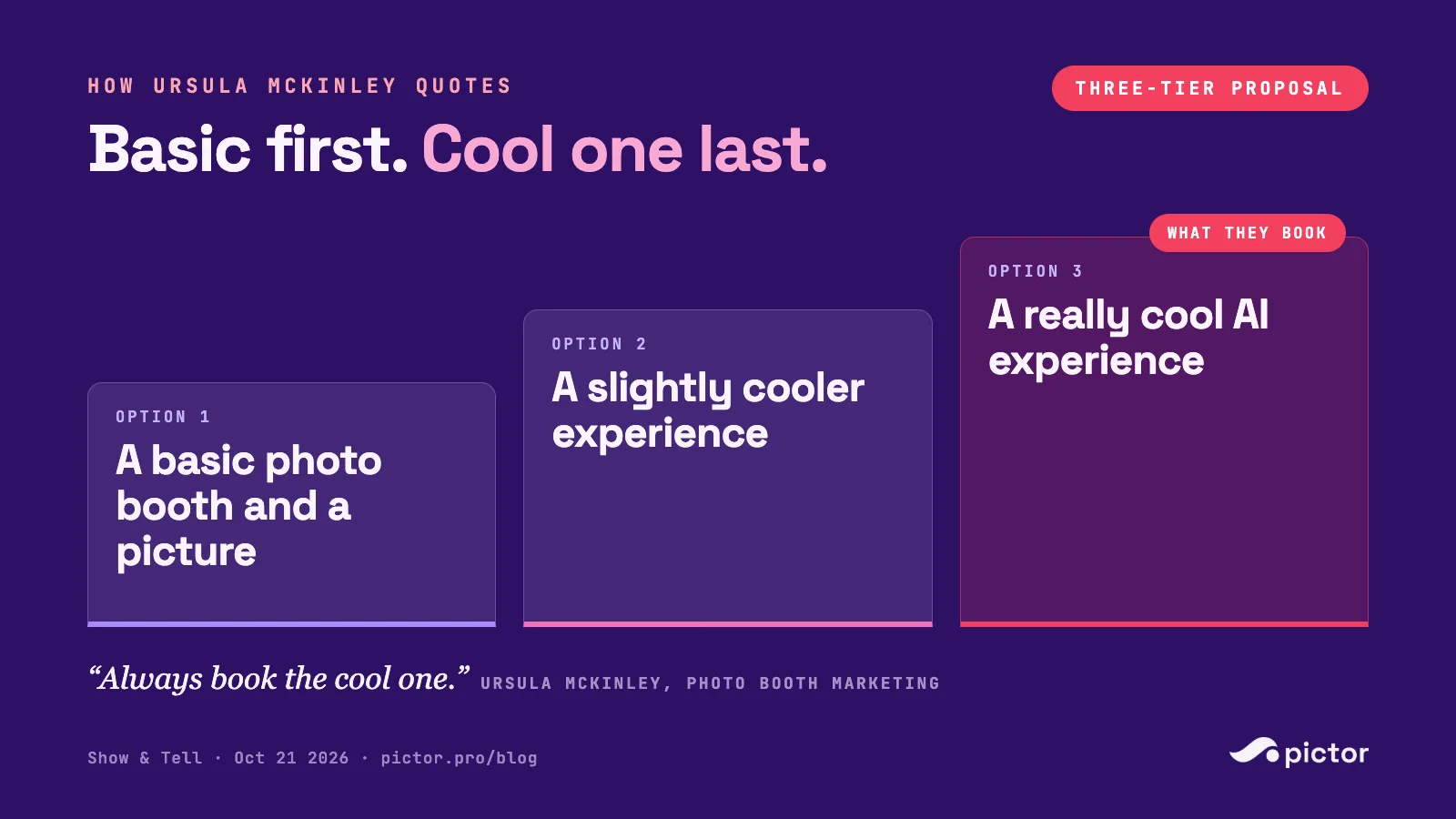
The order matters as much as the tiers. Ursula captures attention with something unusual on social or email, sells the service first (prints or digital only?), then upsells the experience. Most clients start out wanting a simple booth that produces a studio-quality photo, and she treats every booking as an event-management project from there. She also said a large share of what PBM designs never gets booked in its original form. It still does its job, because it gets the inquiry.
Sammy’s version: you’re dangling a carrot. A client may see the haunted house and still ask for pumpkins on a template.
“We really don’t care as long as they book something. The content, the lead generation tool has done its job.” Sammy English, Photo Booth Marketing
Do this: rebuild your next quote as three options: the basic booth, a step up, and the most interesting thing you can deliver. Put the cool one last. If the top tier is AI, our guide to pricing AI photo experiences covers what to charge for it.
What should you ask a client before you quote?
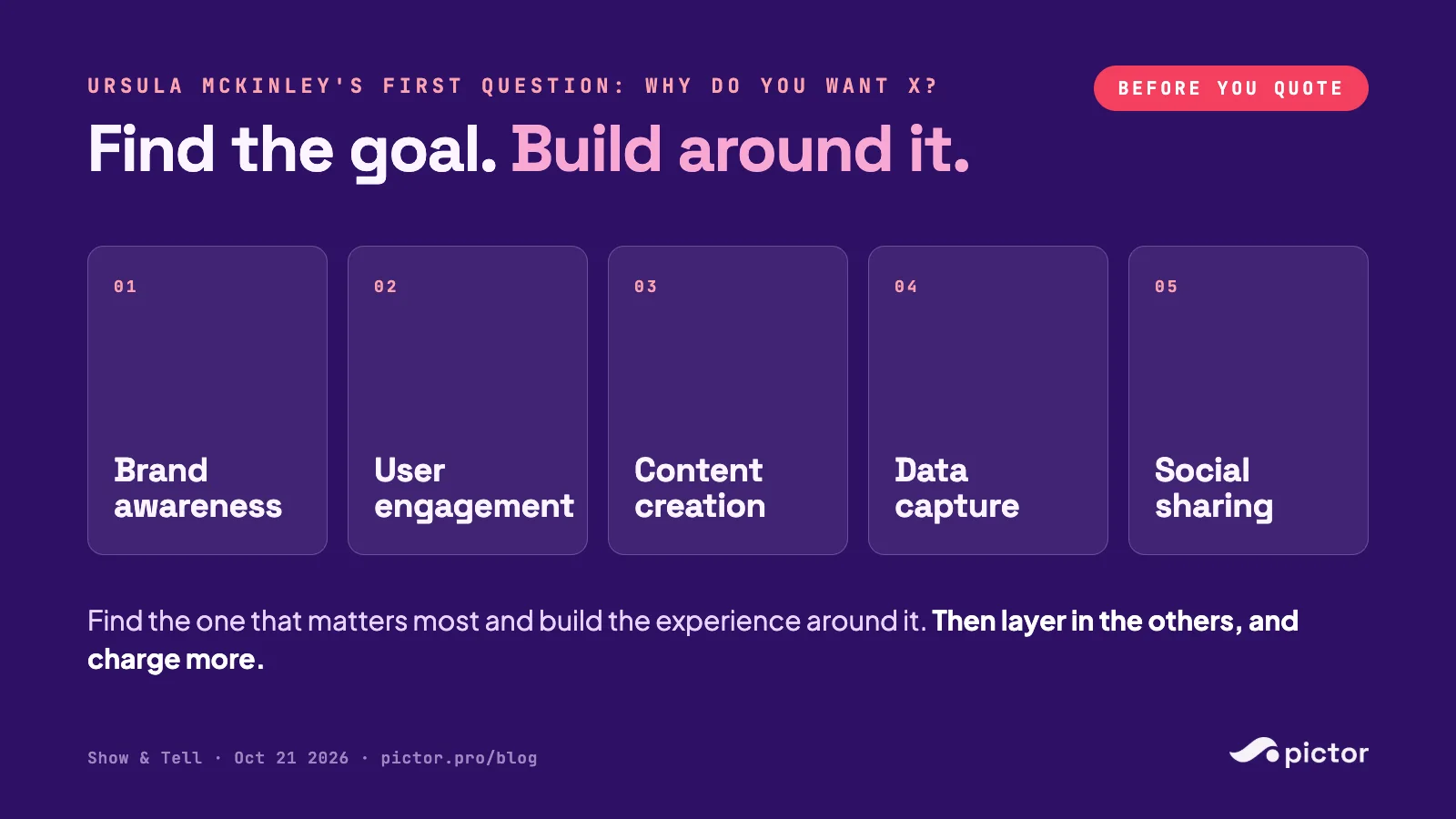
Ask why they want it. Inquiries usually arrive as “I’d like a 360 booth” or “send me costs for a photo booth.” Ursula’s first question is always why they want that thing at their event, and then she listens. Her second question is who will be in the room, because the audience can rule options out on its own. Her example: a room full of guests aged 55 and over won’t step onto a 360 platform, so the 360 is out straight away.
Then she gets to the goal. Most event managers want one or more of five things: brand awareness, user engagement, content creation, data capture or social sharing. Find out which matters most, build the experience around that one, then layer in the others and charge more.
I ask a version of the same thing: what do you want guests to feel, what do you want them to walk away with, and do you need email addresses, surprise and delight, or education? It also tells you whether the client wants the experience or the output. We built the AI Glambot in Pictor because a lot of clients want the output. A real Glambot is a robot arm on a flatbed truck, and some clients want exactly that spectacle in the room. Others only want the clip for social. Those are different products, and the discovery call is where you find out which one you’re selling.
Experience goes past the photo, too. Ursula talked about covering every sense when guests walk on site, right down to custom scents.
Do this: on your next inquiry call, don’t quote until you’ve asked “why do you want that at your event?” and “who will be in the room?”
Why is your photo booth software worth more than the booth?
Because the booth is just the shell. Ursula has said it for years:
“I don’t see hardware as something that is ever sellable. And I’ve always said this, your photo booth is just a shell. You know, take away that shell. Your power is always in your software.”
Her one-hour advice for anyone starting or growing a booth business came back to the same point. Operators spend $10,000 on a booth, $1,000 on backdrops and $500 on props without blinking, then argue over the price of the software, which is also the most powerful marketing tool in the business. You can build an experience in your software and sell it before you ever run it.
That’s what the virtual booth does for us at OutSnapped. We send a client a live link and they play with the actual experience before they book. It has changed production too. Clients now test the experience days before the event, so we fix the typo a week early instead of finding it 30 minutes before the doors open. (More on that in how to test AI prompts before an event.)
Trends also come back around, Ursula said. She ran PR for some of Ireland’s biggest bridal shows and watched wedding styles cycle about every four years. The magazine-cover overlay that took off a few years ago was one of the first overlays she ever saw Sammy use. At OutSnapped, our two most popular offers in 2026 are interactive AI video and the sit-in nostalgic black-and-white booth we’ve run since 2018 (here’s how we build vintage strips in Pictor). This time we shoot it on old iPads instead of a DSLR, and guests pick the era of strip they want.
Do this: Ursula’s advice: learn your software inside out. Spend one hour this week building one experience you don’t offer yet, then post it before anyone has booked it.
How do you turn one event into repeat bookings?
Follow up, and never stop. Ursula’s measure of success isn’t landing the big brand. It’s doing five, six or ten events for the same client.
“So many people in this industry, it’s one and done.”
Her example was the operator who lands a big job with Coca-Cola and never books them again. Her question: how many more events have you done for that client, and did you ever contact them?
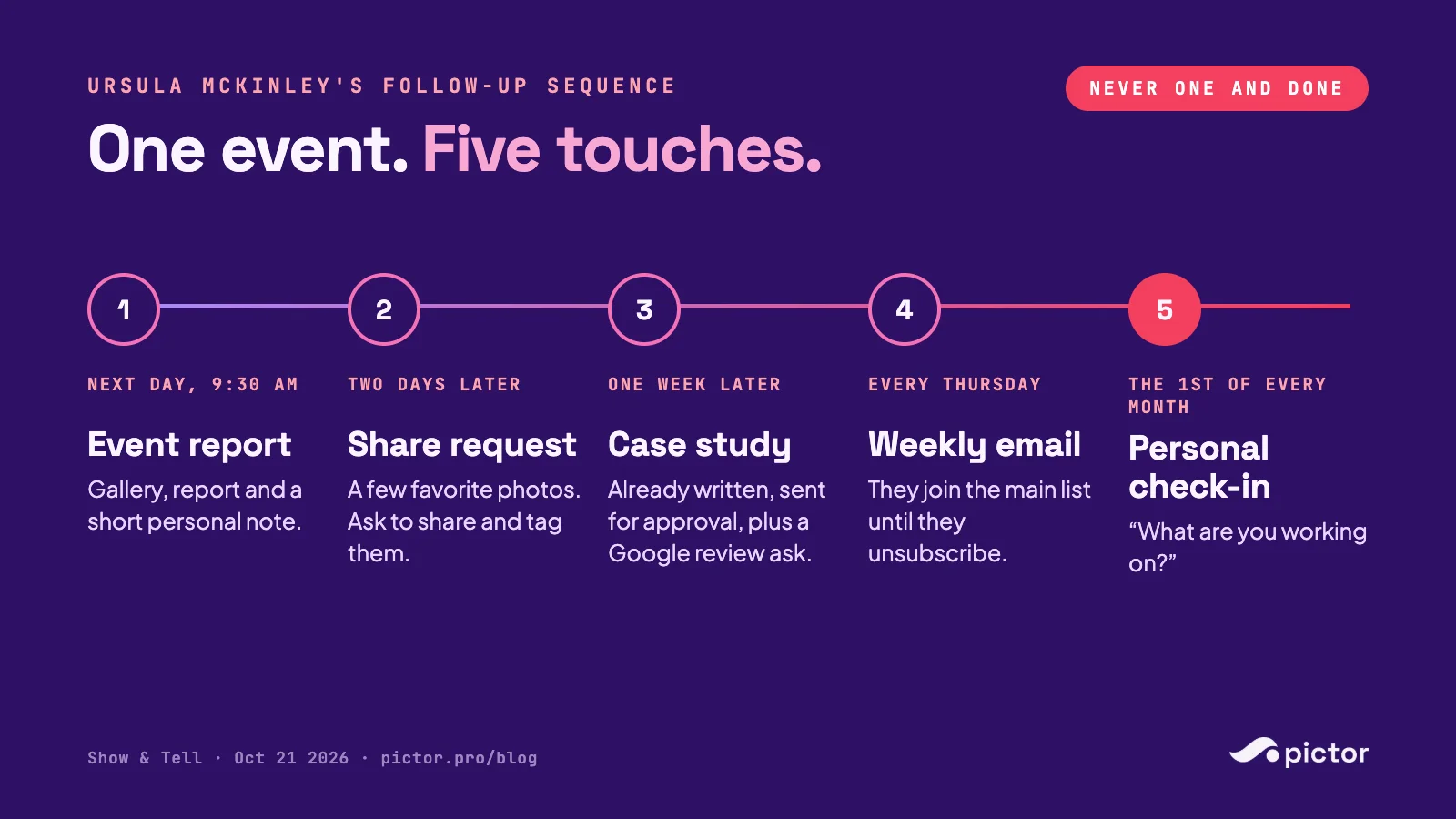
Here is the sequence her own company runs for a new client:
- The morning after, by 9:30. Event report, gallery and a short personal note.
- Two days later. A few photos the team loved, asking permission to share and tag them on social.
- A week later. A case study for the website, already written, sent for their approval, with a request for a Google review to include in it.
- Every Thursday after that. They go into the main email list and get the weekly email until they unsubscribe.
- The 1st of every month. A personal email from Ursula asking what they’re working on.
The goal is the relationship where a client messages you on WhatsApp a week before an event with their budget and tells you to turn up.
When an attendee asked what one part of their marketing to fix this month, Ursula said email. Pick one day a week and write to the people who already know and trust you, every single week.
Do this: set up steps 1 to 3 for your next event this week. Write the case study before you ask for it.
Get the checklist: we turned this sequence into The Photo Booth Client Follow-Up Checklist, with a checklist and a copy-ready email for each step, plus a printable PDF with a per-client tracker.
How do you get paid for concepting, not just showing up?
Separate the creative work from the booth. One thing I’d like our industry to change is that clients think they’re paying for the three to six hours we’re on site, when most of the work is the R&D and concepting before it. Ursula agreed. PBM is running four weeks of training on costing right now, and in her own photo booth company, custom concepts are priced on their own:
“Once you start to get into activations, like in our business for a client, we have a standard fee of 1200 for creating a custom concept. That’s before you put in the price for the booth and all of those things.”
Her company also opens the conversation on price before the client can:
“Literally, we start the conversation with, we are the most expensive in the country.”
Know where your hours go. Chris Collins of BoothBook told us a few weeks ago that a three-hour booking takes about 15 hours of human time, start to finish. Run your own numbers through our photo booth hourly rate calculator and you’ll see what a booking really pays per hour once the concepting is counted. Chris Meyer made the same case in our pricing Show & Tell: price the problem, not the hours on site.
At OutSnapped we stopped doing weddings for years because a New York City wedding was running close to 70 emails, against 7 to 12 for a typical corporate event. A lot of what we built into Pictor is there to cut that number. Couples can change their own names and dates on every template with global text, so nobody on our team has to debate an ampersand. We’re taking weddings again because of it.
Do this: add a concept fee as its own line on your next custom proposal, before the booth price. Then check the whole job in the hourly rate calculator.
Why don’t photo booth owners use the marketing they already have?
Fear, mostly. PBM members get access to a library Sammy put at eight or nine hundred videos, plus templates and full experiences. Ursula said many members still never post any of it, because they’d have to learn it, load it into their software and do the test shots before they could deliver it. Some of PBM’s holiday packs take the whole team more than 100 hours.
“Create it once and sell it a thousand times. That is ultimately what you want to be able to do.”
Sammy blamed mindset. Many operators learn one piece of software, live in that software’s Facebook group, and get told that showing something you don’t own yet is false advertising.
“All these weird broken business mindsets that ultimately don’t put money in your bank account. And last time I checked, we’re all in business to make money.”
Rick from Big Time Selfies backed that up in the chat: he sold a Glambot activation before he owned one, because it was on his website as an experience. PBM’s phrase for it is “market before you buy.” Rent it, white-label it, or buy it once the job is booked.
Ursula’s closing story was about a large sandwich chain she used to shoot for. One product shot could take seven days, and what went in front of the camera was never what got served. Sammy’s version is the Big Mac. My one rule: there’s a difference between selling a dream and creating a nightmare for yourself. Don’t sell a beautiful burger you have no way to make.
In our live poll, we asked operators what would make them add a new experience this season. Of the five who answered, three said marketing assets to sell it and two said client demand.
Do this: pick one experience you can deliver but have never marketed. Post it this week, with a real photo or a clearly labeled mockup.
What does a one-click experience launch look like?
We launched PBM’s Haunted House live. Sammy walked through what’s in it: the AI generates an older, ghostly version of the guest on the staircase behind them, and the pack includes the branded templates, the AI prompts, animated buttons, a video FX option and a straight photo option with background removal. Not every client wants AI, so the pack goes from basic to full AI.
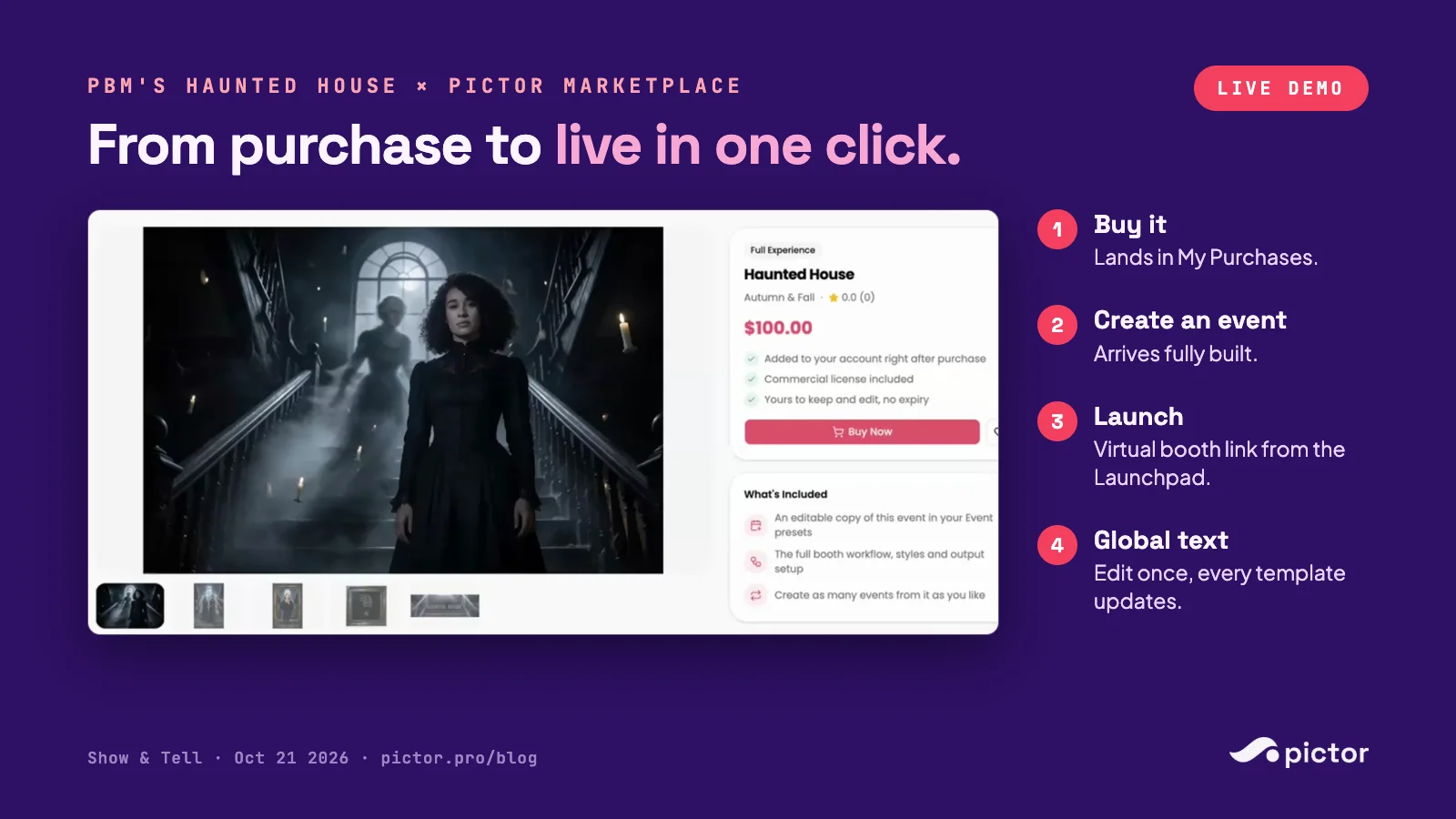
Here’s the flow from the demo:
- Find the Haunted House in the Pictor Marketplace ($100) and buy it. It lands in My Purchases.
- Create an event from it. It arrives fully built.
- Launch it as a virtual booth from the Launchpad. We dropped the live link in the chat and attendees were playing with it within seconds.
- Change the event name, subtitle and body once in global text. Every template in the event updates at the same time: photos, GIFs, boomerangs, AI stills and video.
Global text was not easy to build, and I’m proud of it. We first showed it in our June 3 Show & Tell. It’s the same tool that lets couples edit their own wedding details.
Pictor is free until showtime: sign up, build your event and test it. You only pay when you use Pictor at an event. (See plans.)
One tip for the virtual booth, which is part of Premium: it uses one event license, and you can get two jobs out of it. Send the client the virtual booth to review the experience before they book. Then turn the virtual booth off and use the same license for the in-person event.
How Marketplace pricing works: anything made and listed by Pictor is included with every Pictor license, so you don’t pay for it. Some items use features that depend on your plan (the virtual booth, for example, needs Premium), so you may need to switch those off on other licenses. Other sellers set their own prices, a bit like Etsy. Listings go through a quality check, and sellers get paid through their connected Stripe account.
The Haunted House is also a marketing asset, not just a Halloween booth. Ursula’s point was that once you have a piece like this, you can use it everywhere: Google Business Profile, your website, LinkedIn and email, over and over. And the right client will connect the dots. Someone at a studio who doesn’t need a haunted house might see it and picture their next film premiere.
Do this: open the Marketplace, pick one experience and launch it as a virtual booth. Send the link to one past client this week.
What will sell this holiday season?
Tangibles. People want something to touch and take away, Ursula said, because they’re tired of digital. Holiday ornaments (baubles, in Ireland) have been a big seller for her this year because they double as the table gift. She also likes metallic and pearl paper, and anything with a tear-off offer that brings guests back.
It’s also not too late. (Our guide to winning Q4 corporate holiday bookings has the rest of the playbook.) Ursula’s advice was to reach out to every client from last year now and show them something new.
“They might not buy it, they might not have the budget for it, but it puts you back in front of their mind.”
Do this: email last year’s holiday clients this week with one new tangible, like an ornament or a sticker sheet.
How long should a photo booth marketing campaign run?
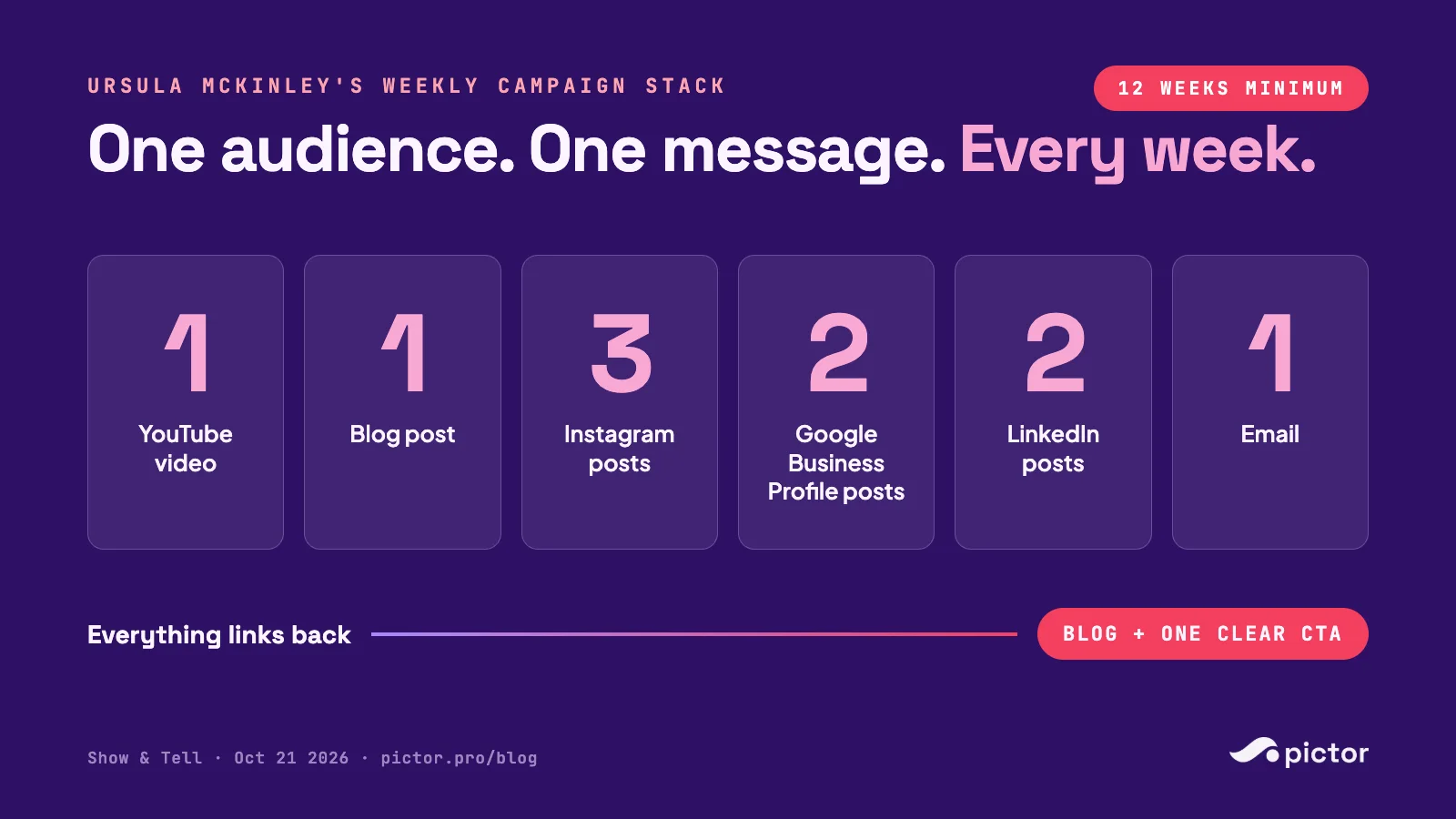
At least 12 weeks: one audience, one message. I asked Ursula when she cuts her losses on a campaign, and that was her floor. Each week her stack is a YouTube video, a blog post, three Instagram posts, two Google Business Profile posts, two LinkedIn posts and an email, all linking back to the blog and the right call to action.
For email tools, Ken asked what she recommends. She uses lemlist for outreach to people who don’t know her yet (she’s used it for about eight years, partly for its LinkedIn tools), and Mailchimp or Klaviyo for branded email to people who do.
Her three pieces of advice for one hour of your time:
- Invest in your education, and learn from people who run a business successfully.
- Stay out of Facebook groups. If someone has that much time to answer questions, Ursula asks, are they busy in their own business?
- Get reliable software and learn it inside out.
Do this: pick one audience and one message, then put a 12-week campaign on your calendar before you judge it.
Should you use AI in your photo booth marketing?
Use it as a tool, not a substitute for your own work. Derek Savickis of Photo Booth Expo (our guest the week before, on where the industry is heading in 2027) asked the biggest marketing mistake Ursula sees. Her answer: AI content and out-of-focus photos on a brand that sells content creation, and price lists on social media. Social exists to start a conversation. Prices come after.
Kayla Braun from Omaha asked the follow-up. She had used AI to mock up a travel-themed, three-station proposal (selfie stamps, postcards and laser-engraved luggage tags) for an event producer. Ursula said she does the same when her designer isn’t available, starting from a real photograph from one of their events, with a disclaimer under it.
“Parts of this may have been generated using rendering or AI. This will not be your final output.” Ursula McKinley, Photo Booth Marketing
Sammy drew the line at unnecessary AI: mocking up a booth you could photograph, or an AI avatar talking about your business. I’ve also found a good iPhone photo often lands better than a polished render, because it looks real. On NDA work at OutSnapped we sometimes start from a real photo and swap the person and the brand. I think that’s fair, because it shows something we have done and can do again.
Do this: replace any AI-generated photo of your own booth on your site with a real photo from your last event.
Ursula’s book recommendations
Kayla asked for these in the chat, and we promised links:
- This Is Marketing by Seth Godin
- Get Rich, Lucky Bitch! by Denise Duffield-Thomas, the business book Ursula recommends to everyone she coaches
- Who Moved My Cheese? by Spencer Johnson, for mindset
I also mentioned Google Labs’ list of things that are “almost possible.” That’s Josh Woodward, who runs Google Labs, on Lenny’s Newsletter.
Selling photo booth experiences FAQ
How do you sell a new photo booth experience to clients?
Offer it as the top tier of a three-option proposal: a basic booth, a step up, and the new experience. Ursula McKinley of Photo Booth Marketing says that when she quotes this way, clients book the coolest option, because they want something different and exclusive to their event.
What should I ask a client before quoting a photo booth?
Ask why they want the booth or experience they asked for, who will be in the room, and what the event’s goal is: brand awareness, engagement, content creation, data capture or social sharing. The audience alone can rule options out. Ursula’s example is that a room of guests aged 55 and over won’t use a 360 platform.
How should a photo booth company follow up after an event?
Ursula’s sequence: send the event report and gallery the next morning by 9:30, ask to share favorite photos two days later, send a pre-written case study and ask for a Google review a week later, then add the client to a weekly email and send a personal check-in on the 1st of every month.
How long should a photo booth marketing campaign run?
At least 12 weeks to one audience with one message, according to Ursula. Her weekly mix is a YouTube video, a blog post, three Instagram posts, two Google Business Profile posts, two LinkedIn posts and an email, all linking back to the blog.
Is it OK to use AI mockups in a photo booth proposal?
Ursula does when her designer isn’t available, but she starts from a real photo of her team’s work and adds a disclaimer that parts may be AI-generated and won’t be the final output. Avoid AI images of your own booth or events in your marketing; a real photo is more trustworthy.
Can you sell a photo booth experience you don’t own yet?
Yes, if you can deliver it. Photo Booth Marketing calls it “market before you buy”: show the experience, book the job, then buy, rent or white-label what you need. The rule is to sell something you can actually make.
Are Pictor Marketplace items free?
Items made and listed by Pictor are included with every Pictor license, so you don’t pay for them. Some use features tied to your plan, such as the virtual booth, which needs Premium. Items from other sellers, like Photo Booth Marketing’s Haunted House, are priced by the seller.
Watch the Replay
The full session, including the live Haunted House launch, is in the video at the top of this page and on YouTube, with chapters so you can jump to any section. Every past episode is in the Show & Tell playlist and our video library.
Photo booth software built by operators
Free until showtime.
Sign up, build your event and test it with ready-made Marketplace experiences and global text that updates every template at once. You only pay when you use Pictor at an event.
No credit card required · Pay when you use it at an event