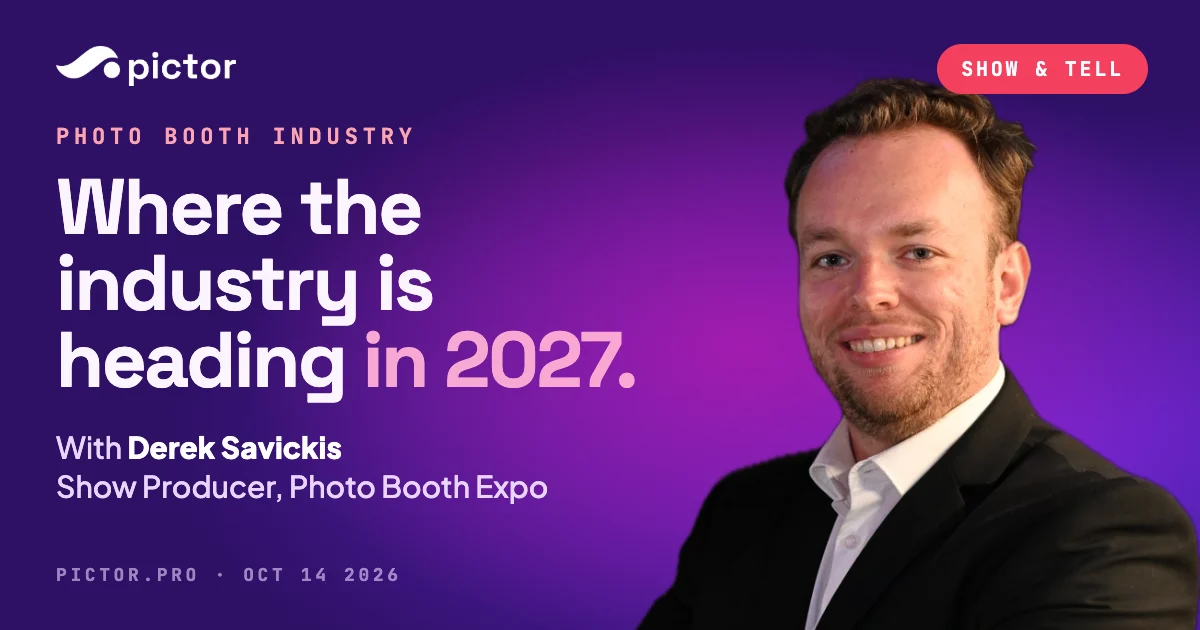
Where the Photo Booth Industry Is Heading in 2027: Derek Savickis of Photo Booth Expo
Photo Booth Expo's Derek Savickis on what changed this year, where the openings are in 2027, what will catch on after PBX Europe, using AI without losing the human touch, and offering more without lowering your price.
Nicholas Rhodes
Drafted with AI assistance; reviewed and approved by Nicholas Rhodes before publishing.
Full replay: Derek Savickis (Photo Booth Expo) and Nicholas Rhodes (Pictor) on where the photo booth industry is heading in 2027. Pictor Show and Tell, October 14, 2026.
Derek Savickis, Show Producer at Photo Booth Expo (PBX), stepped in on short notice for our October 14 Show & Tell after Ursula McKinley’s session moved to October 21. He took the questions operators had sent in ahead of the show: what changed this year, where the openings are in 2027, what will catch on after PBX Europe in Amsterdam, the biggest challenge right now, and how to offer more customization without lowering your price.
Where is the photo booth industry heading in 2027?
Toward software and experiences, according to Derek Savickis of Photo Booth Expo. AI has made software a selling point in its own right, and photo booth companies are becoming experience and activation companies. The operators who win in 2027 will automate the back end, spend the time they get back on clients who want a human touch, and protect their prices.
What changed in the photo booth industry this year?
AI, and with it, software. Derek has watched the industry since before PBX started in 2015, and for most of that time the conversation was about hardware. You had to have a mirror booth because that was what sold, then a 360. Software was an afterthought. The big debate was Breeze or Darkroom, and his answer was to use whichever one you liked.
“Nowadays, like, the software is becoming almost a selling point.” Derek Savickis, Photo Booth Expo
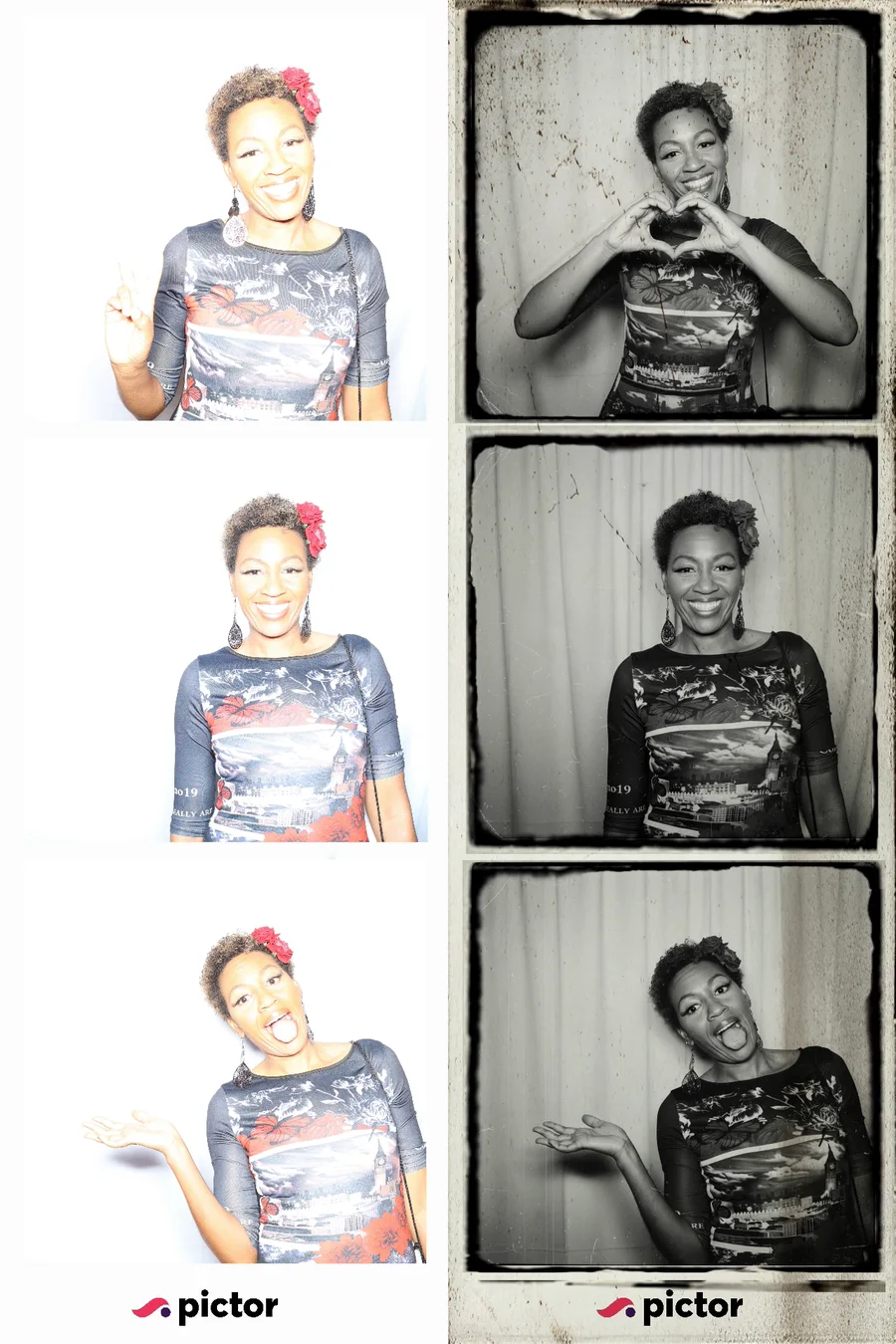
Hardware matters less than it used to, too. Derek’s point: the front cameras on iPads are now better than some of what high-end DSLRs were shooting 10 years ago. As a photographer I love a DSLR, and it took me a long time to accept a non-DSLR booth. At PBX Las Vegas this year we set up a DSLR that was out of focus and overexposed, showed what the camera shot on one side of the frame, and rebuilt the same shot with AI on the other. The AI side looked better.
We started Pictor in 2023 because nobody else would build it. We had a client who wanted AI at their event and a real budget for it. We asked the big software companies in the industry to build it and offered them that paycheck. All the big guys laughed at me. So we took the paycheck and started Pictor, and our first AI event ran that year.
Do this: look at the last five bookings you lost or nearly lost. Count how many turned on the booth hardware and how many turned on the experience or the output. Spend next year’s budget accordingly.
Are photo booth companies becoming experience companies?
Derek thinks so. Most operators run the same core setup for about 80% of their business, and what sets them apart is everything around it: the Glambot, the 360, the next thing nobody has seen yet. Hardware makers are running out of new physical tricks, which is why so much of the push has moved to software.
“I feel like a lot of, like, photo booth companies are shifting into more like experience and activation companies more than anything.” Derek Savickis, Photo Booth Expo
The other half of his answer is speed. Derek also works in engineering and automation, and his family’s company shows why deployment matters. When they added photo booths to their DJ business, booths took over about 66% of the business within a year, because a booth was easier to deploy and faster to scale than a DJ setup. What he expects to see more of next: automating the on-site deployment itself, which is still labor intensive and does not have to be.
That is a lot of what Pictor v2 and our BoothBook integration do for private events. The client picks a template, types in their own names and date, and presses submit. The event builds itself in Pictor, and the gallery link, virtual booth preview and event code can all go out automatically from the moment they book.
Do this: time your next setup from arrival to first guest. Write down every step that is the same at every event. Those are your candidates for a checklist, a pre-built event or a tool.
Where are the biggest opportunities for photo booth operators in 2027?
In doing both: automating the routine work so you have time for the bespoke work. Derek compared it to food. There will always be a place for the Michelin-star restaurant where someone places every mint leaf by hand. There is also a place for the robot pizza machine at the airport when it is 3 AM and you are 12 hours off your time zone. The robot is not replacing grandma’s pizza, and nobody expects it to.
Automate the back end, the admin and the deployment, and your lower-margin events become higher-margin events because they take less of your time. Then put that time into the clients who want a human. Derek’s view is that AI is being pushed at everyone, often badly, and plenty of people now reject it on principle. The companies that use it well and still make clients feel looked after will win.
What’s old is new again, too. At OutSnapped, our event company, the two most popular things we offer right now are AI video, where we turn one image into several clips and stitch them into a three-minute video, and the nostalgic sit-in booth, which we style with AI to make the photos look old. If you are offering a sit-in booth for $900 for three hours, stop. It costs us more than that to get one to an event, and here in New York City we charge four or five times that for it. The market will pay.
Do this: find the one offer in your lineup you have underpriced the longest. Raise it on the next quote and see what happens.
How do you sell a photo booth experience before you talk about price?
Build trust first, then sell the experience. Derek’s line from his wedding sales days:
“Nobody leaves a wedding ’cause the food’s bad.” Derek Savickis, Photo Booth Expo
People leave because the DJ is bad or there is nothing to do. Corporate clients are different. They want an easy win and a booth that will not blow up in their face, so their boss never asks where the party budget went. Derek’s family company was charging corporate Christmas parties around $2,500 for a photo booth back in 2015, and it was easy, because those clients knew the team would show up on time and give them what they wanted.
For couples, move off price as fast as you can and ask what experience they want. Once they feel you see their vision, price stops being the conversation.
Our version of that is a phone call that starts with “tell me about your dream photo booth.” Then we use their words back to them. Some people call the design over the photo a frame. Others call it an overlay. Use whichever one they use.
Do this: for the next five inquiries, write down the exact words the client uses for what they want, and use those words, not yours, in the proposal.
What do you say when a client asks what makes you different?
There is no silver bullet, Derek says. He reached for Kung Fu Panda: there is no secret ingredient, you are the secret ingredient. Read the person in front of you. An excitable client wants to hear how great the night will be. A quiet numbers person wants the numbers. Understanding why they asked will close far more than a list of sales lines.
By the time anyone asks, some trust already exists, because they saw you at an event or online. That is why Derek puts so much weight on social media: most people won’t pick up the phone, so your feed has to carry your personality for you.
“Anybody that thinks about it for like a little bit or cares about the customer a little bit, I promise you, the bar is not that high.” Derek Savickis, Photo Booth Expo
“If you show up on time and you’re easy to deal with, that’s 80% of the battle.” Derek Savickis, Photo Booth Expo
My go-to answer sounds unimportant and is the most important thing we say: our team will be there 10 minutes before you expect them, and you will not be looking for them at the start of your event. It lets us point at the problem our competitors cause without naming anyone.
Reliability starts with hiring. In interviews I send candidates a video on taping down a cord, then hand them a roll of gaffer tape and say “let me see what you got.” How long a piece they pull, whether they cut it square, whether they can do it with someone watching: it tells you a lot about how they will handle an event. Derek, who has hired apprentices in engineering, agreed and added why it works:
“You default to your lowest level of training under stress.” Derek Savickis, Photo Booth Expo
Do this: write your own “10 minutes early” line, one concrete promise about reliability you can keep at every event, and put it in your proposal template today.
What photo booth experiences will catch on in 2027?
Shareable video. Derek thinks there is still meat on the bone with Glambots, because the output is a reel, and reels get more traction than a still photo. The opening he sees: whoever makes it easiest to turn raw footage into a post-ready reel, and whoever captures the behind-the-scenes moment of the shot as it happens. In his marketing work, behind-the-scenes footage often outperforms the ad itself.
We ran exactly that at PBX Las Vegas in February 2026. Our “Ditch the Robot” campaign took one selfie and generated the behind-the-scenes clip of the guest getting instructions at a Glambot, then cut to their red-carpet moment from the camera’s point of view. Pictor v2 also has a full video editor in the template builder.
The other trend is novelty you can take home. Walking the floor in Amsterdam, I saw an Iris cam setup that doesn’t need a big rig, plenty of kiss-cut stickers, and AI sticker printing. We are working on a project now, under NDA, with keychains that carry an NFC tag. Tap it to your phone and you get access to something guests without the keychain don’t. Small surprise-and-delight items like that stick with people longer than another print.
Which leads to Derek’s bigger point. Too many operators box themselves in with “I’m a photo booth company. I do photo booths.” Most of the battle is winning the event, and the companies that can entertain through the whole night, with extra activations, lighting and those Instagram-worthy moments, will grow. At OutSnapped we describe ourselves as interactive photo and video. The catch is that nobody searches for that. They search “photo booth company,” so keep that phrase on your site even as your offer grows past it.
Do this: add one shareable video output and one take-home item to your price list for 2027, and quote both on your next three corporate leads.
What is the biggest challenge in the photo booth industry right now?
Using AI without losing the human touch. Derek, who is 29, points out that plenty of people his age tune out the moment a generic chatbot pops up on a website. The challenge is using AI where it is efficient and useful without scaring people off, and not diving in so far that you stop doing the work yourself.
He gave an example from the software world: ArtCraft, a set of free, open-source look-alikes of Adobe’s creative apps built with AI. (Our AI newsletter covered the developer’s follow-up project.) The community’s verdict, as Derek put it: not done very well, but done. That is the trap.
“If you don’t really have a kind of robust understanding of the process you’re trying to automate and you just say, okay, AI fix my business for me, like, that’s going to be a trap.” Derek Savickis, Photo Booth Expo
His advice is to use AI where it makes the most sense, and to partner with people who have worked on it for a long time and know what the customer experience has to feel like.
Do this: before you automate any client-facing step, write down how you do it by hand today, step by step. If you can’t write it down, you are not ready to automate it.
How do photo booth companies get found in AI search?
Make your website easy for AI to recommend. Derek sees more and more people skip Google entirely and type “best photo booth Houston” into ChatGPT. If your site doesn’t give the AI a confident answer for your city, it recommends your competitors, and people trust that answer more than a page of search results.
We learned this the hard way. Last September, Google changed its algorithm and OutSnapped’s inbound leads disappeared almost overnight. We spent most of a year getting them back. We weren’t paying attention to AI search because leads were fine, and then they weren’t. The lesson: when everything is working is exactly when to work on what’s next.
We also found that AI tools were repeating incorrect information about Pictor that competitors had published. Prospects on demo calls kept asking about things that weren’t true. We answered with comparison pages that show the incorrect claims next to the facts, with dated screenshots, so the record the AI reads is accurate.
There is a money side to this too. Derek described the market as K-shaped:
The K-shaped event market
The top is spending more. The middle is disappearing.
-
Upper arm of the K
Bigger, better, bolder
Clients with money are spending more on bigger events and activations. This is who your website and AI search presence should attract.
-
Lower arm of the K
A race to the bottom
Mid-tier events are thinning out and competing on price. You don’t want to be on this leg.
Framework: Derek Savickis (Photo Booth Expo), Pictor Show & Tell, Oct 14 2026
Even Fortune 500 clients are pleading smaller budgets this year. Don’t cave. Know what an event actually costs you, and price from there.
Do this: ask ChatGPT, Perplexity and Google’s AI Mode for “best photo booth in [your city]” today. If you aren’t named, that is your next marketing project. Our October 28 Show & Tell with Damir of Digiperia is all about getting found.
How many hours of work is a three-hour photo booth booking?
About 15, start to finish, for an event that runs three hours on site. With the BoothBook integration, we’re confident that drops to around seven and a half for a typical private event. Chris Collins, BoothBook’s founder, walked through where every hour goes in last week’s recap: how to save time on every photo booth booking.
That math is why working less makes you more. Cut your time per client in half and you can serve two clients in the same hours, which is the same as doubling your rate. Run your own numbers through the photo booth hourly rate calculator.
BoothBook × Pictor
Cut your booking time in half
Clients pick their own template in the BoothBook portal, the event builds itself in Pictor, and the gallery syncs back. Access is by request while we onboard operators.
Do this: run your last booking through the calculator with the real hours, not the three on site.
What is the Pictor Marketplace, and do you need a designer to use it?
The Photo Booth Marketplace is where Pictor users find ready-made event themes and AI experiences, and no, you don’t need a designer. As of today it has close to 100 offerings: about 50 full themes, made up of hundreds of assets between them, and about 50 AI prompts.
It is also where partners sell their catalogs. Thanks to PhotoBooth Marketing, Photo Booth Templates, Photo Booth Talk and Photo Booth Graphics for building with us. Ursula McKinley of PhotoBooth Marketing launches her Haunted House experience live on Show & Tell on October 21.
Because everything is pre-designed, you can send clients a link to your Lookbook. They pick the design they like, customize it with their own text, and the event builds in Pictor without you touching it. It works especially well with BoothBook, and on its own too.
Do this: switch on the 10 Marketplace themes that fit the events you book most, and send your next client the Lookbook link instead of a PDF of options.
How do you offer more customization without lowering your price?
Pull back scope, never price. Derek was blunt:
“You should never, ever, ever talk about lowering prices ever.” Derek Savickis, Photo Booth Expo
“The second somebody sees you as a low cost option, they’re never going to value the higher end stuff.” Derek Savickis, Photo Booth Expo
His analogy: if Ferrari started selling an economy car, it would lose its prestige at the top. And if you walk into a Honda or Toyota dealer with half a million dollars, they can’t sell you a supercar. Your extra options are what let you guide the client: here is what we usually do, here is what it costs, and if your budget is smaller, we can take these features out. Clients often look at what they would lose and decide they want it after all.
When the budget is tight
Pull back scope, not price
-
Don’t
“We can do it for less”
You become the low-cost booth, and that client never values your higher-end packages.
-
Do
“Here’s what we can take out”
Your usual package at your usual price, then a smaller one with fewer features. Same rate, smaller scope.
Derek’s tell: the clients he made the most money from said “looks good, see you in a bit.” The ones haggling over a $400 booth across 15 emails are low-quality leads.
Advice: Derek Savickis (Photo Booth Expo), Pictor Show & Tell, Oct 14 2026
Derek admits you sometimes need those clients to keep the lights on over the winter. The fix is upstream: everything else in this recap, from reliability to AI search, is about attracting leads who don’t race you to the bottom.
My one exception to never lowering a price: a repeat client who has worked with us many times comes to me and says, “I know this normally costs 8K, I’ve got 6K for it.” I’ll say yes. I know what it’s like to work with them, it’s still a good payday, and the way they asked shows they respect the pricing. It’s a thank-you for the repeat business.
Do this: for every package you sell, write a “smaller scope” version at the same hourly rate, so you have something to offer when the budget is tight instead of a discount.
About Derek Savickis

Derek has been in the events industry his entire life. He worked alongside his father, Rob Savickis, in the DJ business. They started using photo booths in 2012, and later launched Photo Booth Expo in 2015. Derek is officially taking over operations of Photo Booth Expo from his father and is excited to bring the show to new heights. Having been in the industry for so long and helping countless entrepreneurs follow their passion, Derek knows what it takes to succeed in the photo booth world and is eager to share how to make it happen.
His first Las Vegas trade show was at 11 months old, when his dad was exhibiting at Mobile Beat in 1998.
What’s next for PBX 2027
Derek says the PBX website will start filling in over the next few weeks with speakers and schedule, and he has made a real push to bring new voices to the stage. He has more announcements he is excited about and isn’t sharing until they’re locked in. As for me opening the main stage at 9 AM on day one: I’ve said it out loud, so it’s an affirmation now. I’ll let you know if it happens.
Lightning round
- Favorite podcast: Ologies with Alie Ward, where each episode goes deep with an expert in one field, from trees to bees.
- Favorite book: Atomic Habits by James Clear. Derek’s pick for new operators, because the people who last are the ones who set money aside for taxes, do what they said they would do, and work on their marketing when they don’t feel like it.
- Pineapple on pizza: Derek grew up around enough Italians in Toronto to never order it. He also wouldn’t pick it off. Same here.
The book link above is an affiliate link. If you buy through it, we may earn a small commission at no extra cost to you.
Photo booth industry 2027 FAQ
What is the biggest trend in the photo booth industry for 2027?
AI and software. Derek Savickis of Photo Booth Expo says software has become a selling point in its own right, where a few years ago the conversation was about hardware like mirror booths and 360s. Photo booth companies are also turning into experience and activation companies, offering more than a single booth.
What photo booth experiences are becoming popular?
Shareable video, like Glambot clips and behind-the-scenes reels, and take-home novelty items such as kiss-cut stickers and NFC keychains. Derek’s test for any new experience is how Instagram-worthy the moment is.
How should photo booth companies use AI?
Use it for the back end: admin, booking workflows and deployment. Keep the human touch for clients who want it. Derek warns against handing your business to AI without understanding the process you’re automating, and against generic website chatbots that put customers off.
How do I get my photo booth business recommended by ChatGPT?
Make your website clear and specific about what you offer and where, so AI tools can answer “best photo booth in [your city]” with your company. More customers now ask ChatGPT instead of searching Google. Check what the AI says about you, and correct anything inaccurate on your own site.
Should I lower my photo booth prices when a client has a smaller budget?
No. Pull back scope instead: offer a smaller package with fewer features at the same rate. Once a client sees you as the low-cost option, Derek says, they never value your higher-end work. Discounts for loyal repeat clients are a reasonable exception.
What is a K-shaped market for photo booth companies?
It means the market is splitting. Clients with money are spending more on bigger, bolder events, while mid-tier events are disappearing and competing on price. Derek’s advice is to position your business, including your website, for the upper arm of the K.
Photo booth software built by operators
Automate the back end. Keep the human touch.
AI photo and video, Marketplace themes your clients customize themselves, and the BoothBook integration that builds the event for you. Start free, no credit card.
No credit card required · Tokens never expire