Is a Photo Booth Business Profitable? The Real Numbers Behind Your First Year
Real booking data, three startup models, break-even math, and the costs beginners forget to count, so you know what it actually takes to turn a profit.

Nicholas Rhodes
Drafted with AI assistance; reviewed and approved by Nicholas Rhodes before publishing.
Is a photo booth business profitable?
Yes, a photo booth business can be profitable, but one good event doesn’t prove it. Profitability depends on whether your pricing, booking volume, startup investment, and operating costs work together over a full year. A $1,000 booking can be a great use of a Saturday or a poor one, depending on what it cost you to deliver.
Beginner series · Stage 0 of 5 · Part 1 of 22
A booking might bring in $800, $1,200, or several thousand dollars. That revenue looks impressive until you count insurance, transport, setup time, labor, consumables, software, marketing, taxes, and the hours spent emailing the client back. The good news: the economics can work well when you start carefully. The risk is spending too much before you’ve proven people in your market will book you.
What does the market actually pay?
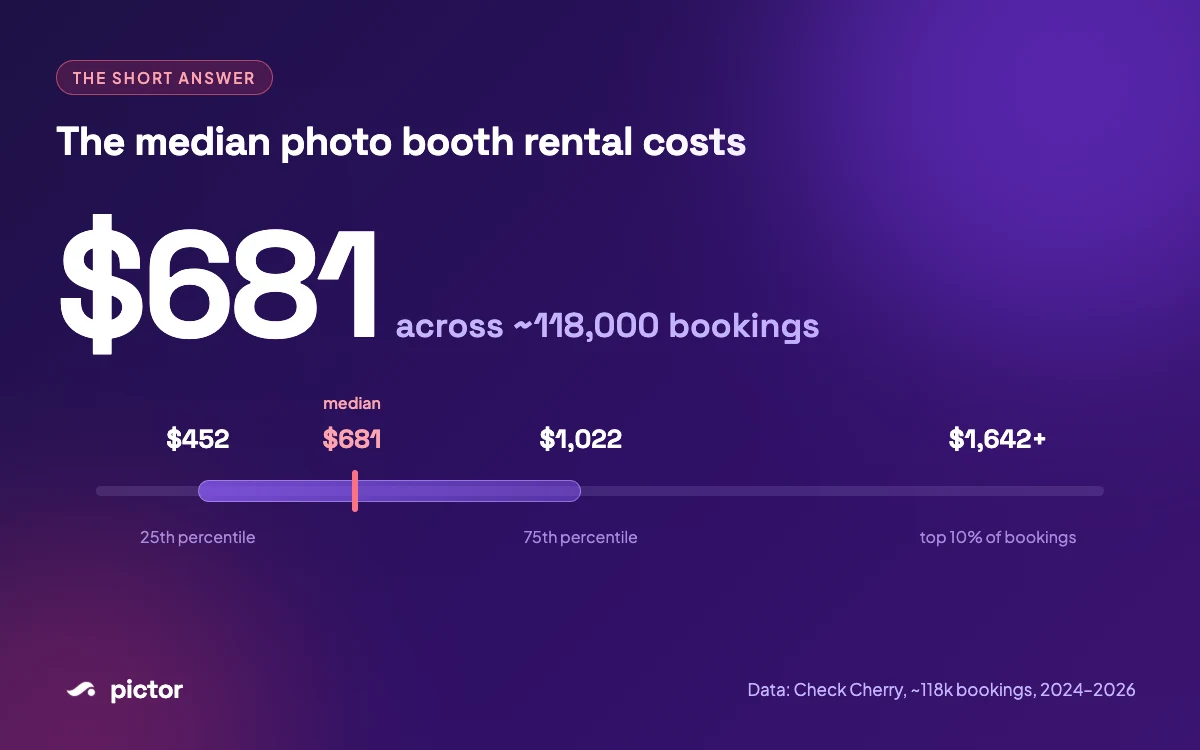
An analysis of roughly 118,000 real photo booth bookings found a median booking value of $681, with half of all rentals falling between $452 and $1,022. Wedding bookings had a median of $886, and corporate bookings had a median of $899. The top 10% of bookings overall exceeded $1,642, with weddings reaching $1,973 and corporate events reaching $2,100. That data comes from Check Cherry’s booking dataset, covered in more depth in Pictor’s photo booth pricing benchmark guide.
These are benchmarks, not promises. Your actual revenue depends on your location, booth format, event type, positioning, sales process, and ability to deliver a reliable experience.
What does it cost to start?
You don’t need the most expensive booth on the market to begin. In fact, validating demand before a major hardware purchase is usually the safer move. Most beginners land somewhere in the $950–$2,600 range for a first setup: a tablet or camera, a stand, lighting, basic props, software, and insurance. That range covers a working professional setup, not a bare-minimum one.
| Model | Example startup cost | Best for |
|---|---|---|
| Lean digital | ~$950–$1,500 | Testing demand, parties, digital-only events |
| Standard event | ~$1,500–$2,600 | Weddings and regular local bookings, with printing |
| Premium / multi-format | $2,600–$10,000+ | Corporate activations, multiple formats, later-stage growth |
These are planning examples, not quotes. Your actual cost depends on what you already own, whether you print onsite, and whether you buy new or used gear. The full breakdown, including a line-item budget worksheet, lives in Photo Booth Startup Costs in 2027 Coming Oct 8 (Part 2 of this series).
The lean model
A lean setup uses a tablet or existing camera, a stable stand, lighting, basic props, software, insurance, and a digital-only delivery workflow. You may not offer prints at first, which reduces equipment and consumable costs while still letting you serve parties, showers, dinners, and smaller corporate events. The goal isn’t to look unfinished. It’s to run a professional experience with fewer moving parts.
The standard model
A standard setup typically adds a dedicated camera or tablet, stronger lighting, onsite printing, better backdrops, branded templates, and a real transport and backup system. This is usually the most practical starting point for an operator targeting weddings and private events.
The premium model
A premium setup could include a 360 booth, mirror booth, multiple cameras, custom fabrication, upgraded lighting, an attendant team, or advanced AI experiences. Premium equipment can support higher rates, but the hardware alone doesn’t create premium demand. You still need the marketing, sales process, portfolio, staffing, and operational reliability to justify it.
What does one event actually clear?
Say you book a $600 lean event with $100 in direct costs. That leaves $500 gross profit before fixed overhead and your own labor. A $1,000 standard event with $220 in direct costs clears about $780. An $1,800 premium event with $550 in direct costs clears about $1,250.
Direct costs include transport, printing supplies, paid event labor, payment processing, and event-specific materials. They don’t include every cost of running the business. For more on pricing the whole job instead of just the hours in front of the camera, see Pictor’s pricing conversation with Chris Meyer of BoothCamp Create.
What do beginners forget to count?
Insurance
Many venues and corporate clients require proof of liability insurance. You may also need equipment coverage and certificates of insurance that reflect how and where you operate. Prices vary widely by business, location, coverage limits, and claims history. Get quotes before you publish your packages.
Transport
Transport is more than fuel: mileage and vehicle wear, parking and tolls, loading and unloading time, overnight stays for distant events, and van or trailer costs as you grow. A booking 90 minutes away can look attractive until you count the round trip, setup window, and breakdown.
Consumables
For print events, consumables include paper, ribbon, ink, labels, batteries, cleaning supplies, and replacement props. A reasonable planning range for basic consumables runs roughly $15–$60 per event, though print volume and format move that number considerably.
Labor
If you run the event yourself, your time still has a cost, even if you don’t write yourself a check for every hour. Count sales calls and emails, contracts and payment admin, design and client approvals, packing, travel, setup, guest-facing event time, breakdown, and gallery delivery. If you hire an attendant, a common planning range for event staffing runs roughly $80–$150 per event, though local rates and event complexity vary.
Gross margin isn’t the same as actual profit
Gross margin looks at revenue minus the direct costs of delivering one booking. On a $1,000 event with $220 in event-specific costs, that’s $780 gross profit, or a 78% gross margin. That 78% doesn’t mean you personally took home $780.
Actual profit also has to account for annual insurance, software, website and marketing, equipment depreciation, repairs, storage, business registration, accounting, payment processing, vehicle costs, taxes, and your own labor. A new owner-operator can see strong gross margins while taking home much less than expected, especially with inconsistent booking volume or heavy unpaid time on sales and admin.
Track both numbers every month. Gross margin tells you whether the event itself works. Net profit tells you whether the business works.
When do you break even?
Break-even is the point where your cumulative profit covers your initial investment. These are simplified examples that leave out fixed overhead, taxes, owner labor, and slow months, but they show the shape of the math.
| Example | Startup investment | Avg. gross profit / event | Break-even |
|---|---|---|---|
| Lean | $1,200 | $500 | ~3 events |
| Standard | $2,000 | $780 | ~3 events |
| Premium | $6,000 | $1,250 | ~5 events |
A business booking four standard events a month could theoretically recover a $2,000 setup within a month or two, before broader overhead. A business booking one event a month may take much longer, no matter how impressive the equipment is.
Why buying expensive hardware before validation is risky
Buying premium equipment feels like progress, and sometimes it is. But it can also create pressure to accept unprofitable work just to justify the purchase. Before investing heavily, try to validate who your target customer is, what event types exist in your market, what clients currently pay, which features they actually request, how many qualified inquiries you can generate, and whether you can deliver the experience reliably.
You can build sample galleries, talk with venues and planners, run a styled shoot, and test your sales process before committing to every possible booth format. Software is another place to control early costs. Pictor’s free trial lets you test event creation, branding, capture workflows, and delivery before adding a larger software line to your startup budget (compare Pictor plans). When you’re ready to add AI experiences, GroupSense™, and custom prompts, Pictor for operators supports photos, GIFs, boomerangs, video, and AI in one platform.
Which Pictor plan do you need to start?
Most new operators start on Basic ($49/mo) for core photo, GIF, and print workflows, or a free trial while validating demand. Move to Pro ($99/mo) when you add the Custom Prompt Editor and want DSLR tethering. AI images cost 1–2 tokens (as low as $0.07 each at volume) and tokens never expire, so testing AI pricing doesn’t require committing to a plan change first.
Ready to see what your setup could look like? Start free on Pictor →
The bottom line
A photo booth business can be profitable when you start with an investment you can afford to recover, price the complete job rather than just event hours, separate gross margin from actual profit, track insurance, transport, labor, and consumables, build demand before buying specialized hardware, focus on reliable delivery, and raise prices as your positioning and demand improve.
The best first purchase usually isn’t the biggest booth. It’s the setup that lets you run a professional event, learn what your market wants, and make your next decision using real booking data.
Before making decisions about insurance, business structure, contracts, liability, or other legal matters, consult your insurance provider and a qualified lawyer familiar with your location and business model. Not legal or financial advice; the figures in this guide are general planning examples.
FAQ
How much does it cost to start a photo booth business?
Most beginners land in the $950–$2,600 range for a working first setup covering equipment, software, and insurance. Premium or multi-format operations can run well past $10,000 as they grow.
How much can a photo booth business make per event?
Published booking data puts half of all rentals between $452 and $1,022. Weddings and corporate events often support higher pricing than private parties, and premium formats or custom brand activations can command more.
What is a realistic profit margin?
Gross margins can be strong because direct event costs are often low relative to booking price. Actual net profit is lower after fixed overhead, owner labor, marketing, insurance, equipment, taxes, and slow periods.
Should I start with an iPad or DSLR booth?
An iPad setup is usually simpler and less expensive to transport. A DSLR setup can offer more control over image quality. The right choice depends on your target clients, event type, budget, and software compatibility.
Can I start without a printer?
Yes. Digital-only packages reduce your initial equipment and consumable costs. Some wedding and corporate clients expect onsite prints, though, so confirm demand in your market before making digital-only your permanent model.
Is Pictor suitable for a new photo booth business?
Pictor’s free trial lets new operators test branded event workflows before committing to a larger software cost. The platform supports photos, GIFs, boomerangs, video, AI, and instant sharing as your offering develops.
Next in the series: Photo Booth Startup Costs in 2027 Coming Oct 8, with a downloadable startup budget worksheet.
Beginner series · Stage 0 of 5 · Part 1 of 22
Start here: How to Start a Photo Booth Business
Next: Photo Booth Startup Costs in 2027: What You Actually Need to Spend Coming Oct 8